


Community colleges serve nearly 40 percent of all U.S. undergraduates, yet their retention challenges remain largely overlooked in mainstream higher education strategy conversations [1]. While four-year institutions dominate retention research and vendor attention, two-year colleges face fundamentally different realities: students balancing full-time jobs, single parents navigating childcare alongside coursework, and first-generation learners without family roadmaps for college success.
Here's the truth: the strategies that work at residential four-year campuses often fall flat at community colleges. Cookie-cutter approaches ignore the structural realities these institutions face daily.
This playbook offers community college retention strategies specifically designed for the two-year context. Whether you're a Dean of Student Success, a Vice President of Academic Affairs, or an institutional researcher tracking completion metrics, you'll find actionable frameworks grounded in current data and operational realities.
Key Takeaways
Community college retention requires fundamentally different approaches than four-year strategies
Flexible scheduling and modular credentials significantly impact persistence for working adult learners
Dual enrollment pipelines create early momentum that carries into degree completion
Developmental education reform has become a primary retention lever
Data-driven early intervention can identify at-risk students within the first three weeks
Understanding the Two-Year Retention Landscape
Community college retention rates tell a sobering story. According to the National Student Clearinghouse Research Center, the fall-to-fall retention rate for students who started at public two-year institutions hovers around 62 percent—roughly 15 percentage points lower than their four-year counterparts [2]. But raw numbers miss crucial context.
Community college students aren't failing at higher rates because they're less capable. They're navigating circumstances that would challenge any learner: 62 percent work while enrolled, 29 percent are supporting children, and the average age skews significantly older than traditional four-year freshmen [3].
The American Association of Community Colleges emphasizes that retention strategies must account for these realities rather than treating them as obstacles to overcome [4]. Students aren't choosing between college and life responsibilities—they're attempting both simultaneously.
Why Traditional Retention Models Miss the Mark
Most retention research traces back to Vincent Tinto's student integration model, developed primarily through studying residential four-year institutions. The model emphasizes academic and social integration as keys to persistence. While the underlying principles hold value, the application looks entirely different at a commuter campus where students arrive, attend class, and leave.
Two-year students don't have residence halls fostering organic connections. They don't have the luxury of joining multiple clubs or attending evening study sessions. Their integration happens—or doesn't—in the classroom, through advising interactions, and via flexible support systems that meet them where they are.
Flexible Scheduling as a Retention Strategy
When students can't make college fit their lives, they leave. Flexible scheduling isn't a nice-to-have amenity—it's a retention imperative.
Compressed and Accelerated Course Formats
Eight-week terms, weekend intensives, and compressed summer sessions allow working students to maintain momentum without sacrificing employment. Research indicates that students in accelerated formats often complete at comparable or higher rates than those in traditional 16-week courses [5].
The key lies in intentional design rather than simply cramming content into shorter timeframes. Successful compressed courses feature:
Clearly scaffolded assignments with regular checkpoints
Built-in flexibility for unavoidable work-life conflicts
Proactive outreach when students miss even one session
Streamlined administrative processes for late registration

Evening, Weekend, and Hybrid Options
Students working traditional daytime hours need pathways that don't require choosing between paychecks and progress. Institutions seeing retention gains have invested in robust evening and weekend programming—not as an afterthought, but as a fully supported alternative track.
Hybrid formats combining online flexibility with periodic face-to-face sessions address both scheduling constraints and the engagement benefits of in-person connection. The most effective hybrid designs maintain consistent touchpoints rather than relegating students to isolated online work.
Stackable Credentials and Clear Pathways
Nothing erodes motivation faster than unclear progress. Stackable credentials—short-term certificates that build toward associate degrees and beyond—provide visible milestones that sustain student momentum.
When a student earns a Certificate of Achievement after one semester, they've accomplished something tangible. That credential carries labor market value while creating psychological investment in continued enrollment. The American Association of Community Colleges has championed this approach as essential for serving adult learners [4].
Dual Enrollment Pipelines and Early Momentum
Dual enrollment programs, where high school students earn college credit before graduation, have emerged as one of the most effective community college retention tools available. Students entering college with prior credits demonstrate significantly higher completion rates than peers starting from scratch [6].
Building Effective Dual Enrollment Programs
The retention benefits of dual enrollment extend beyond accumulated credits. These programs familiarize students with college expectations, build relationships with faculty, and demystify higher education for first-generation families.
Strong dual enrollment initiatives share common characteristics:
Seamless credit articulation with clear pathways to completion
Intentional onboarding that transitions students from "high school student taking college classes" to "college student"
Early advising connections that persist beyond dual enrollment
Family engagement components that bring parents into the college-going conversation
National Student Clearinghouse data consistently shows that dual enrollment participants persist and complete at higher rates, with the effect particularly pronounced for students from low-income backgrounds [2].

Avoiding the Summer Melt Phenomenon
The transition from high school to college creates a vulnerable window where intended enrollment often evaporates. For dual enrollment students, this risk multiplies—they may assume their existing credits guarantee success without realizing they need to actively re-enroll and engage support systems.
Proactive outreach during summer months, clear registration guidance, and early connection to advisors helps convert dual enrollment momentum into degree completion.
Developmental Education Reform as Retention Strategy
Few factors predict community college dropout more reliably than placement into developmental education sequences. Students assigned to multiple levels of remedial coursework before reaching credit-bearing courses face completion odds that approach statistical improbability.
The Corequisite Model Revolution
Traditional developmental education required students to complete remedial courses before enrolling in college-level work—sometimes spending two or three semesters on non-credit courses. The corequisite model flips this approach, enrolling students directly in college-level courses with simultaneous support.
The results have been striking. Multiple state-level implementations show dramatically higher completion rates for gateway English and math among students using corequisite support compared to traditional remediation sequences [7].
Translation? Students don't need to be "fixed" before starting real college work. They need appropriate support while engaging credit-bearing material.
Redesigning Math Pathways
The traditional algebra-to-calculus sequence serves students heading toward STEM fields but creates unnecessary barriers for others. Quantitative reasoning and statistics pathways aligned to actual program requirements remove artificial obstacles while maintaining rigor.
A nursing student doesn't need intermediate algebra—they need statistical literacy for evidence-based practice. A business major benefits more from quantitative applications than from factoring polynomials they'll never use.
These reforms don't lower standards. They apply appropriate standards to actual student goals.
Early Warning Systems That Actually Work
Identifying struggling students means nothing without mechanisms to help them. Community colleges face unique challenges in early intervention: limited staff, commuter students difficult to reach, and compressed timelines that leave little room for delayed responses.
Meaningful Metrics for Two-Year Students
Effective early warning systems in the two-year context track indicators specific to this population:
Course attendance patterns in the first three weeks
Financial aid disbursement delays
Developmental course performance
Engagement with support services
Assignment submission patterns
The window for intervention is narrow. At four-year institutions, a student might struggle through an entire semester before disappearing. At community colleges, disengagement often happens within weeks. By the time midterm grades post, many at-risk students have already stopped attending.
Closing the Loop on Interventions
Alerts without action create false confidence. When an early warning system flags a student, what happens next? Who reaches out? Within what timeframe? With what resources available?
Institutions improving retention have moved beyond flagging systems to integrated response protocols. An alert triggers a specific advisor outreach within 48 hours, with documented follow-up and warm handoffs to appropriate support services.
Real-time engagement data helps staff intervene before students disengage completely. Rather than waiting for midterm failure reports, proactive systems identify declining participation while relationships still exist to leverage.
Building Community Without Residential Life
Social connection drives persistence, but community colleges can't rely on residence halls and campus traditions to create belonging. They must be more intentional about engineering connection within the constraints students face.
Classroom-Centered Community
For many community college students, the classroom represents their only consistent campus touchpoint. Faculty become the primary relationship builders—a reality that requires professional development and institutional support.
High-impact practices that create connection without requiring extensive out-of-class time include:
Structured peer learning activities during class sessions
Early semester community-building exercises
Faculty who learn and use student names
Brief but consistent check-ins about student wellbeing
Clear pathways to academic support when struggles emerge
Cohort Models and Learning Communities
When students progress through sequences together, they form relationships that sustain persistence through difficult moments. Cohort models—where the same group of students takes multiple courses together—create built-in accountability and peer support.
Learning communities linking thematically related courses provide similar benefits while maintaining scheduling flexibility. A student taking linked English composition and introduction to social work courses builds connections with peers sharing similar goals.
Technology-Enabled Connection
Mobile-first engagement approaches meet students where they already spend time. Platforms that consolidate campus resources, facilitate peer connection, and provide personalized nudges toward support services can partially bridge the engagement gap created by commuter contexts.
The key lies in reducing friction. Students shouldn't navigate multiple portals to find tutoring, counseling, or financial aid. A single entry point that surfaces relevant resources based on individual circumstances respects the time constraints community college students face.
Advising Redesign for Scale and Impact
Traditional advising models assume students will seek help when they need it. Community college students—often first-generation and unfamiliar with how college works—rarely initiate contact until crises emerge.
Proactive and Intrusive Advising
The shift from reactive to proactive advising fundamentally changes retention outcomes. Rather than waiting for students to schedule appointments, advisors reach out at critical junctures: before registration deadlines, after poor midterm performance, when financial aid holds appear.
"Intrusive" advising—a term some institutions have rebranded as "proactive care" or "appreciative advising"—acknowledges that many students don't know what they don't know. They need guidance before problems become insurmountable.

Case Management Approaches
Assigning students to specific advisors creates continuity that generic advising centers can't replicate. When the same advisor follows a student from enrollment through completion, they accumulate knowledge that enables increasingly personalized support.
Case management models work particularly well for specific populations: first-generation students, those receiving federal financial aid, or students flagged by early warning systems. The relationship investment pays dividends in retention.
Technology-Enhanced Advising
Advisors at community colleges often carry caseloads of 800 or more students—ratios that make meaningful relationships nearly impossible through manual approaches alone. Technology platforms that surface relevant information, automate routine communications, and flag students needing attention help advisors focus limited time on high-impact interactions.
The goal isn't replacing human connection with automation. It's ensuring that human connection happens with the right students at the right moments.
Financial Support Beyond Tuition
Community college tuition often represents the smallest financial barrier students face. Transportation, childcare, textbooks, food security, and housing stability all threaten persistence more immediately than tuition bills.
Emergency Aid Programs
Small, rapidly disbursed emergency grants—often under $500—prevent students from dropping out over manageable financial crises. A car repair, an unexpected medical bill, or a utility disconnection notice can derail enrollment if funds aren't available quickly.
Effective emergency aid programs feature:
Simple application processes completable in minutes
Rapid disbursement within days, not weeks
Limited documentation requirements
Clear communication about availability
Basic Needs Supports
Food pantries, transportation assistance, childcare subsidies, and housing resources address challenges that no academic intervention can solve. Students can't focus on coursework when they're hungry or uncertain where they'll sleep.
Institutions addressing retention comprehensively have invested in basic needs infrastructure, often partnering with community organizations to extend limited institutional resources.
Textbook and Course Material Access
When textbooks cost more than tuition for a course, students frequently go without—compromising their ability to succeed. Open Educational Resources, inclusive access programs, and lending libraries remove cost barriers that disproportionately impact community college students.
Measuring What Matters
Retention metrics require nuance in the two-year context. A student who completes a workforce certificate and enters employment has succeeded—even if traditional persistence rates would count them as a "dropout" for not returning the following fall.
Completion Metrics That Reflect Reality
Comprehensive measurement approaches track:
Credential attainment at all levels (certificates, degrees)
Transfer rates for students intending to continue
Workforce outcomes for career-focused programs
Momentum metrics like credit accumulation rates
Equity gaps across demographic groups
Disaggregated Data for Targeted Intervention
Institutional averages mask crucial variation. Retention rates for evening students may differ dramatically from daytime cohorts. First-generation students may struggle more in online formats. Students in specific programs may face unique challenges.
Disaggregated analysis reveals where interventions should concentrate and whether strategies work equally across populations. Equity-minded institutions refuse to accept disparities as inevitable.
Building an Integrated Approach
None of these strategies work in isolation. Flexible scheduling without advising support leaves students confused. Early warning systems without basic needs resources flag problems they can't solve. Developmental education reform without clear pathways creates momentum toward unclear destinations.
The institutions achieving meaningful retention gains coordinate strategies across divisions, breaking down silos between academic affairs, student services, financial aid, and institutional research.
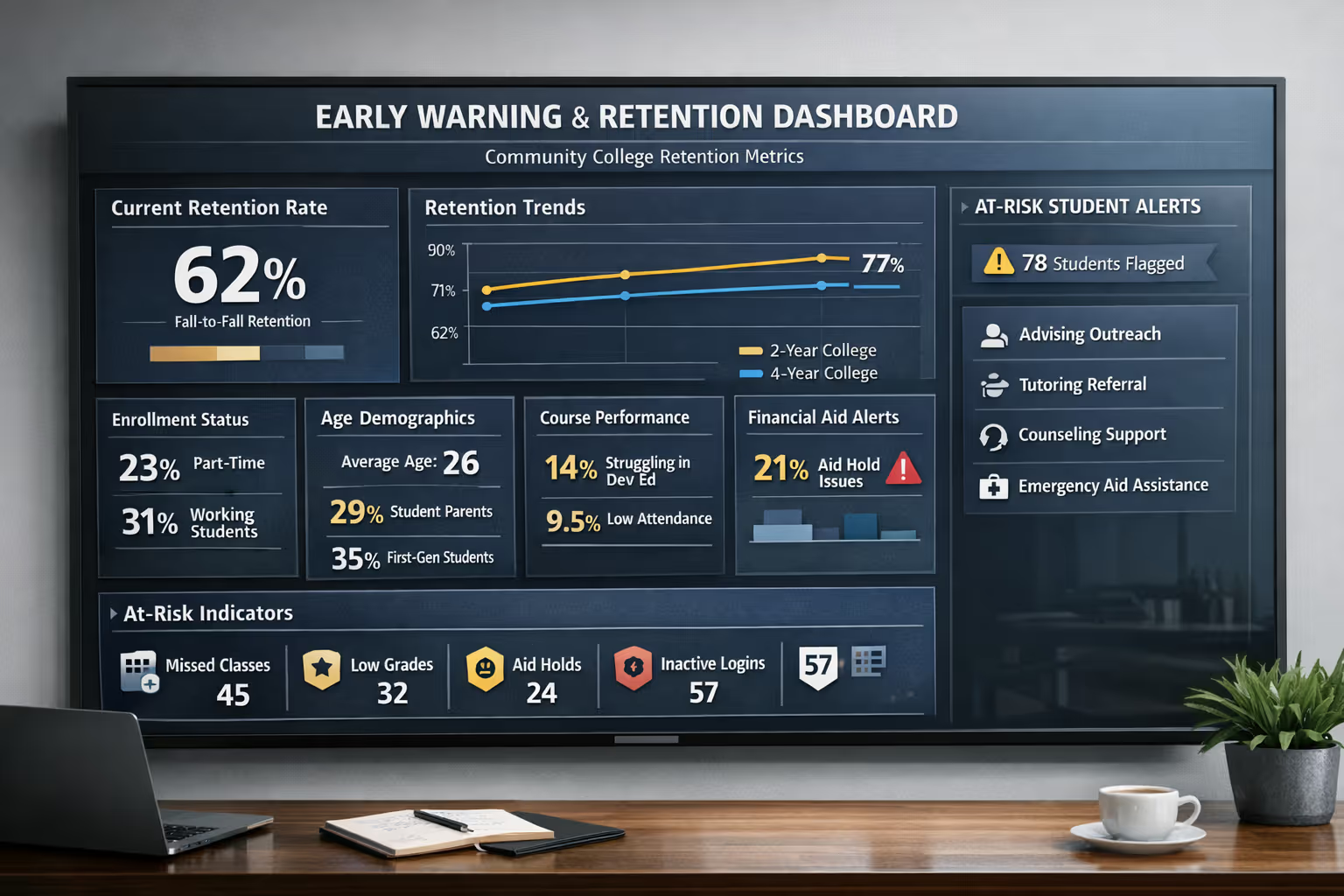
The Role of Technology Platforms
Integrated student success platforms can unify fragmented efforts, providing:
Single points of access for student support resources
Real-time engagement data for early intervention
Personalized nudges toward relevant services
Communication tools that reach commuter students
Analytics dashboards for continuous improvement
When systems talk to each other, staff can see the whole student rather than fragmented glimpses. An advisor knows that a struggling student also has a financial aid hold and missed three tutoring appointments—context that enables targeted support.
Your Next Steps
Community college retention requires commitment to sustained, coordinated effort rather than quick fixes. Consider starting with:
Immediate actions:
Audit current scheduling flexibility and identify gaps
Review developmental education sequences for corequisite opportunities
Evaluate early warning system response protocols
Short-term priorities:
Establish or strengthen dual enrollment pathways
Train faculty in engagement techniques that build classroom community
Streamline emergency aid processes
Strategic investments:
Explore integrated technology platforms that consolidate student support
Redesign advising models for proactive outreach
Develop comprehensive basic needs infrastructure
The students community colleges serve deserve strategies designed for their realities—not adapted afterthoughts from four-year contexts. The playbook exists. Implementation requires institutional will.
Ready to explore how technology can support your community college retention efforts? CampusMind partners with two-year institutions through pilot programs designed for community college contexts. Book a call to discuss how gamified engagement and real-time insights might fit your student success strategy.
Frequently Asked Questions
What makes community college retention different from four-year retention?
Community college students face distinct circumstances including higher rates of employment while enrolled, family caregiving responsibilities, and commuter contexts that limit campus engagement opportunities. Effective retention strategies must address these realities rather than assuming residential campus dynamics. Scheduling flexibility, basic needs support, and classroom-centered community building matter more than traditional social integration approaches.
How quickly can we see results from retention interventions?
Some interventions show impact within a single semester—corequisite developmental education reforms, for example, demonstrate immediate improvements in gateway course completion. Other strategies like cohort-based learning communities build effects over time. Most institutions should expect meaningful movement within two to three semesters of sustained implementation, though early indicators may appear sooner.
What role does technology play in community college retention?
Technology platforms can help community colleges scale personalized support despite resource constraints. Integrated systems that consolidate student resources, provide early warning alerts, and facilitate proactive outreach help staff focus limited time on high-impact interactions. The key is selecting tools designed for two-year contexts rather than adapting four-year solutions.
How do we address retention without additional staff?
Many retention improvements come from redesigning existing processes rather than adding positions. Corequisite developmental education eliminates wasted time in remedial sequences. Streamlined advising technology helps current staff reach more students effectively. Cohort models leverage peer support rather than requiring additional institutional resources.
What metrics should community colleges prioritize?
Look beyond simple fall-to-fall retention rates. Track credential attainment at all levels, transfer rates for appropriate students, credit accumulation velocity, and equity gaps across demographic groups. Students who complete certificates and enter the workforce represent successes even if they don't return—metrics should reflect diverse student goals.
About CampusMind
CampusMind builds student engagement technology rooted in behavioral science and designed with student privacy at the center. Our team combines higher education experience with data-driven approaches to help institutions identify disengagement early and connect students with appropriate support. We believe retention improves when students feel seen, supported, and connected to their campus community—and we build tools that make that possible at scale.
Works Cited
[1] American Association of Community Colleges — "Fast Facts 2024." https://www.aacc.nche.edu/research-trends/fast-facts/
[2] National Student Clearinghouse Research Center — "Persistence and Retention: Fall 2022 Beginning Cohort." https://nscresearchcenter.org/persistence-retention/
[3] Community College Research Center — "Community College FAQs." https://ccrc.tc.columbia.edu/community-college-faqs.html
[4] American Association of Community Colleges — "Building Pathways to Credentials and Careers." https://www.aacc.nche.edu/programs/pathways/
[5] Complete College America — "Corequisite Remediation: Spanning the Completion Divide." https://completecollege.org/article/corequisite-remediation-spanning-the-completion-divide/
[6] What Works Clearinghouse — "Dual Enrollment Programs." https://ies.ed.gov/ncee/wwc/interventionreport/671
[7] Community College Research Center — "What We Know About Developmental Education Reform." https://ccrc.tc.columbia.edu/publications/what-we-know-developmental-education-reform.html