

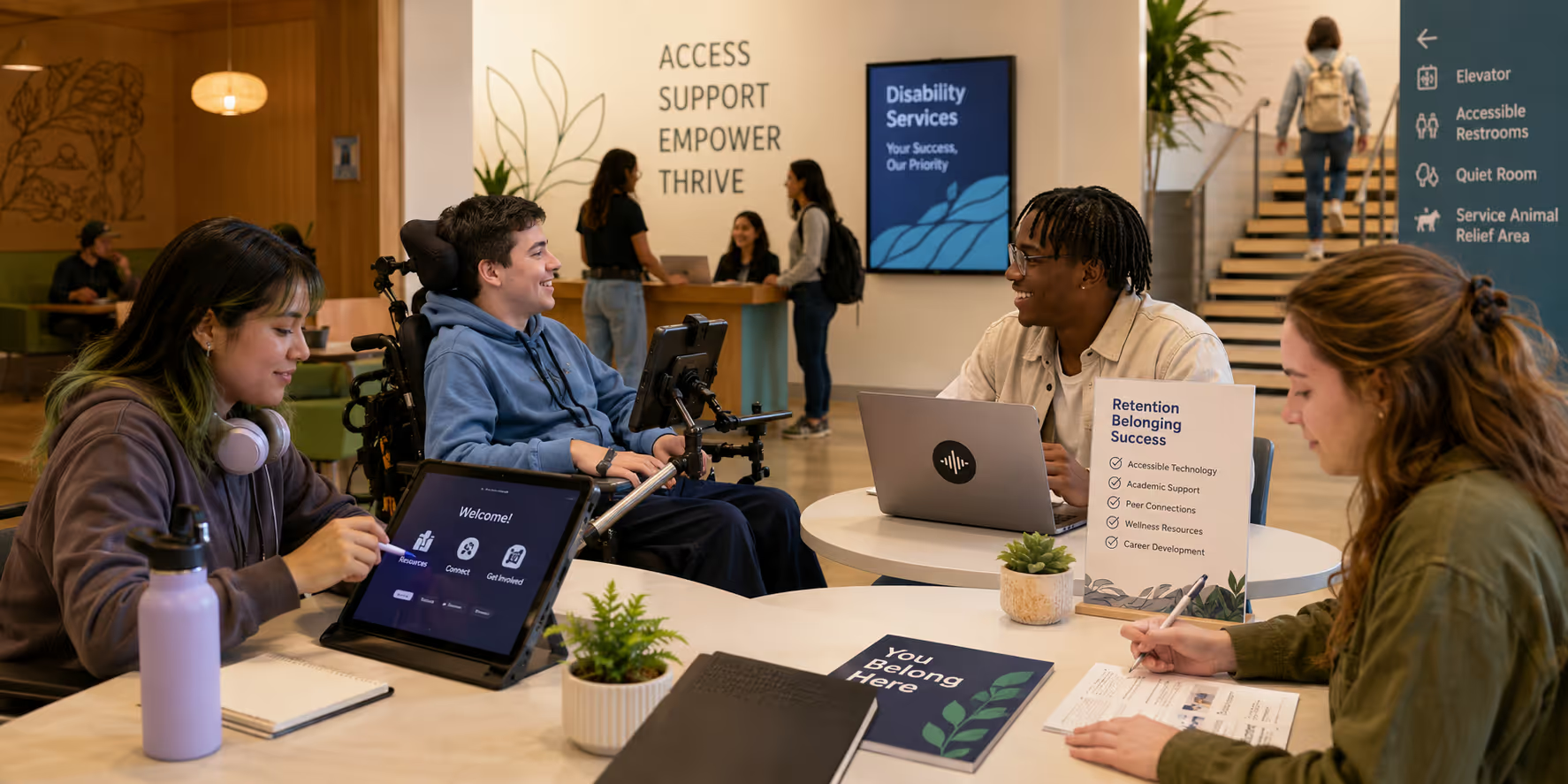
Last spring, a disability services coordinator at a mid-sized state university described a pattern she'd seen repeat for years: a sophomore with a fluctuating chronic illness—lupus, in this case—had been struggling since her first semester. The student's symptoms would flare unpredictably, sometimes leaving her bedridden for days. She'd been diagnosed in high school but had never requested accommodations because her condition didn't fit neatly into the categories she associated with "disability." She wasn't blind. She wasn't in a wheelchair. She didn't have a learning difference anyone had named.
By the time she finally walked into the disability services office, she'd already failed two courses, lost her scholarship, and was filling out withdrawal paperwork. The accommodations themselves—flexible attendance policies, extended deadlines during flares, permission to record lectures—took less than an hour to arrange. But she'd spent three semesters believing those options weren't meant for her.
This student's story isn't unusual. It represents a systematic retention failure that institutions have the power to address—not through more compliance paperwork, but through a fundamental shift in how accessibility support is designed and delivered.
Disability services, when reimagined as proactive infrastructure rather than reactive accommodation, becomes one of the most underleveraged retention strategies available to campus leadership today.
Key Takeaways
According to 2019-20 data from the National Center for Education Statistics, approximately 19% of undergraduates report having a disability, yet formal accommodation registration rates remain far lower at most institutions [1]
Students with disabilities graduate at significantly lower rates than their peers, representing a preventable retention gap that institutions can address through systemic changes
Universal Design for Learning (UDL) benefits all students, not just those with documented disabilities, making accessibility investments scale efficiently across entire student populations
Proactive outreach and flexible engagement systems can connect students to support before academic struggles compound into withdrawal decisions
Institutions that approach accessibility as retention infrastructure—rather than compliance obligation—see improved outcomes across their entire student population
The Gap Between Reported Disability and Registered Accommodations
Traditional disability services models operate reactively. A student must first recognize they have a qualifying condition—which sounds straightforward but often isn't. Then they must understand that accommodations exist and apply to their situation. They must locate the correct office, gather appropriate documentation (which can require recent evaluations costing hundreds or thousands of dollars), navigate intake processes, and then advocate for themselves with individual faculty members—all while simultaneously adjusting to college life, managing coursework, and attempting to build a social network.
For many students, particularly those from underrepresented backgrounds, those with newly acquired disabilities, or those who weren't diagnosed until adulthood, this burden proves too heavy to carry alongside everything else college demands.
The Association on Higher Education and Disability (AHEAD) has documented this pattern extensively. Students who would benefit from accommodations frequently don't request them [2]. The reasons vary: stigma from previous educational experiences where requesting help meant being labeled "slow" or separated from peers. Lack of awareness that conditions like anxiety, ADHD, chronic pain, or autoimmune disorders qualify for support. Negative interactions with past institutions that made the process feel adversarial. Or simply not knowing where to begin.
Whatever the specific cause, the outcome remains consistent: capable students struggle unnecessarily, and many leave.
National Center for Education Statistics data indicates that roughly one in five undergraduates reports some form of disability [1]. Yet registration rates with disability services offices rarely approach those numbers on most campuses. The students who fall through this gap aren't failing because they lack intelligence or motivation. They're navigating systems that weren't designed with them in mind from the start.
Why ADA Compliance Alone Fails to Support Student Retention
Most institutions approach accessibility through a compliance framework. They meet Americans with Disabilities Act requirements. They respond to accommodation requests when students submit them. They check the necessary boxes for accreditation reviews. Leadership then wonders why students with disabilities still struggle to persist at rates comparable to their peers.
Compliance establishes a legal floor. It also proves insufficient as a retention strategy.
The difference between compliant institutions and genuinely accessible institutions lies in institutional philosophy. Compliant institutions ask what they're legally required to do. Accessible institutions ask how to design environments where every student can thrive from day one—without first requiring them to navigate bureaucratic processes to prove they deserve support.
This philosophical shift matters because disability doesn't present itself in neat, fixed categories that match documentation requirements.
Students experience fluctuating conditions that vary in severity across semesters—the student with Crohn's disease who functions well most weeks but occasionally can't leave her dorm bathroom for days. They acquire new disabilities through accidents, illness, or emerging mental health challenges—the athlete who sustains a concussion and suddenly can't process lectures at normal speed. They navigate temporary impairments from injuries or medical treatments—the student recovering from surgery who needs six weeks of modified participation, not a permanent accommodation file.
They live with undiagnosed conditions that have never been formally identified—the first-generation student who's always struggled with reading but compensated through extraordinary effort, never realizing dyslexia was the reason textbooks took her three times longer than her roommate.
Consider what happens when institutions design support systems only for documented, registered, neatly categorized disability: they miss the complicated reality of how students actually experience challenges. They also miss retention opportunities with students who would thrive given appropriate support but who will never successfully navigate the current accommodation process.
Universal Design for Learning: Building Flexibility Into Educational Environments
Universal Design for Learning offers an alternative approach. Originally developed by CAST (formerly the Center for Applied Special Technology), UDL provides a framework for creating flexible learning environments that accommodate individual differences from the outset rather than retrofitting accommodations after students have already struggled [3].
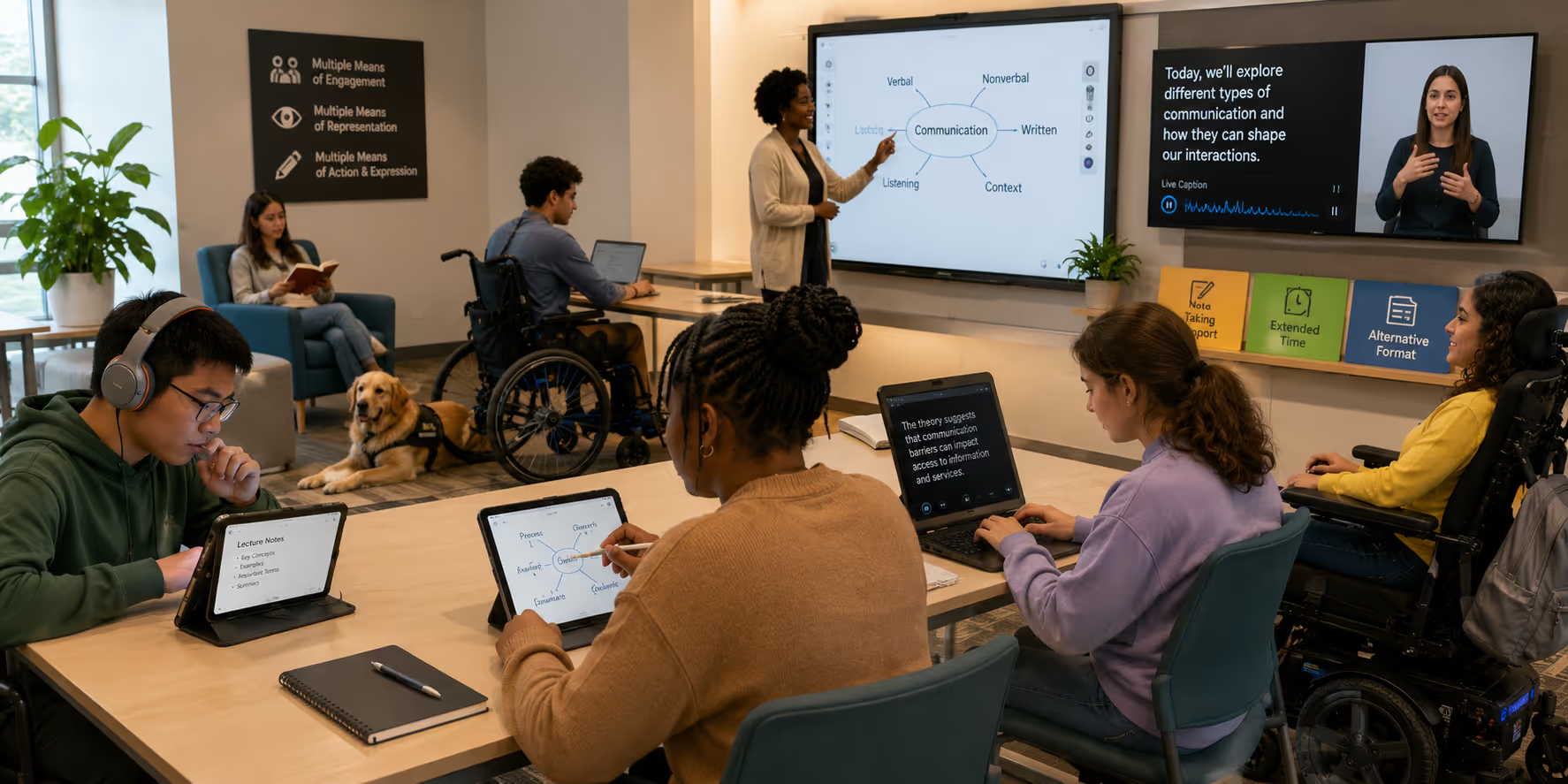
The framework rests on three interconnected principles:
Multiple means of engagement involves offering various pathways to motivate students and sustain their interest in learning. This might include choice in assignment topics, varied collaboration options, or explicit connections between course content and students' existing interests and goals. A student who struggles with motivation during depressive episodes might engage more consistently when they can choose project topics that connect to their career aspirations.
Multiple means of representation involves presenting information through different formats so students can access content through channels that work best for their learning needs. This includes captioned videos, transcripts for audio content, and visual diagrams accompanying written explanations. The student who processes information better through reading can follow along with lecture transcripts; the student who learns better through listening can replay audio recordings.
Multiple means of action and expression involves allowing students to demonstrate their knowledge through different modalities rather than defaulting to a single assessment format. This might mean offering options for written papers, oral presentations, multimedia projects, or portfolio assessments. The student with severe test anxiety can demonstrate mastery through a project; the student who struggles with writing can present orally.
What makes UDL particularly powerful as a retention strategy is that these design choices benefit all students, not exclusively those with diagnosed disabilities.
Captioned videos support deaf and hard-of-hearing students—and also support students studying in noisy residence halls, students for whom English is a second language, students who retain information better when reading along with audio, and students reviewing material at double speed before exams.
Flexible deadline structures reduce anxiety for students managing depression or chronic illness—and also support students balancing demanding work schedules, students navigating family caregiving responsibilities, students dealing with unexpected life circumstances, and students who simply perform better when they can manage their own time.
When institutions implement UDL principles systematically, they stop playing catch-up with individual accommodation requests and start creating environments where more students succeed without needing to request special treatment. The student with lupus mentioned earlier might never have needed to visit the disability services office if her courses had already built in flexible attendance policies and multiple ways to demonstrate learning.
Proactive Accessibility Support in Practice
Moving from reactive accommodation to proactive accessibility requires concrete operational changes across campus systems.
Early and Repeated Communication About Available Support
Students cannot use services they don't know exist. Proactive institutions embed accessibility information throughout the entire student journey—not as a single mention during orientation when students are processing hundreds of new pieces of information, but as a consistent thread woven through multiple touchpoints.
This means including clear accessibility information in admissions materials, orientation programming, every course syllabus, regular administrative communications, and advising conversations. It means using multiple channels—email, text, app notifications, physical signage—because different students attend to different communication modes.
One disability services director described changing her office's approach: rather than waiting for students to find them, her staff now presents at every new student orientation, partners with residence life to train RAs on recognizing when students might benefit from services, and sends friendly outreach emails at predictable high-stress points in the semester (before midterms, before finals, after grades post).
The goal is normalizing help-seeking. When references to disability services appear alongside references to tutoring, career services, and counseling—all presented as standard parts of the student success infrastructure—students stop perceiving accommodation requests as admissions of weakness.
Simplified Pathways to Requesting Support
Every additional step in the accommodation request process represents a potential exit point where students abandon their attempts to get help.
Consider what documentation requirements often demand: a student with ADHD may need a recent psychoeducational evaluation, which can cost $1,000-3,000 out of pocket and require months-long waitlists with qualified evaluators. A student whose childhood diagnosis is documented in K-12 records may discover those records are difficult to obtain or don't meet the college's specific documentation standards. A student with a chronic illness may have medical records but struggle to get their physician to complete the specific forms the disability office requires.
Proactive institutions audit their intake procedures for unnecessary barriers. This might mean reducing documentation requirements for conditions where extensive verification adds little value beyond bureaucratic gatekeeping—accepting self-report for temporary accommodations, for instance, or provisional accommodations while documentation is being gathered. It might mean offering multiple entry points rather than requiring students to navigate a single rigid process. It might mean experimenting with universal accommodation statements that allow students to access certain baseline supports without formal registration.
Some institutions have begun offering what they call "academic flexibility agreements"—baseline accommodations like permission to record lectures or one flexible deadline per course—available to any student who requests them, no documentation required. The students who need more extensive support still register formally, but the students who need modest flexibility aren't forced through processes designed for complex cases.
Flexible Notification and Communication Systems
Students process information differently. Some respond to visual reminders and calendar integrations. Others need text-based nudges at specific times. Students with executive function challenges often require multiple prompts across different channels before important information registers.
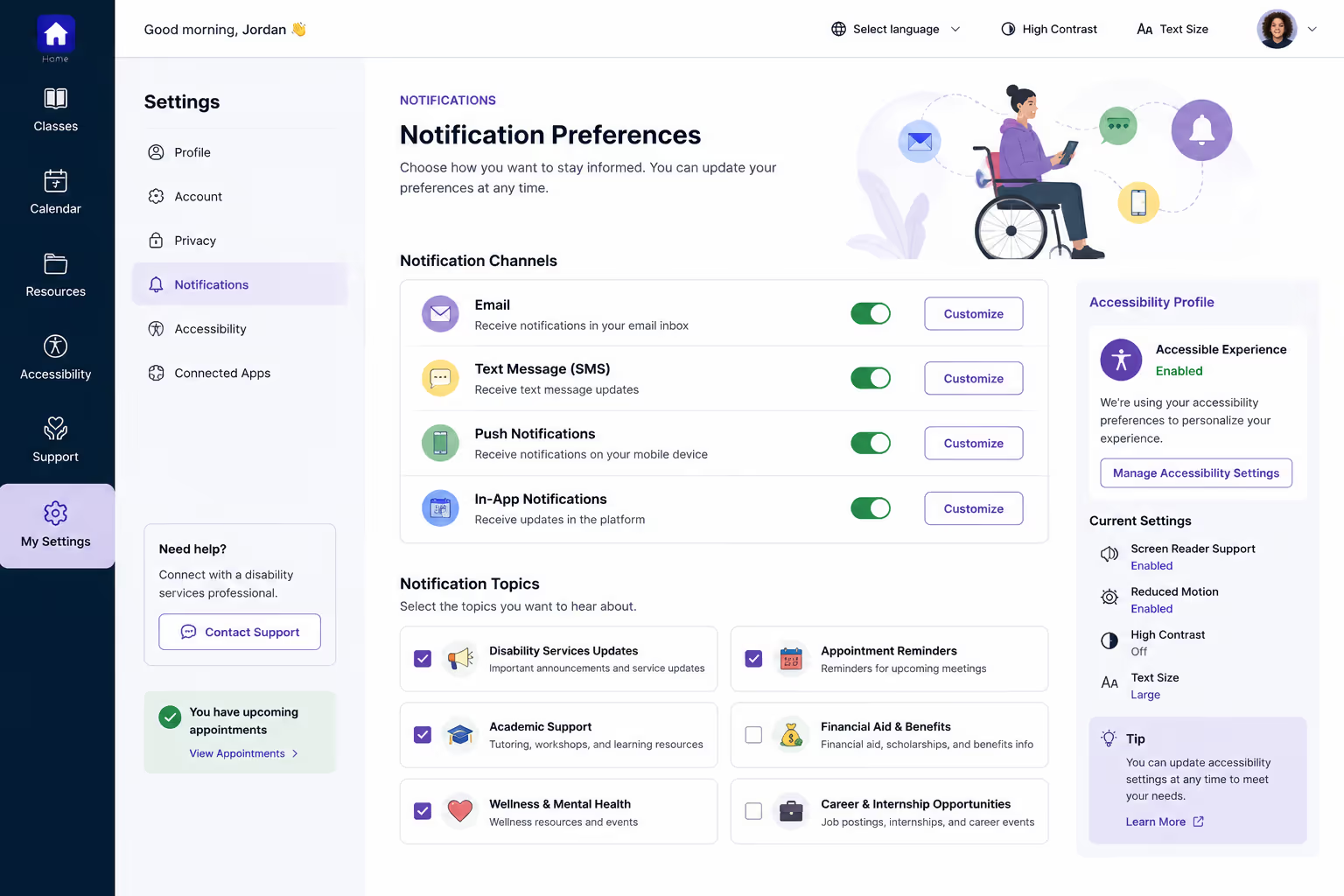
Engagement platforms that allow personalized notification preferences can help ensure critical information actually reaches students rather than disappearing into cluttered inboxes. When systems offer customization—notification timing, channel preferences, frequency settings—they inherently become more accessible to diverse cognitive styles.
A student with ADHD who knows she ignores email but responds to text messages can set her preferences accordingly. A student who feels overwhelmed by constant notifications can reduce frequency while still receiving essential deadlines. A student who needs extra processing time can receive reminders earlier than standard timing.
Training for Faculty and Frontline Staff
Disability services professionals cannot be present for every student interaction. The academic advisor who notices a student has withdrawn from several courses. The professor who observes a student's attendance dropping precipitously. The RA who overhears a student expressing frustration about keeping up with coursework. These frontline staff often interact with struggling students long before those students ever consider visiting disability services.
Proactive institutions train faculty, academic advisors, resident assistants, and other frontline staff to recognize potential signs that a student might benefit from accessibility support, normalize help-seeking behavior in their conversations, and make warm referrals rather than generic suggestions.
This training helps staff understand that students experiencing difficulty often won't explicitly ask for help—they may not recognize that their struggles have solutions, or they may feel ashamed to admit they're having trouble. A professor who casually mentions during office hours that "lots of students find it helpful to work with disability services, especially if they're dealing with attention issues or anxiety" opens a door the student might never have known existed.
Integration Across Campus Support Systems
When disability services operates in isolation from other student support functions, students fall through gaps between offices.
Consider the student struggling academically due to an undiagnosed learning difference. She might interact with academic advising (who sees her dropping courses), tutoring services (who notice she takes much longer than other students to complete work), and counseling (where she discusses her growing anxiety about academic performance). If these offices don't communicate, no one connects the dots to suggest she might benefit from evaluation for a learning disability. This underscores the need for integrated student support systems that foster communication and coordinated care.
Proactive institutions build communication channels between disability services, academic advising, counseling centers, residential life, and student engagement systems. They create coordinated referral pathways so that a student's interaction with any support office can lead to appropriate connections across the network. They use data systems that allow (with appropriate privacy protections) pattern recognition that might identify students who could benefit from services they haven't yet accessed.
This doesn't mean sharing protected information inappropriately. It means creating systems where a counselor can ask, "Have you ever talked to disability services about accommodations for your anxiety?" and where an advisor can follow up a difficult conversation with, "I'm going to send you some information about a few offices that might be helpful."
Neurodiversity and Personalized Student Engagement
The neurodiversity movement has fundamentally shifted how many educators understand cognitive differences. Rather than framing conditions like autism, ADHD, and dyslexia purely as deficits requiring remediation, the neurodiversity paradigm recognizes these as natural variations in human cognition—differences that present both challenges and strengths depending on environmental fit [4].
This reframing has practical implications for retention strategy.
Neurodivergent students often struggle not because they lack intelligence or capability, but because traditional academic environments assume a narrow range of what counts as "normal" cognitive functioning. The student with ADHD who can hyperfocus for six hours straight on topics that capture her interest but cannot sustain attention through a standard fifty-minute lecture isn't lazy or unmotivated—she's operating with a different attentional system that traditional classroom structures don't accommodate.
The student with autism who produces brilliant written work but freezes during verbal participation isn't deficient in knowledge—he's being assessed through a modality that doesn't match his communication strengths.
Personalized engagement approaches become particularly valuable for these students:
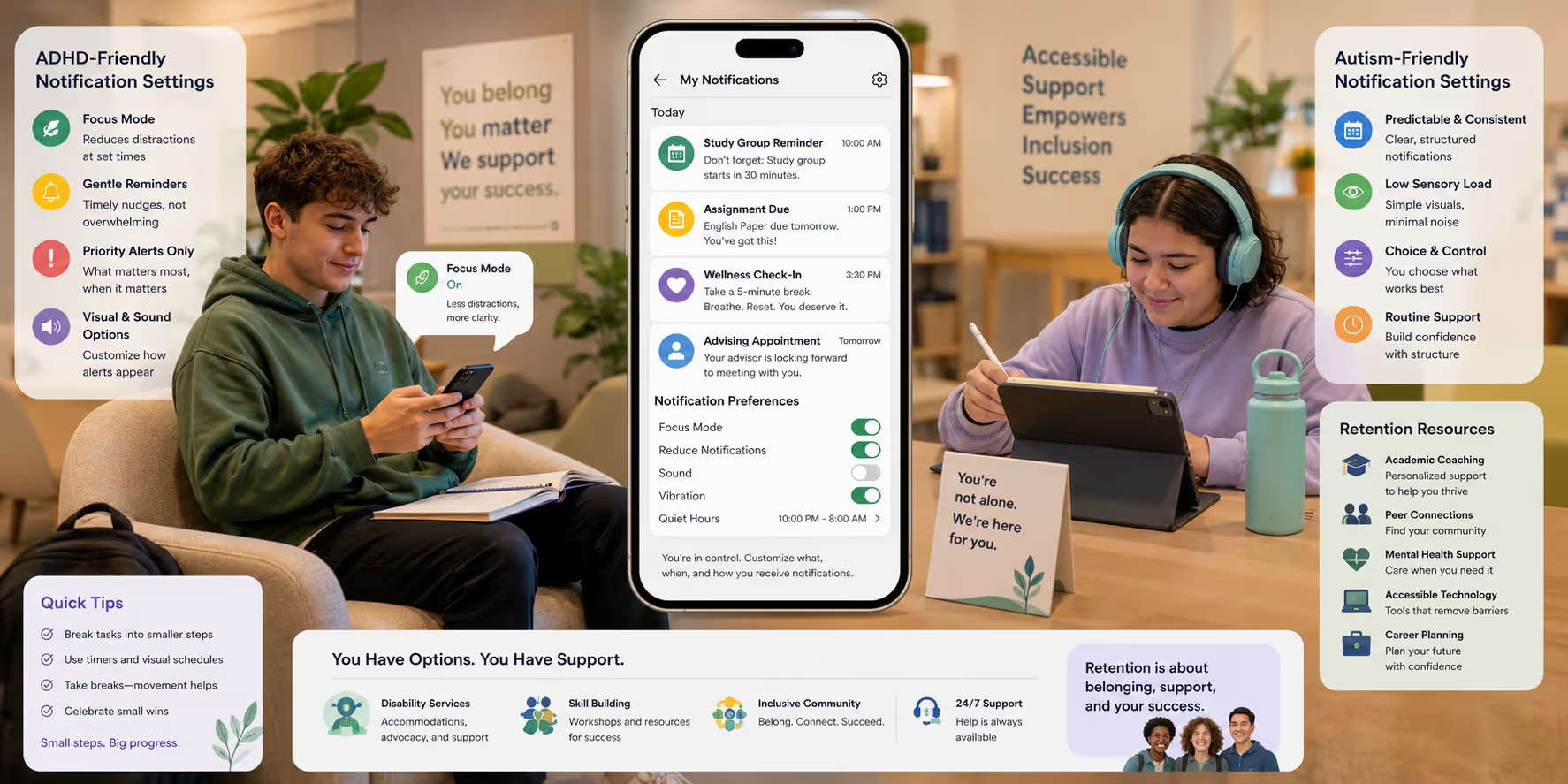
Customizable notification preferences that account for different processing styles—allowing students to choose when, how, and how frequently they receive communications rather than imposing a one-size-fits-all approach. The student with ADHD who needs multiple reminders can set them; the student with anxiety who finds constant notifications overwhelming can reduce them.
Visual progress tracking that provides external structure for students whose internal executive function systems don't naturally maintain awareness of deadlines, requirements, and progress toward goals. Rather than assuming students can hold complex multi-week timelines in working memory, systems can externalize this tracking visually.
Low-stimulation pathways for accessing information—clean designs, reduced visual clutter, and straightforward navigation that doesn't require cognitive overhead just to find basic information. The student who experiences sensory overload shouldn't have to fight through cluttered interfaces to locate the financial aid office phone number.
Flexibility in timing and modality for how and when students engage with campus resources. The student who functions well at midnight but poorly at 9 AM shouldn't be locked out of support simply because offices keep standard business hours.
When campus systems offer genuine personalization rather than forcing all students through identical processes, they inherently become more accessible to neurodivergent students. And these flexibilities benefit broader populations as well—students with demanding work schedules, students managing chronic health conditions, students who simply learn and operate differently from assumed defaults.
Digital Accessibility and WCAG Compliance
Any serious conversation about accessibility in contemporary higher education must address digital environments. Students interact with their institutions primarily through screens—learning management systems, student information portals, mobile applications, email platforms, and engagement tools. If these digital touchpoints aren't accessible, physical campus accommodations solve only part of the problem.
The Web Content Accessibility Guidelines (WCAG) provide internationally recognized standards for digital accessibility [5]. Institutions should ensure that any technology they deploy—including student engagement platforms—meets at least WCAG 2.1 Level AA standards as a baseline.
Key requirements include:
Screen reader compatibility ensures that students who are blind or have low vision can navigate digital interfaces using assistive technology. This requires proper heading structures, alt text for images, and semantic HTML that conveys meaning beyond visual appearance. A student using a screen reader shouldn't spend forty-five minutes trying to submit a routine assignment that sighted students complete in ten.
Keyboard navigation supports users who cannot operate a mouse due to motor impairments. Every function available through mouse clicks must also be accessible through keyboard commands alone.
Sufficient color contrast ensures that text remains readable for users with visual impairments or color blindness. This affects not just body text but also buttons, links, error messages, and form labels.
Captions and transcripts for audio and video content support deaf and hard-of-hearing users, as well as users in sound-sensitive environments or those who process written information more effectively than audio.
Clear, consistent navigation structures help users with cognitive disabilities predict how interfaces will behave and find information without unnecessary cognitive load.
Beyond meeting technical standards, genuinely accessible digital experiences are often simply better experiences for everyone. Clean interfaces with logical information architecture and consistent design patterns help all users find what they need efficiently.
The Financial Case for Accessibility Investment
For campus leaders navigating competing budget priorities, accessibility investments require clear justification. The retention-focused case offers compelling reasoning.
Students with disabilities who receive adequate support persist and graduate. Research from the National Council on Disability and other sources consistently demonstrates that when students with disabilities have access to appropriate accommodations and support services, their retention and graduation rates improve significantly [6]. The accommodations themselves typically aren't expensive on a per-student basis—the expensive outcome is losing students who could have succeeded with relatively modest support investments.
Consider the math: a student paying $15,000 annually in tuition who leaves after one year represents $45,000 or more in lost revenue over what could have been a four-year enrollment. The cost of providing accommodations—extended test time, note-taking services, accessible materials—rarely approaches this figure. Institutions that lose students to preventable attrition are paying the highest possible price for inadequate support.
Accessibility improvements scale efficiently over time. Unlike interventions that require ongoing per-student costs that grow with enrollment, accessibility improvements to digital systems, physical spaces, and course design benefit every subsequent student. An investment in making the learning management system more accessible this year continues paying dividends for every student who enrolls in future years. The return on investment compounds.
A faculty development initiative teaching UDL principles costs the same whether it improves courses for 500 students or 5,000 students. Once a course is redesigned with built-in flexibility, that flexibility serves every future student without additional investment.
Regulatory and legal landscapes are becoming stricter. The Department of Justice has increased enforcement of digital accessibility requirements under the ADA. The Department of Education's Office for Civil Rights continues investigating accessibility complaints and issuing findings that require institutional remediation—often under pressure, public scrutiny, and significant expense. Proactive investment now prevents more costly reactive remediation later.
Accessible institutions attract diverse talent. As awareness of disability rights and neurodiversity grows, prospective students and their families increasingly research institutional accessibility before making enrollment decisions. Reputation for genuine accessibility becomes a competitive advantage in student recruitment, particularly for students who have experienced inadequate support at previous institutions.
For institutions seeking to calculate specific financial impact, consider modeling tuition revenue retained when students with disabilities persist rather than transferring or dropping out. Even modest improvements in retention rates for this population—which represents nearly one in five students according to federal data [1]—can translate to significant revenue preservation that offsets accessibility investments many times over.
Practical Next Steps for Campus Leadership
Moving from reactive compliance to proactive accessibility support doesn't require complete institutional transformation overnight. It requires intentional, incremental progress with clear accountability.
For disability services leaders:
Audit your current registration process for unnecessary barriers—documentation requirements that create obstacles without adding value, intake procedures that assume students already understand the system, timelines that don't account for the realities of gathering records
Partner with orientation, first-year experience, and academic advising programs to embed accessibility information earlier in student journeys, before struggles have already begun
Develop formal referral relationships with counseling, academic support, and student engagement offices to create coordinated support networks where struggling students don't fall through gaps between offices
For student affairs administrators:
Evaluate engagement platforms and other student-facing technologies for WCAG compliance before procurement decisions—accessibility requirements should be standard selection criteria, not afterthoughts
Ensure student communication systems allow personalized notification preferences that accommodate different processing styles and attention patterns
Train staff across departments to recognize signs of student struggle and make warm referrals to appropriate resources, including disability services
For institutional leadership:
Frame accessibility as retention infrastructure in strategic planning and budget conversations, not merely as compliance obligation or equity initiative
Include accessibility and disability services metrics in student success dashboards alongside traditional retention indicators
Fund Universal Design for Learning initiatives that improve educational environments for all students, not just those with documented disabilities
For faculty:
Apply UDL principles to course design from the start rather than retrofitting individual accommodations semester by semester
Include clear, welcoming accessibility statements in syllabi that normalize help-seeking rather than treating it as exceptional
Offer multiple means of demonstrating knowledge when assessment design permits, rather than defaulting to single high-stakes exam formats
Frequently Asked Questions
How do we justify accessibility investments when institutional budgets are constrained?
Frame accessibility as retention infrastructure rather than additional compliance spending. Calculate the tuition revenue lost when students with disabilities leave your institution before graduation—federal data suggests this population represents nearly one in five undergraduates. Compare that revenue loss to the cost of proactive accessibility improvements. The financial case typically favors prevention over attrition. Additionally, many accessibility improvements like UDL course design and streamlined digital systems benefit all students, multiplying the return on investment beyond the disability population alone.
Won't reducing documentation requirements lead to students claiming accommodations they don't need?
Available research doesn't support this concern. The actual barrier for most students with disabilities is underutilization of available services, not inappropriate overuse. Students generally don't seek accommodations they don't need—the application process remains effortful even when streamlined. Institutions that have relaxed documentation requirements for certain accommodation types report no meaningful increases in fraudulent requests. The students you lose by making accommodations difficult to obtain far outnumber any hypothetical bad actors.
How can student engagement platforms specifically support students with disabilities?
Effective platforms offer personalized notification preferences that accommodate different cognitive processing styles, accessible interfaces meeting WCAG standards for screen readers and keyboard navigation, flexible pathways for engaging with resources rather than rigid single channels, and integration with existing support services. Platforms that help students connect with resources proactively—before they're already failing—through personalized recommendations are particularly valuable for students who may not self-identify as needing disability-specific support.
What's the practical difference between individual accommodations and Universal Design for Learning?
Individual accommodations are adjustments made after course design is complete, provided to specific students with documented disabilities who have navigated the registration process. Universal Design for Learning builds flexibility into learning environments from the start, benefiting all students without requiring individual disclosure or documentation. Accommodations ask how to modify something for one student; UDL asks how to design so most students can access it without needing modifications.
How do we support students who haven't disclosed disabilities or don't know they qualify for services?
This question captures precisely why UDL and proactive approaches matter. When courses, services, and engagement systems are designed with flexibility built in, students benefit whether or not they've formally disclosed or registered with disability services. Normalizing help-seeking through campus culture and communication, reducing stigma around accommodations, and creating environments where disclosure isn't required to receive baseline support all help reach students who won't navigate formal accommodation processes.
Moving Forward: Accessibility as Retention Infrastructure
The student with lupus who nearly withdrew wasn't asking for special treatment. She was asking for an educational environment that didn't systematically work against how her body functions. The accommodations she eventually received—flexible attendance, extended deadlines during flares—weren't extraordinary measures. They were modest adjustments that any well-designed system could have built in from the start.
When institutions meet this standard, they don't just retain students with disabilities—they create better learning environments for everyone. The flexibility that helps a student with ADHD also helps the working student managing a demanding schedule. The clear navigation that helps a student using assistive technology also helps the first-generation student who didn't grow up understanding how academic institutions organize information. The multiple means of demonstrating learning that help a student with test anxiety also help the student who simply thinks better through discussion than through written exams.
Proactive accessibility support isn't charity or mere legal compliance. It's recognition that sustainable retention depends on removing barriers before they cause students to leave. It's understanding that students cannot persist through systems designed without them in mind.
The institutions that treat disability services as retention infrastructure—rather than as a compliance afterthought—will see measurable improvements in student success. Those that continue treating accessibility as a checkbox exercise will continue losing students who could have thrived with better support.
Ready to explore how integrated engagement platforms can support accessible student success at your institution? Schedule a CampusMind demo call to learn how proactive, personalized engagement systems help connect all students—including those with disabilities—to the support they need.
About This Resource
This article was developed by CampusMind's student success team, drawing on research from disability services professionals, Universal Design for Learning experts, and higher education accessibility advocates. CampusMind partners with colleges and universities to build connected, proactive support systems that help all students thrive—including students with disabilities who benefit from personalized engagement pathways and accessible digital experiences.
Works Cited
[1] National Center for Education Statistics — "Students With Disabilities." https://nces.ed.gov/programs/coe/indicator/cgg/students-with-disabilities
[2] Association on Higher Education and Disability (AHEAD) — "Research and Resources on Students with Disabilities in Higher Education." https://www.ahead.org/professional-resources/publications
[3] CAST — "Universal Design for Learning Guidelines Version 2.2." https://udlguidelines.cast.org/
[4] Singer, J. — "Neurodiversity: The Birth of an Idea." https://neurodiversity2.blogspot.com/p/what.html
[5] Web Accessibility Initiative — "Web Content Accessibility Guidelines (WCAG) 2.1." https://www.w3.org/TR/WCAG21/
[6] National Council on Disability — "National Disability Policy: A Progress Report." https://ncd.gov/progress_reports/