
Nearly half of all Latino undergraduates in the United States attend a Hispanic-Serving Institution [1]. This represents a defining characteristic of American higher education, one that shapes how millions of students experience college. Yet despite this concentration of Hispanic students, many HSIs face challenges translating enrollment numbers into graduation outcomes that reflect their institutional mission.
Federal HSI designation requires only that 25% of enrolled students identify as Hispanic. It says nothing about whether those students feel seen, supported, or positioned to succeed. The distance between "serving" in name and serving in practice is where culturally responsive retention approaches make all the difference.
This guide examines what evidence suggests works at HSIs—not generic retention tactics repackaged with surface-level adaptations, but strategies rooted in the cultural strengths, family dynamics, and lived experiences of Hispanic students.
Key Takeaways
HSI designation alone does not guarantee culturally responsive practices—intentional design matters
Family engagement strategies should honor collective decision-making traditions common in many Hispanic households
Bilingual support systems can reduce barriers without stigmatizing students
Peer mentorship programs connecting students with similar backgrounds tend to strengthen belonging
Data systems that track engagement across cultural and linguistic dimensions provide more actionable insights
Understanding the HSI Landscape
Hispanic-Serving Institutions represent one of the fastest-growing segments of American higher education. According to the Hispanic Association of Colleges and Universities (HACU), more than 500 federally designated HSIs now exist, educating approximately two-thirds of all Hispanic college students [2].
What those numbers do not capture: the considerable diversity within HSI populations.
Some HSIs serve predominantly Mexican-American students whose families have lived in the Southwest for generations. Others enroll recent immigrants from Central America, South America, or the Caribbean. Still others serve mixed populations where Hispanic students represent the plurality but not the majority.
This means no single "Hispanic student experience" exists. Effective retention approaches must account for:
Immigration generation status: first-generation immigrant versus third-generation american
Country of origin: regional cultural differences that shape expectations and communication styles
Language dominance: varying bilingual capabilities and comfort levels
Documentation status: associated stressors that affect academic focus and resource access
Socioeconomic diversity: within Hispanic communities themselves
Excelencia in Education, a leading research organization focused on Latino student success, emphasizes that HSIs must move beyond enrollment metrics toward intentional practices that accelerate Latino student achievement [3].
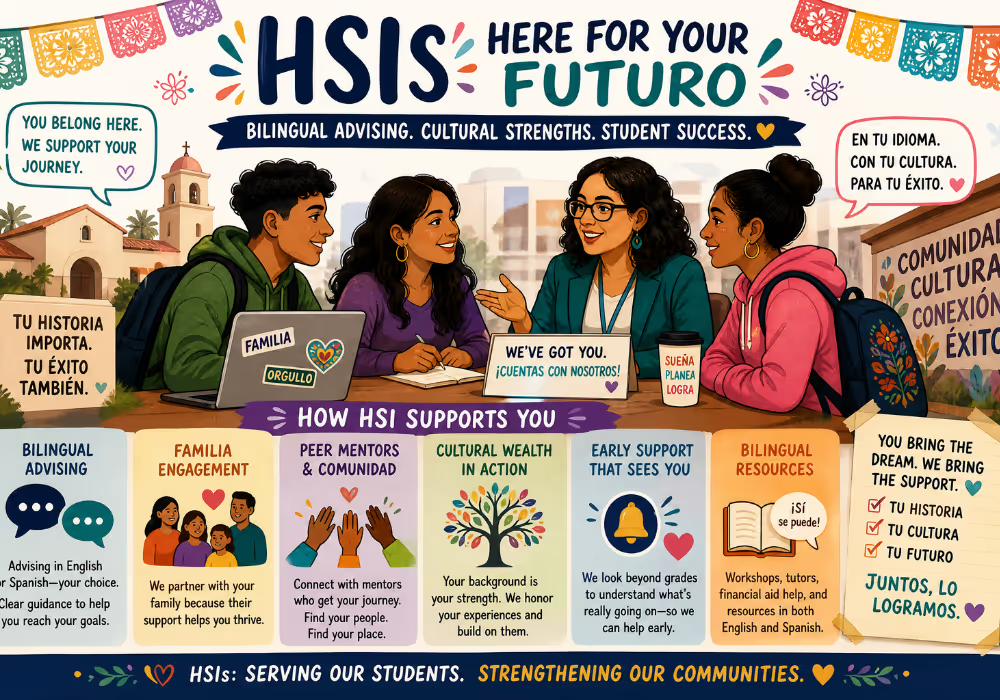
Why Generic Retention Strategies Often Fall Short at HSIs
Traditional retention playbooks tend to assume a certain type of student: one who arrived at college with extensive preparation, family members familiar with the system, and a clear path from enrollment to graduation.
These assumptions frequently do not match the reality at HSIs.
Consider a first-generation college student whose parents never experienced American higher education. Standard parent orientation programs assume parents know what questions to ask. Financial aid workshops assume families understand the FAFSA process. Academic advising assumes students know how to advocate for themselves in institutional settings.
When students navigate systems their families have never encountered, different approaches become necessary.
The Language Dimension
Research indicates that a meaningful percentage of incoming college freshmen are non-native English speakers, with that proportion significantly higher at many HSIs [4]. Yet institutions sometimes treat bilingual students as deficient rather than resourceful.
Students who switch fluidly between languages demonstrate a cognitive skill that research associates with executive function advantages. Treating this ability as a remedial characteristic misses an opportunity.
HSIs that recognize bilingualism as a strength tend to find that family engagement in Spanish is not a workaround but a feature. Academic support in students' home language can accelerate rather than delay English proficiency and overall academic success.
Culturally Responsive Retention Strategies That Work
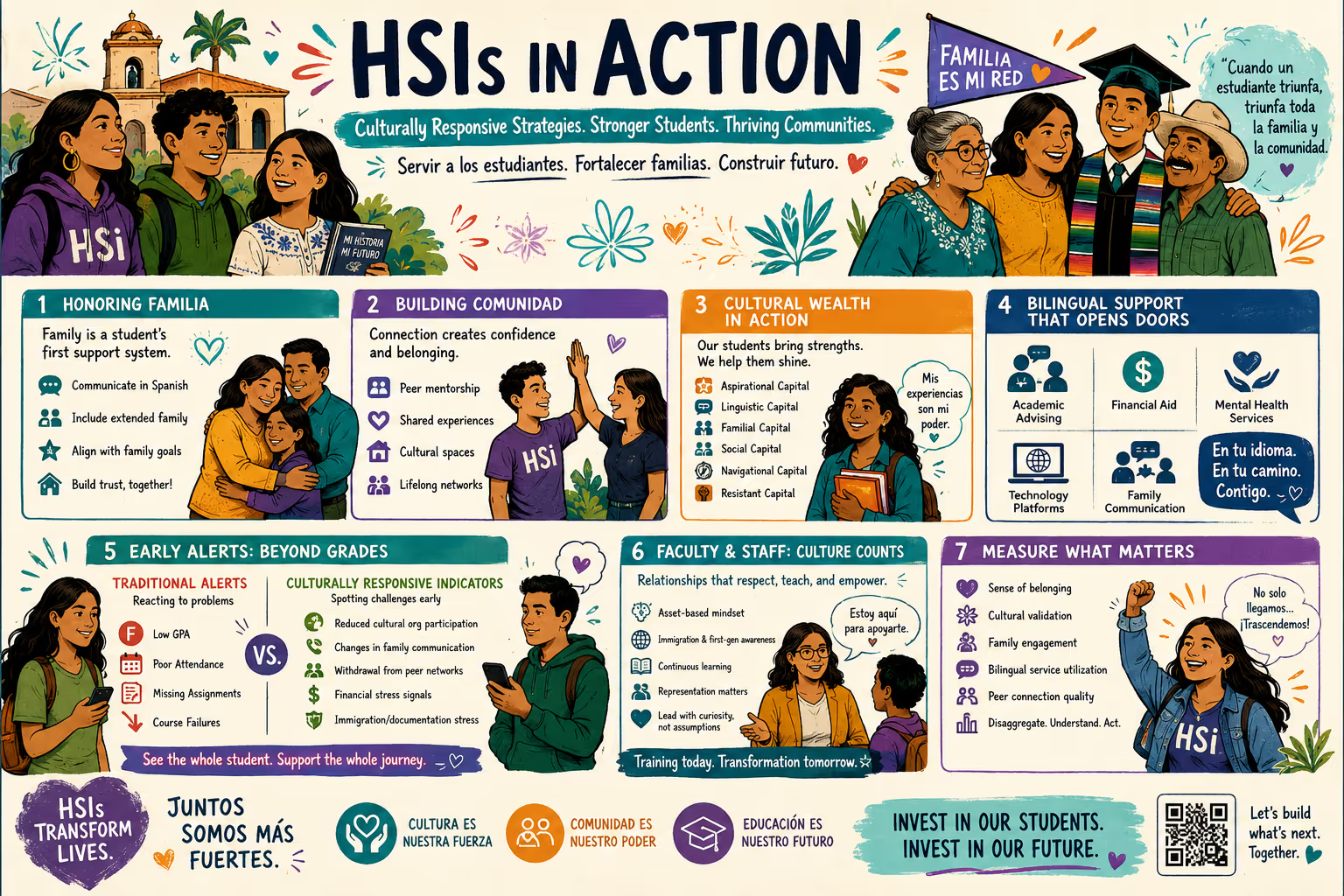
Honoring Familia in Family Engagement
Many Hispanic families operate with collective decision-making models that differ from the individualistic frameworks embedded in most American institutions. This represents an opportunity rather than a barrier.
Research consistently shows that family support is among the strongest predictors of Hispanic student persistence [5]. The question is not whether to involve families, but how.
Approaches that tend to work:
Hosting family events in Spanish with English interpretation available, rather than the reverse
Framing parent communication around shared family goals, not just individual student outcomes
Recognizing that "family" often extends beyond nuclear units to include grandparents, aunts, uncles, and older siblings
Creating communication channels that welcome family involvement without requiring students to serve as constant translators
Approaches that often create friction:
English-only parent portals that exclude non-English-speaking family members
Communication timed around traditional work schedules that assume 9-to-5 employment
Events requiring parents to navigate unfamiliar campus geography without support
The goal is servir la familia—serving the family unit in ways that strengthen the student's support network rather than isolating them from it.
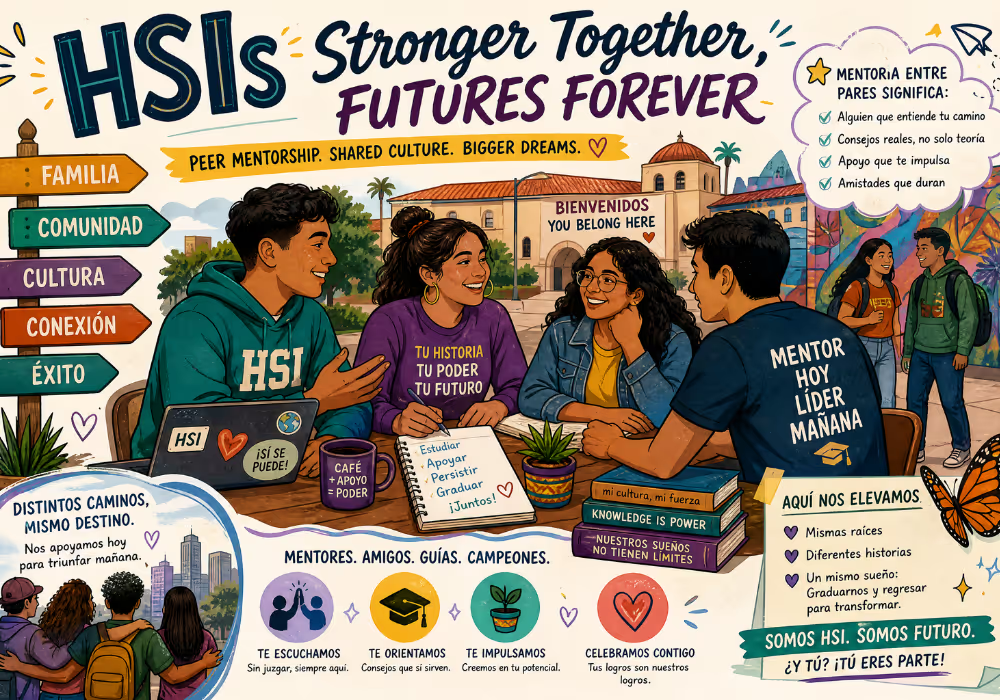
Building Comunidad Through Peer Networks
Hispanic students who connect with peers from similar backgrounds tend to show stronger persistence rates. This is about belonging, not isolation.
Peer mentorship programs that pair incoming students with successful upperclassmen from similar backgrounds provide several advantages:
Role modeling: Students see people like themselves thriving academically and socially
Practical guidance: Mentors share strategies that worked in their specific context
Cultural validation: Students do not have to explain their background constantly
Network building: Connections extend beyond the formal mentorship relationship
Effective peer programs at HSIs often go beyond formal pairings. They create comunidad—community spaces where students encounter others who understand their experiences without explanation.
Integrating Cultural Wealth Into Academic Support
Consider a student named Maria: a first-generation college student whose parents immigrated from Guatemala. Maria grew up translating documents for her family, navigating government offices, and managing household logistics that required switching between languages and cultural contexts multiple times daily.
Traditional academic support might overlook these experiences. But sociologist Tara Yosso's Community Cultural Wealth framework identifies six forms of capital that students from marginalized communities bring to college: aspirational, linguistic, familial, social, navigational, and resistant capital [6].
HSIs that recognize these strengths design academic support differently:
Aspirational capital: First-generation students often carry intense family aspirations. Academic support can connect coursework to family goals and community impact, making abstract concepts feel personally meaningful.
Linguistic capital: Bilingual students like Maria have practiced code-switching their entire lives. Academic support can build on this adaptability rather than treating it as confusion or deficit.
Familial capital: Family stories of sacrifice and persistence provide motivation. Academic support can honor these narratives rather than positioning college as separation from family.
For Maria, this might mean an advisor who asks about her family's hopes for her education, recognizes her translation experience as a transferable skill, and helps her see how her background prepares her for challenges her classmates may never have faced.
Early Alert Systems With Cultural Competence
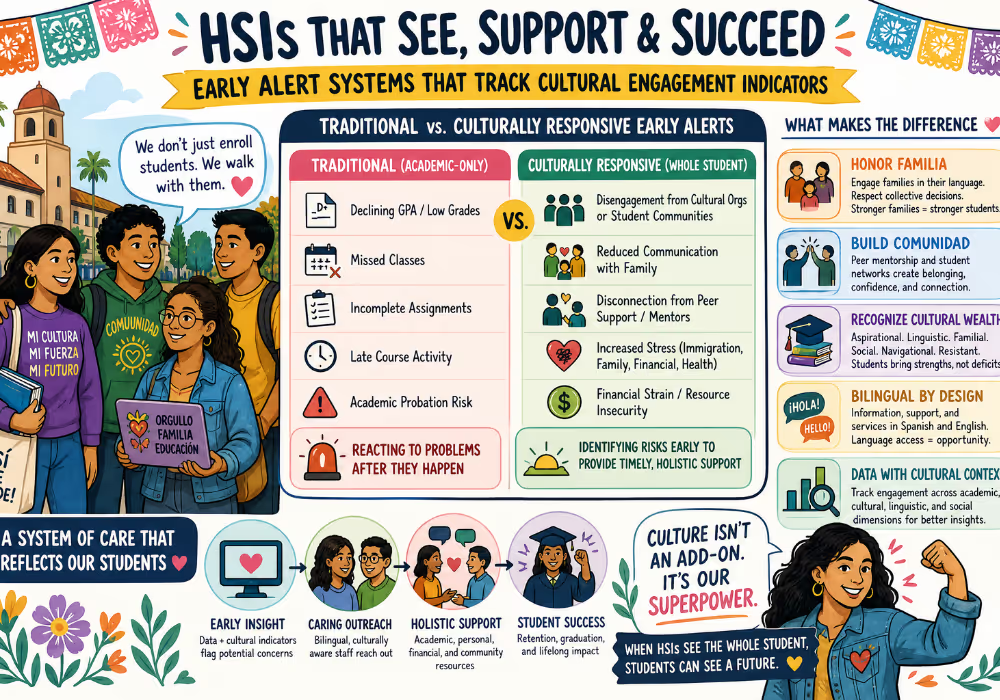
Traditional early alert systems flag academic performance metrics: missed classes, declining grades, incomplete assignments. These indicators matter, but they often arrive too late.
At HSIs, leading indicators frequently involve cultural and social dimensions:
Withdrawal from cultural student organizations
Reduced communication with family
Disconnection from peer support networks
Increased stress related to documentation status or family obligations
Financial pressures that escalate without early intervention
Effective early alert systems at HSIs track engagement across these dimensions, not just academic performance. They recognize that a student skipping classes might be dealing with family crisis, immigration stress, or financial emergency—situations that require different interventions than academic remediation alone.
[Consider: An infographic comparing traditional early alerts (GPA, attendance, assignment completion) with culturally responsive indicators (cultural org participation, family communication patterns, peer network engagement, financial stress signals) would help visualize this distinction.]
Building Bilingual Support Infrastructure
Language should not function as a barrier to support.
This seems obvious, but many HSIs still operate with English-dominant systems that require bilingual students to navigate everything in their second language while simultaneously managing the cognitive load of college-level coursework.
What Bilingual Infrastructure Looks Like
Academic advising: Advisors who speak Spanish fluently—not just conversationally—can discuss academic planning with students and their families in the language where nuance is possible. This matters for complex decisions about majors, career paths, and graduation requirements.
Financial aid: FAFSA confusion already challenges retention. When families cannot ask questions in their primary language, simple misunderstandings become enrollment barriers.
Financial aid: FAFSA confusion already challenges retention. When families cannot ask questions in their primary language, simple misunderstandings become enrollment barriers.
Technology platforms: Student success platforms, engagement apps, and communication systems should offer genuine Spanish-language interfaces—full functionality, not machine-translated buttons. This applies across the institutional technology stack: Student Information Systems (SIS), Learning Management Systems (LMS), Customer Relationship Management platforms (CRM), and early alert systems.
The Stigma Question
Some administrators worry that bilingual services stigmatize students by implying they cannot function in English. This concern, while well-intentioned, often misunderstands how bilingual students actually operate.
Students who grew up speaking Spanish at home and English at school are accustomed to language switching. They typically do not experience Spanish-language support as remedial—they experience it as recognition that their full linguistic capability matters.
The stigma concern often reflects institutional discomfort more than student experience.
Faculty and Staff Development for Cultural Responsiveness
Infrastructure matters, but people matter more.
Students at HSIs consistently report that their most meaningful connections are with faculty and staff who understand their backgrounds—or who demonstrate genuine curiosity about learning [7].
Effective Professional Development Approaches
Asset-based framing: Training should help faculty see Hispanic students' cultural backgrounds as strengths, not obstacles to overcome. This requires more than one workshop; it requires ongoing reflection and practice.
Immigration awareness: Many Hispanic students carry stress related to their own or family members' immigration status. Faculty who understand this context respond more effectively to student struggles that may not have obvious explanations.
First-generation student dynamics: Understanding how first-generation status intersects with cultural background helps faculty advise students more effectively. The challenges compound in ways that require nuanced responses.
Avoiding savior narratives: Well-meaning faculty sometimes position themselves as rescuing students from their backgrounds. This undermines student agency and cultural identity. Students benefit from support, not rescue.
The Representation Question
Hispanic students benefit from seeing faculty and staff who share their background. But HSIs often struggle to recruit and retain Hispanic faculty members.
Institutions can address this through:
Targeted recruitment from HSI graduate programs, creating pipelines for future faculty
Mentorship and development for Hispanic staff members already on campus
Creating campus cultures where Hispanic faculty feel valued beyond their identity
Addressing systemic barriers to advancement that disproportionately affect faculty of color
Measuring What Matters
Traditional retention metrics—semester-to-semester persistence, six-year graduation rates—tell only part of the story at HSIs.
Culturally responsive assessment also tracks:
Sense of belonging: Do Hispanic students feel they fit at the institution?
Cultural validation: Do students feel their backgrounds are respected and valued?
Family engagement levels: Are families included in the college journey in meaningful ways?
Bilingual service utilization: Are Spanish-language services being used, or do barriers prevent access?
Peer connection quality: Are students building relationships that support persistence?
Disaggregating data by ethnicity, language background, and immigration generation reveals patterns that aggregate numbers miss. A campus might show acceptable overall retention while specific populations—undocumented students, recent immigrants, students from specific national backgrounds—struggle in ways that demand targeted intervention.
Technology's Role in Culturally Responsive Support
Student engagement platforms can either reinforce or reduce cultural barriers, depending on how they are designed and deployed.
Platforms That Support HSI Success
Effective technology for HSIs includes:
Genuine bilingual functionality: Full Spanish-language interfaces with culturally appropriate content, not just translated buttons
Family communication features: Ways to include parents and extended family appropriately, respecting both student autonomy and family involvement
Cultural event integration: Visibility for cultural programming alongside general campus activities
Peer connection tools: Features that help students find others with similar backgrounds
Culturally informed early alerts: Systems that track social and cultural engagement, not just academic metrics
When evaluating student success technology, HSI leaders should ask specific questions about each system category:
Does the LMS support bilingual course materials and communication?
Does the SIS capture data that allows for culturally relevant analysis?
Does the CRM enable family communication in Spanish?
Do early alert systems include cultural and social engagement indicators?
What to Avoid
Technology that creates more barriers than it removes:
English-only platforms with no genuine translation capability
Communication systems that assume nuclear family structures
Engagement tracking that ignores cultural programming
Alert systems focused exclusively on academic metrics
A Call to Action for HSI Leadership
Hispanic-Serving Institution designation represents both opportunity and obligation.
The opportunity: HSIs have critical mass. They enroll enough Hispanic students to build genuine community, develop culturally responsive infrastructure, and create institutional cultures where Hispanic students thrive rather than merely survive.
The obligation: Federal HSI funding comes with implicit responsibility to serve Hispanic students effectively—not just enroll them.
Campus leaders at HSIs should evaluate their retention strategies against a simple question: Would this approach work better if we designed it specifically for our Hispanic student population, rather than adapting generic strategies after the fact?
If the answer is yes, rebuilding becomes necessary.
Start by auditing current support systems for cultural responsiveness. Examine language access across all student-facing services. Evaluate family engagement practices against Hispanic family dynamics. Assess whether peer support systems connect students with others who share their backgrounds.
Then invest in infrastructure that treats cultural responsiveness as foundational rather than supplementary.
For HSI leaders exploring student engagement platforms that prioritize cultural responsiveness, look for solutions offering genuine bilingual functionality, family engagement features that honor extended family structures, and data systems that track engagement across the dimensions that actually matter for your student population. A conversation with platform providers about their HSI-specific capabilities can clarify whether their tools match your institutional needs.
Frequently Asked Questions
What makes an institution officially designated as an HSI?
Federal HSI designation requires that at least 25% of full-time equivalent undergraduate students identify as Hispanic and that the institution meets certain income eligibility thresholds. However, designation alone does not guarantee culturally responsive practices—that requires intentional institutional effort beyond meeting numerical requirements. Many institutions achieve designation through demographic shifts without fundamentally changing how they serve Hispanic students.
How can HSIs better engage Spanish-speaking families in student success?
Effective family engagement at HSIs involves offering communication and events in Spanish as the primary language with English interpretation available, rather than the reverse. This includes Spanish-language parent portals, bilingual financial aid support, and recognition that family units often extend beyond parents to include extended family members who influence student decisions. The key is removing language as a barrier rather than treating Spanish-speaking families as an accommodation.
Why do generic retention strategies often fall short at Hispanic-Serving Institutions?
Generic retention strategies assume student populations with extensive college preparation, family familiarity with higher education systems, and individualistic decision-making frameworks. These assumptions frequently do not match the experiences of first-generation Hispanic students whose families may use collective decision-making and have limited exposure to American higher education systems. Effective HSI strategies build on cultural strengths rather than treating cultural differences as deficits.
What role does bilingualism play in Hispanic student success?
Bilingualism should be treated as a cognitive and cultural asset rather than a deficit requiring remediation. Research suggests bilingual students often demonstrate strong executive function skills developed through regular code-switching. HSIs that provide support in students' home language can accelerate rather than delay academic success while validating students' full linguistic identities. The goal is recognizing bilingualism as a strength to build upon.
How can technology platforms better serve HSI student populations?
Effective technology for HSIs includes genuine Spanish-language interfaces with full functionality, family communication features that accommodate extended family structures, visibility for cultural programming, peer connection tools that help students find others with similar backgrounds, and early alert systems that track social and cultural engagement alongside academic performance. Platform evaluation should include specific questions about bilingual capabilities and culturally informed data tracking.
About This Guide
This article reflects current research on Hispanic student success in higher education, drawing on frameworks from leading organizations including the Hispanic Association of Colleges and Universities (HACU) and Excelencia in Education. The strategies outlined here represent evidence-informed approaches that institutions across the country have implemented to support retention outcomes for Hispanic students. CampusMind's focus on family engagement features and holistic student support aligns with many of the principles discussed here, though the research base extends well beyond any single platform.
Works Cited
[1] Hispanic Association of Colleges and Universities — "HACU Member Hispanic-Serving Institutions (HSIs)." https://www.hacu.net/hacu/HSIs.asp
[2] Hispanic Association of Colleges and Universities — "2023 Fact Sheet: Hispanic Higher Education and HSIs." https://www.hacu.net/images/hacu/OPAI/HACU_FactSheet_2023.pdf
[3] Excelencia in Education — "Seal of Excelencia: What Works for Latino Students in Higher Education." https://www.edexcelencia.org/seal-of-excelencia
[4] National Center for Education Statistics — "English Language Learners in Higher Education." https://nces.ed.gov/
[5] Journal of Hispanic Higher Education — "Family Support and Latino College Student Persistence: A Systematic Review." https://journals.sagepub.com/home/jhh
[6] Yosso, T. J. (2005) — "Whose Culture Has Capital? A Critical Race Theory Discussion of Community Cultural Wealth." Race Ethnicity and Education, 8(1), 69-91. https://doi.org/10.1080/1361332052000341006
[7] Excelencia in Education — "Latino College Completion: United States." https://www.edexcelencia.org/research/latino-college-completion/united-states