

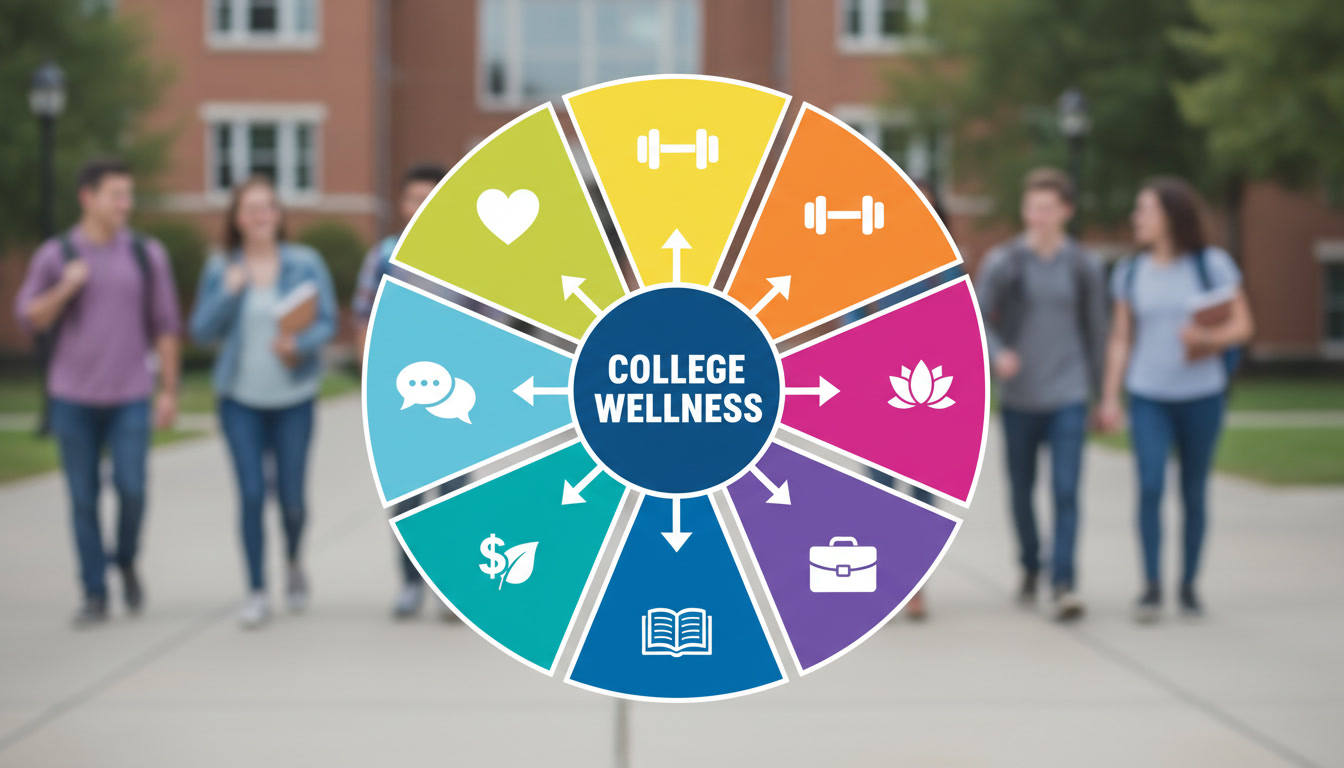
The 8 dimensions of wellness in college are emotional, physical, social, intellectual, spiritual, environmental, financial, and occupational. Developed by Dr. Peggy Swarbrick and adopted by SAMHSA, this holistic framework helps students balance academics with personal wellbeing—supporting better mental health, stronger belonging, and improved retention rates. Many campuses now teach the 8 dimensions of wellness college model to help students build resilience early.
Why Grades Aren't Everything: Rethinking Success Through the 8 Dimensions of Wellness in College
When you picture a successful college student, what comes to mind? Straight A's? A packed resume? Maybe both?
Here's the thing: research tells a different story. Students who focus solely on academic performance often struggle with burnout, isolation, and stress that can derail their entire college journey. In fact, the 2024-2025 Healthy Minds Study found that while severe depression among college students has dropped to 18%, more than half (52%) still report high levels of loneliness [1]. And according to a 2024 Gallup-Lumina Foundation report, emotional stress is the primary threat to student enrollment—cited by 54% of students considering leaving school [2].
So what actually predicts whether a student will thrive, persist, and graduate? It turns out that holistic wellbeing matters more than GPA alone. That's where the 8 dimensions of wellness in college come in. Many students who follow the 8 dimensions of wellness college approach report better balance and reduced burnout.
What Are the 8 Dimensions of Wellness?
The 8 dimensions of wellness framework was originally developed by Dr. Peggy Swarbrick, an occupational therapist and researcher, beginning in the early 1990s [3]. The model has since been adopted by the Substance Abuse and Mental Health Services Administration (SAMHSA) and hundreds of universities nationwide [4].
Rather than treating wellness as a single thing you either have or don't, this approach recognizes that wellbeing is multidimensional. Each dimension connects to the others—when one area suffers, it can ripple across your entire experience. And when you nurture multiple dimensions together, you build resilience that carries you through challenges. Today, the 8 dimensions of wellness college framework is considered a foundational tool for student wellbeing programs.
Let's break down each dimension and explore how it connects to your success as a college student.
Emotional Wellness: Building Your Inner Foundation

Emotional wellness means recognizing your feelings, managing stress effectively, and developing resilience when life throws curveballs. This emotional component is one of the core pillars of the 8 dimensions of wellness college model.
Why it matters for students: The 2024 Student Voice survey from Inside Higher Ed found that two in five students say mental health impacts their ability to focus, learn, and perform academically "a great deal" [5]. Students who develop emotional regulation skills—like mindfulness and cognitive reappraisal—are less likely to experience anxiety and depression [6].
Try this: Start a gratitude practice, connect with campus counseling services, or use free meditation apps. Even five minutes of daily reflection can strengthen this dimension.
Physical Wellness: More Than Just Exercise
Physical wellness encompasses movement, sleep, nutrition, and preventive care. Strengthening this area also reinforces the overall 8 dimensions of wellness college balance students aim to build.
Why it matters for students: Sleep deprivation, poor nutrition, and sedentary habits directly impact concentration, memory, and mood. Students who prioritize physical health report better academic performance and lower stress levels.
Try this: Walk to class instead of driving. Use your campus recreation center. Aim for 7-9 hours of sleep—yes, really. Your brain consolidates learning during rest.
Social Wellness: Finding Your People
Social wellness involves belonging and connection. It’s one of the most influential dimensions within the 8 dimensions of wellness college structure.
Why it matters for students: This might be the most critical dimension for college success. Research from Penn State and Wake Forest University found that students who felt they belonged to the college community showed better academic performance, mental health, and higher retention rates [7]. A 2024 study by the Institute for Higher Education Policy confirmed that belonging is directly tied to retention, engagement, and graduation—particularly for students from historically marginalized backgrounds [8].
Try this: Join one student organization that genuinely interests you. Attend campus events. Make an effort to study with classmates rather than always going solo.
Intellectual Wellness: Staying Curious
Intellectual wellness means engaging your mind, expanding your knowledge, and embracing lifelong learning. It's about creativity, critical thinking, and the joy of discovery—not just checking boxes for your degree requirements.
Why it matters for students: Students who engage intellectually beyond their required coursework—through undergraduate research, extracurricular learning, or creative projects—report higher satisfaction and develop skills that serve them long after graduation.
Try this: Take an elective outside your major. Attend a campus lecture on something unfamiliar. Challenge yourself to learn one new thing each week that has nothing to do with your grades.
Spiritual Wellness: Connecting to Purpose

Spiritual wellness doesn't require religious practice—though it can include it. This dimension involves exploring your values, finding meaning and purpose, and developing a sense of inner peace and connection to something larger than yourself.
Why it matters for students: Purpose and meaning are associated with grit, resilience, and psychological wellbeing [9]. Students who can articulate why they're pursuing their education tend to persist through challenges more effectively.
Try this: Reflect on what matters most to you. Practice mindfulness or meditation. Volunteer for a cause you care about. These activities build purpose and perspective.
Environmental Wellness: Where You Live and Learn
Environmental wellness recognizes that your surroundings impact your wellbeing. This includes your physical spaces—dorm room, study spots, campus environment—as well as your digital environment and relationship with the natural world.
Why it matters for students: A 2022 Penn State study found that students with a stronger sense of community and positive environmental connections before the pandemic had lower rates of anxiety and depression during COVID-19 and were less likely to drop out [10]. Your environment shapes how you feel, focus, and function.
Try this: Keep your living space organized. Find a study spot that works for you. Spend time outdoors when possible. Limit screen time before bed.
Financial Wellness: Managing Money Stress
Financial wellness involves understanding your financial situation, making informed decisions, and building habits that support your current and future needs. It's about feeling in control of money rather than controlled by it.
Why it matters for students: A 2024 Ellucian survey revealed that 59% of students have considered dropping out due to financial stress, and 78% report that financial uncertainty negatively impacts their mental health [11]. Financial stress is associated with anxiety, depression, and lower academic performance [12].
Try this: Create a simple budget. Use campus financial literacy resources. Know where to find emergency aid if you need it. Small steps toward financial awareness reduce anxiety significantly.
Occupational Wellness: Purpose Through Work
Occupational wellness connects your values, skills, and interests to meaningful work—whether that's your job, academic pursuits, internships, or volunteer activities. It's about finding satisfaction and purpose in what you do each day.
Why it matters for students: Career uncertainty can drive students to leave school. Students who see clear connections between their coursework and future career outcomes report higher motivation and persistence [13].
Try this: Use career services early—don't wait until senior year. Explore internships, job shadows, or informational interviews. Connect with alumni in fields that interest you.
How the 8 Dimensions Work Together

Here's what makes this framework powerful: the dimensions are interconnected. This interconnectedness is one reason the 8 dimensions of wellness college model has become widely adopted across higher education.
The goal isn't perfect balance across all eight areas—that's unrealistic. Instead, focus on awareness. Where are you thriving? Where could you use support? Even small improvements in one dimension can create positive ripple effects across others.
Putting It Into Practice: Your Holistic Wellness Checklist
Ready to assess your own wellness? Many self-assessments are based on the 8 dimensions of wellness college guidelines, helping students identify where they thrive and where support is needed.
Emotional: How am I managing stress? Do I have healthy coping strategies?
Physical: Am I getting enough sleep, movement, and nutrition?
Social: Do I feel connected to others? Where can I build community?
Intellectual: Am I engaging my mind beyond requirements?
Spiritual: What gives my life meaning and purpose?
Environmental: Do my spaces support my wellbeing?
Financial: Do I understand my financial situation? Am I taking steps to manage it?
Occupational: Does my work feel meaningful? Am I building toward my goals?
Campus Mind's self-assessment quiz can help you evaluate each dimension and identify personalized next steps. Pair it with our student success guide for practical strategies tailored to your needs.
The Bottom Line
Success in college isn't just about grades—it’s about how you engage in every part of your life. The 8 dimensions of wellness college model provides a clear roadmap for thriving, not just surviving.
Start with one dimension. Make one small change. Notice how it affects the others. That's how sustainable wellness is built—one intentional choice at a time.
Frequently Asked Questions
Q1: What are the 8 dimensions of wellness for college students?
A1: The 8 dimensions of wellness in college are: emotional (managing feelings and stress), physical (movement, nutrition, sleep), social (relationships and belonging), intellectual (lifelong learning), spiritual (purpose and meaning), environmental (your surroundings), financial (money management), and occupational (meaningful work). Together, they create a holistic framework for student wellbeing and success.
Q2: How does wellness affect college student retention?
A2: Wellness directly impacts retention. Research shows that emotional stress is the top reason students consider leaving college, cited by 54% of students. Students with strong social connections and sense of belonging have significantly higher retention rates. Financial stress causes 59% of students to consider dropping out. Addressing wellness holistically helps students persist and graduate.
Q3: Why is social wellness important in college?
A3: Social wellness is one of the strongest predictors of college success. Studies show that students who feel they belong to their campus community demonstrate better academic performance, improved mental health, and higher retention rates. Loneliness remains common—52% of students report high loneliness—making intentional community-building essential for thriving in college.
Q4: How can I improve my wellness as a college student
A4: Start by assessing where you're thriving and where you need support across the 8 dimensions. Make one small change—like joining a student organization (social), establishing a sleep routine (physical), or creating a simple budget (financial). Small, consistent improvements in one area often create positive ripple effects across others.
Q5: Who created the 8 dimensions of wellness model?
A5: The 8 dimensions of wellness model was developed by Dr. Peggy Swarbrick, an occupational therapist and researcher, beginning in the early 1990s. Originally featuring five dimensions, the model evolved to eight based on real-world needs. It has been adopted by SAMHSA and hundreds of universities as a framework for holistic wellbeing.
About the Author
Author Byline: Written by the Campus Mind content team. Campus Mind partners with colleges and universities to support student engagement, retention, and holistic wellbeing through data-driven, gamified solutions. Our content is informed by peer-reviewed research and higher education best practices.
Review Note: This article presents general wellness information based on established frameworks and peer-reviewed research. Campus Mind is not a replacement for counseling, medical treatment, or professional mental health services. If you are experiencing a mental health crisis, please contact your campus counseling center or call 988 (Suicide & Crisis Lifeline).
YMYL Disclaimer: This article provides educational information about wellness dimensions. Individual experiences vary. Students facing specific challenges should seek support from qualified campus professionals, counselors, or healthcare providers.


