The residence hall is full, but the hallways feel empty. Students scroll through their phones alone in their rooms while club meetings down the hall sit half-attended. A first-generation student eats lunch by herself again, wondering if college was the right choice.
This scene plays out on campuses nationwide. And here's the truth: social isolation isn't just a comfort issue—it's a retention challenge hiding in plain sight.
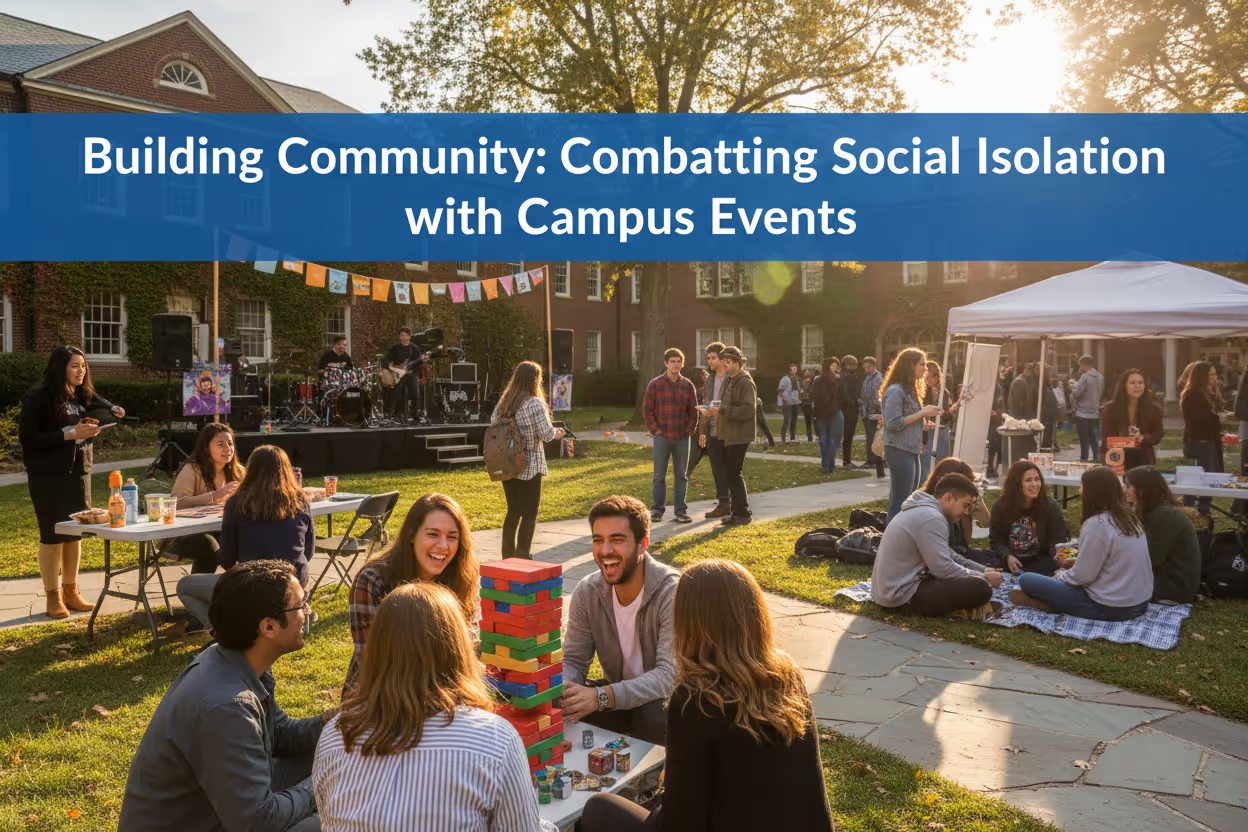
Students who feel disconnected from their campus community are significantly more likely to leave before graduation. But the reverse is also true. When institutions create meaningful opportunities for connection through intentional campus events, they build the kind of belonging that keeps students enrolled, engaged, and thriving.
This guide explores how campus leaders can use events strategically to combat social isolation—and why the investment pays dividends in retention, wellbeing, and institutional success.
What the Research Says About Belonging and Retention
The connection between social integration and student persistence isn't speculation. Decades of higher education research confirm that students who feel they belong are far more likely to stay.
A landmark study published in the Journal of College Student Development found that students who participated in campus activities during their first year showed retention rates up to 15 percentage points higher than their less-involved peers [1]. The National Survey of Student Engagement consistently reports that high-impact practices—including collaborative learning and campus involvement—correlate with both persistence and academic achievement [2].
Translation? Students don't just leave because coursework is hard. They leave because they feel alone.
Vincent Tinto's foundational research on student departure established that academic and social integration work together to influence whether students persist [3]. When students find their people—whether through clubs, events, or informal connections—they develop the social capital that anchors them to the institution.
Post-Pandemic Isolation: A Shifted Landscape
The challenge has intensified since 2020. Research from the Healthy Minds Network shows that over 60% of college students now meet criteria for at least one mental health concern [4]. A 2023 study in the Journal of American College Health found that students who began college during or after the pandemic reported significantly higher rates of loneliness and social anxiety compared to pre-pandemic cohorts [5].
These students didn't just miss orientation—they missed years of social skill-building during high school. Many arrived on campus without the informal networks that previous generations took for granted. The result: a cohort that needs more intentional connection support, not less.
The data extends beyond retention. Students with strong social connections report better mental health outcomes, higher GPAs, and greater satisfaction with their college experience [6]. In this context, building community isn't optional—it's foundational to student success.
Why Traditional Approaches Fall Short
Many campuses recognize the importance of student engagement. So why does isolation persist?
The answer often lies in how events are designed and delivered. Consider the typical approach:
Mass emails promoting dozens of events that blend together
Programming scheduled without regard for student schedules or preferences
One-size-fits-all activities that appeal to already-connected students
Front-loaded orientation events with little follow-up
Students receive information through fragmented channels—flyers, portal announcements, Instagram posts, emails that pile up unread. By week three, the orientation energy fades, and students who haven't found their place slip through the cracks.
First-generation students, commuters, transfer students, and those from underrepresented backgrounds face additional barriers. They may not know the unwritten rules of campus engagement. They may work multiple jobs. They may feel like events "aren't for people like me."
A Dean of Students at a mid-sized public university put it this way: "We were throwing events into the void. High attendance at the welcome barbecue, then crickets by October. We realized we weren't building community—we were hosting parties."
Effective community-building requires more than scheduling activities. It demands intentional design, targeted outreach, and sustained follow-through.
Strategic Framework for Inclusive Campus Events
Combatting social isolation requires moving beyond ad hoc programming toward strategic, data-informed event design. The following framework helps campus leaders create events that actually connect students.
Start with Accessibility
Before planning what events to offer, examine who can actually attend.
Consider timing first. Evening events exclude students with night classes or work obligations. Weekend programming misses commuters who aren't on campus. Mid-day activities conflict with peak class schedules.
Practical timing strategies:
Offer "Coffee Hour" formats between 10-11 AM, when most students have gaps
Schedule "Grab and Go" programming during lunch rushes in dining halls
Create 15-minute micro-events that fit between back-to-back classes
Host duplicate events at different times (Tuesday evening and Thursday morning versions)
Physical and financial accessibility matter too. Events requiring transportation, paid admission, or special equipment create barriers. The most inclusive programming removes friction wherever possible.
Accessibility audit checklist:
Is the venue wheelchair accessible and sensory-friendly?
Is the event free, or is there a clear waiver process for students with financial need?
Can students participate without advance registration (drop-in format)?
Is childcare available for student parents?
Are materials available in multiple languages where relevant?
Design for Connection, Not Just Attendance
A crowded event isn't necessarily a successful one. The goal is meaningful interaction, not headcounts.
Structured activities that facilitate conversation outperform passive programming. Instead of a movie screening where students sit silently, consider:
Discussion breaks: Pause the film twice for 5-minute small-group prompts
Collaborative challenges: Team-based trivia or escape-room-style puzzles that require cooperation
Shared meals with intentional seating: Assign tables randomly or by residence hall floor to mix friend groups
Skill-sharing circles: Students teach each other something (origami, a card game, a language phrase)
Research on intergroup contact theory shows that positive interactions across different backgrounds reduce prejudice and build empathy [7]. Events that thoughtfully mix students from different majors, years, and backgrounds create richer community bonds than homogeneous gatherings.
The "Two Conversations" Test: Before launching any event, ask: Will the average attendee have at least two meaningful conversations with someone they didn't arrive with? If the answer is no, redesign the format.
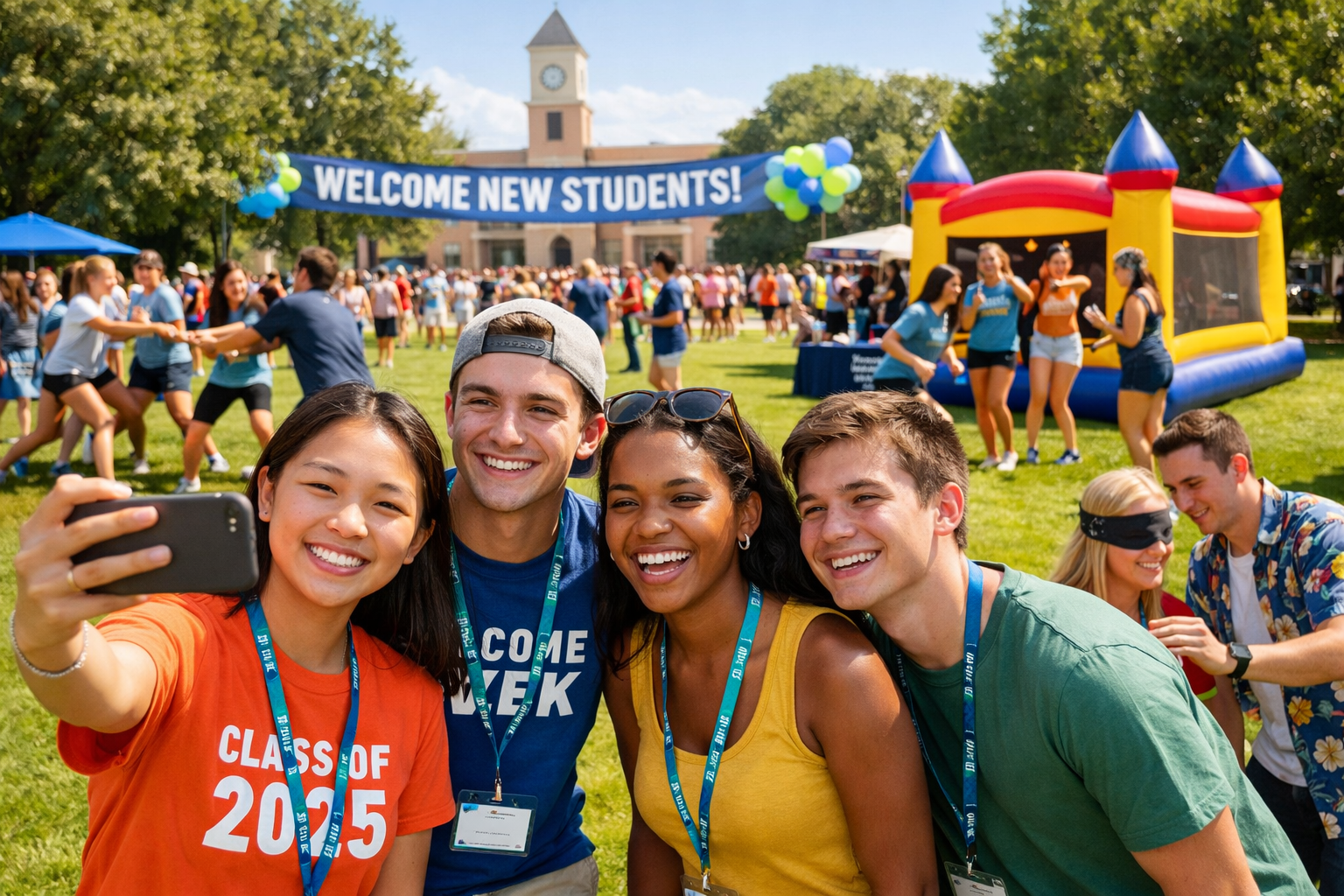
Leverage Week of Welcome Programming
The first weeks of the semester represent a critical window. Students arrive open to new experiences, actively seeking connection. Institutions that capitalize on this moment set the foundation for year-long engagement.
Effective Week of Welcome (WOW) programs share several characteristics:
Peer-led activities. Students connect more readily with other students than with administrators.
Low-pressure social events. Not everything needs to be an information session.
Repeated exposure opportunities. One event isn't enough; students need multiple chances to find their fit.
Clear pathways to ongoing involvement. Welcome Week should funnel into clubs, organizations, and sustained programming.
What sets high-performing WOW programs apart:
At institutions with strong first-year retention, orientation doesn't end after week one. These schools schedule "WOW Part 2" programming in weeks 3-4, when homesickness peaks and initial friend groups often fracture. They assign peer mentors who check in personally—not just mass-email—with their mentees through midterms.
The mistake many campuses make is treating orientation as a discrete event rather than a launchpad. When Week of Welcome ends and programming drops off, newly enrolled students lose momentum.
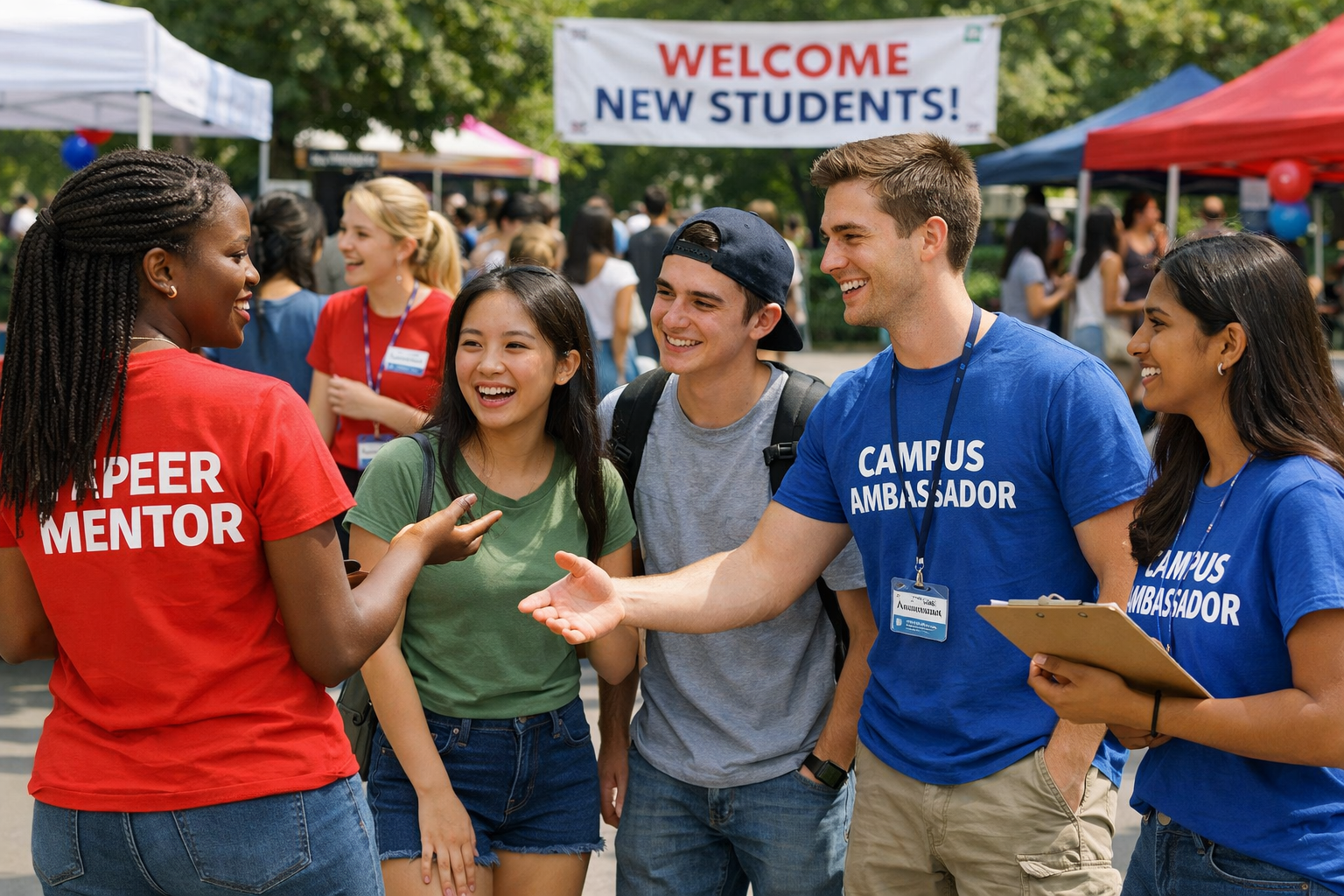
Peer Ambassadors: Your Most Effective Connectors
Students trust other students. Peer ambassador programs leverage this reality to extend institutional reach and create authentic connection points.
Effective peer ambassador models go beyond campus tours. Consider training student ambassadors to:
Facilitate small-group discussions during orientation and throughout the semester
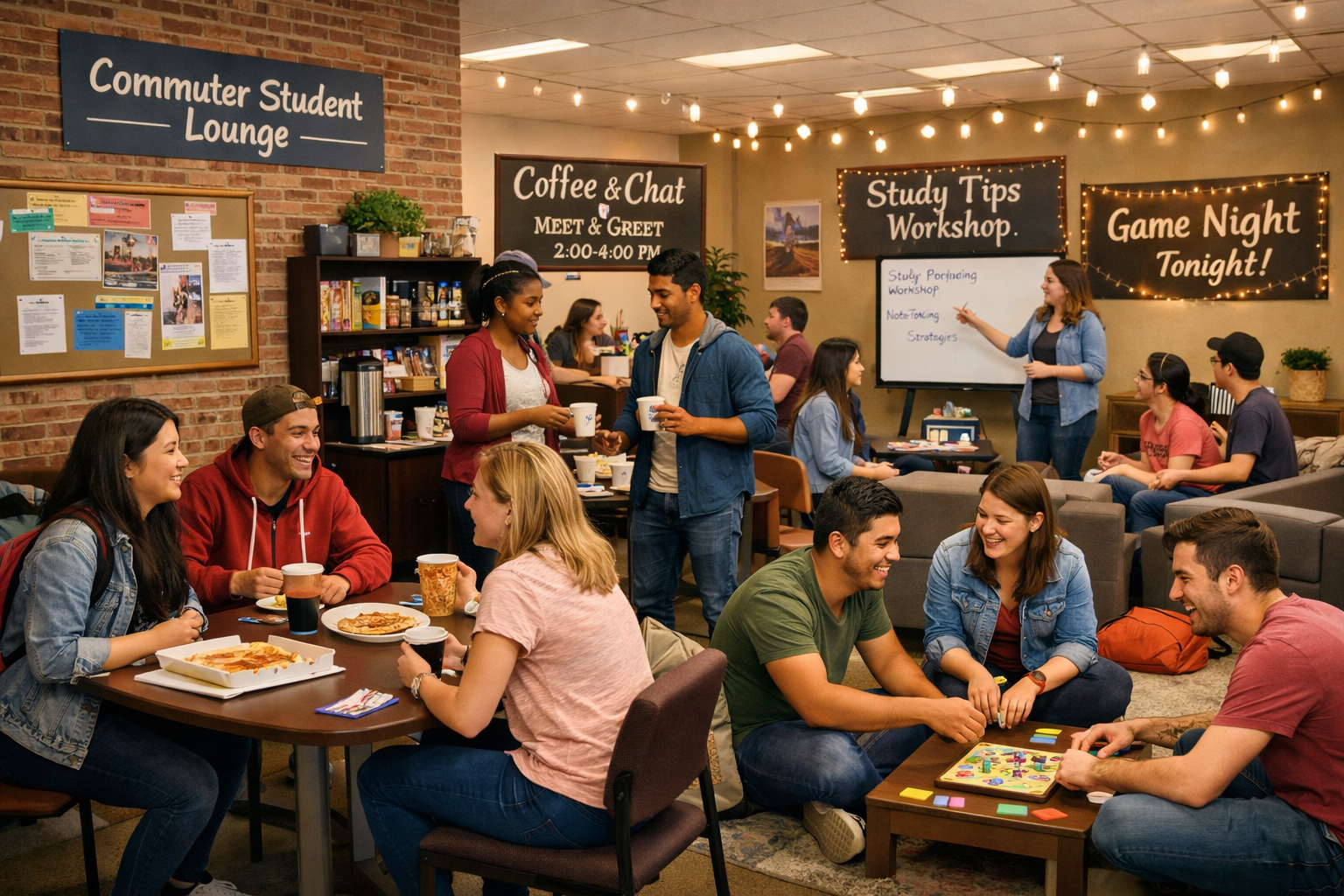
Host informal gatherings in residence halls or commuter lounges
Conduct personal outreach to students who seem disengaged
Represent diverse backgrounds so all students see themselves reflected
Research from the American College Personnel Association demonstrates that peer mentoring programs improve retention, academic performance, and sense of belonging [8]. The key is selecting ambassadors who genuinely care about helping others succeed—and training them with specific skills rather than assuming enthusiasm is enough.
Training Peer Ambassadors for Real Impact
Untrained ambassadors often default to surface-level check-ins ("How's it going?") that don't build genuine connection. Effective training includes:
Specific conversation skills:
How to ask open-ended follow-up questions
How to recognize and respond to signs of distress
How to make warm handoffs to professional resources
How to facilitate introductions between students who might click
Practical scenarios:
What to do when a student says "I'm fine" but clearly isn't
How to include a student sitting alone at an event
How to follow up after a student misses several meetings
Ongoing support:
Weekly debriefs with professional staff
Clear escalation protocols for concerning situations
Recognition and compensation for their labor
Peer ambassadors also serve as early warning systems. They notice when a student stops showing up, seems withdrawn, or expresses thoughts about leaving. Institutions that empower ambassadors to flag concerns create informal intervention networks that catch students before they fall away.
Cross-Campus Collaborations That Work
Siloed programming limits reach. When student affairs, academic departments, athletics, residence life, and multicultural centers each run separate events, students receive fragmented messages and institutions duplicate effort.
Cross-campus collaboration creates events with broader appeal and deeper impact. Examples include:
Academic-social hybrids. A psychology department lecture followed by small-group discussion and refreshments combines intellectual engagement with social connection.
Living-learning community events. Programming that bridges residential and academic experiences reinforces belonging on multiple dimensions.
Cultural celebrations with educational components. Events honoring diverse backgrounds attract varied audiences while building cross-cultural understanding.
Athletic event tie-ins. Pre-game gatherings, watch parties, and team meet-and-greets leverage school spirit for community-building.
Breaking Down Silos: Operational Strategies
The logistical challenge is coordination. Effective collaboration requires:
Shared infrastructure:
A unified campus events calendar visible to all departments
Joint planning committees that meet monthly (not just at semester start)
Shared budget codes that allow departments to co-sponsor without bureaucratic friction
Incentive alignment:
Include "collaborative programming" as a metric in departmental reviews
Create small grants specifically for cross-departmental events
Publicly recognize successful partnerships in campus communications
Communication protocols:
Designate a single point person in each unit for event coordination
Establish a shared Slack channel or Teams group for real-time coordination
Schedule post-event debriefs to capture lessons learned
One large state university created a "Collaboration Catalyst" role—a half-time position whose sole job is facilitating partnerships between departments. Within one year, cross-departmental events increased by 40%, and student satisfaction with programming rose measurably.
Volunteer and Service Opportunities as Connection Points
Service-learning and volunteer programming offer unique advantages for community-building. Students engaged in shared purpose form bonds quickly, and the experience connects them to the broader local community as well.
Volunteer opportunities work particularly well for students who find purely social events uncomfortable. The focus on a task—packing food boxes, tutoring children, cleaning up a park—takes pressure off small talk while creating natural conversation opportunities.
Institutions can maximize impact by:
Partnering with local nonprofits for ongoing service relationships rather than one-off events
Integrating service into academic courses through service-learning requirements
Creating student-led service organizations that provide leadership development alongside community connection
Recognizing service participation through transcript notation, awards, or public acknowledgment
Alternative Break Programs: Intensive Community Building
Alternative break programs, where students travel together for service projects during school breaks, are particularly effective for building tight-knit communities. Students who spend a week working alongside peers return to campus with ready-made friend groups.
These programs work because they combine:
Shared purpose that transcends social backgrounds
Extended time together that allows relationships to deepen
Structured reflection that helps students process the experience
Follow-up programming that maintains connections after the trip
Even students who arrive as strangers often describe alternative break peers as "family" by trip's end. The intensity of shared service creates bonds that classroom interactions rarely match.
10 Low-Barrier Event Ideas That Actually Work
Campus leaders often struggle to translate strategy into specific programming. Here are ten event formats that consistently drive meaningful connection while remaining accessible and affordable:
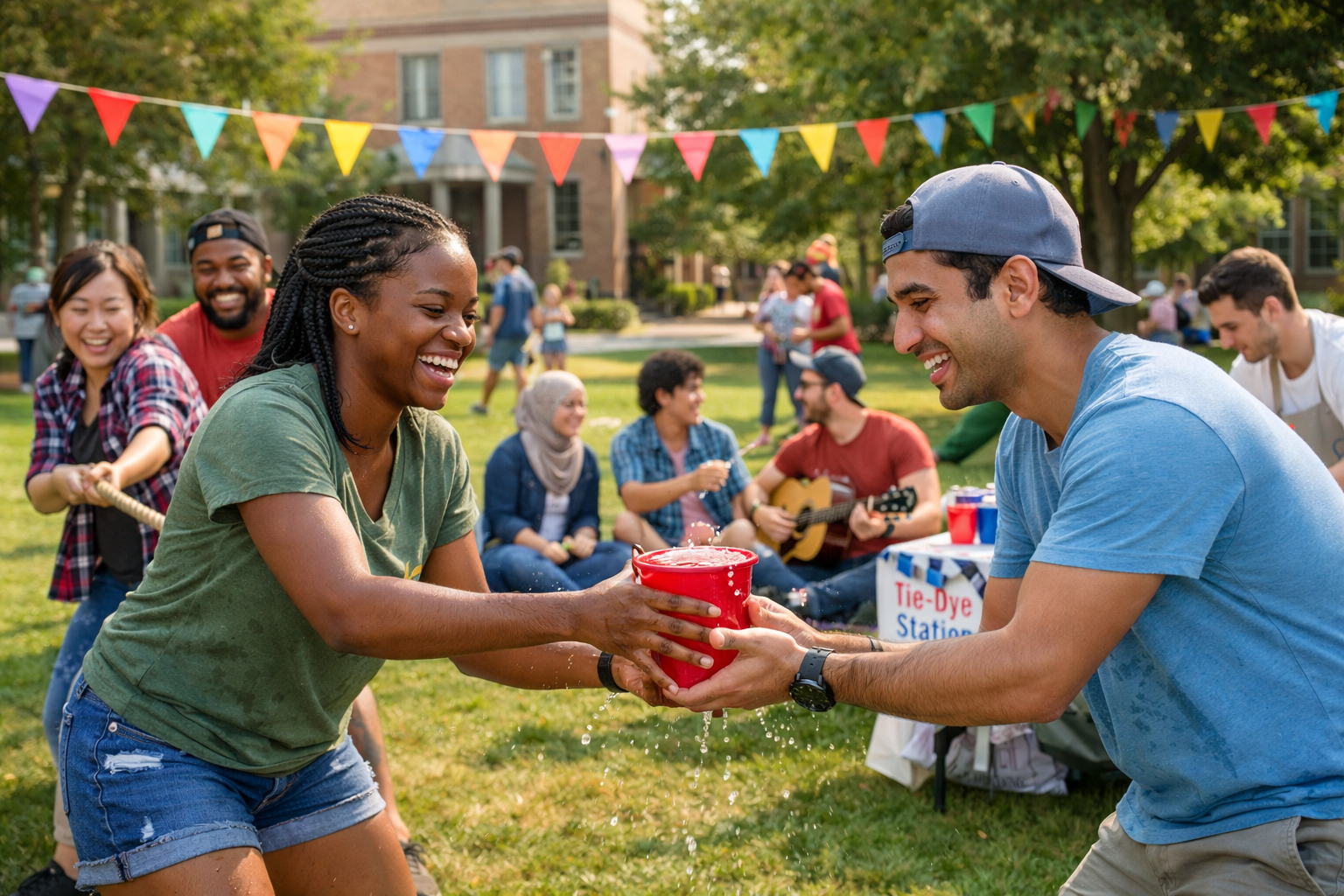
"Mug Club" Coffee Hours: Weekly drop-in sessions in the commuter lounge where students bring their own mug for free coffee and conversation. No agenda, no registration—just a welcoming space.
Midnight Breakfast During Finals: Free pancakes served by administrators and faculty from 10 PM-midnight during finals week. The role reversal creates memorable moments.
"Finish the Puzzle" Community Tables: Large jigsaw puzzles set up in the student union that anyone can work on between classes. Creates low-pressure interaction with strangers.
Major Mixers: Monthly events pairing students from different majors who share career interests (e.g., pre-law students from political science, philosophy, and English).
Walking Groups: Faculty or staff-led walking groups that explore campus or nearby trails. Physical activity plus conversation in a non-threatening format.
Cultural Kitchen: Students from different backgrounds teach each other to cook dishes from their home cultures. Food plus skill-sharing plus storytelling.
Study Buddy Matching: Structured program pairing students in the same courses who might not otherwise connect, with initial in-person meetups facilitated by staff.
"Pet a Dog" Stress Relief: Therapy dogs in high-traffic areas during peak stress periods. Students naturally cluster, share stories, and connect.
Commuter Car Wash: Free car washing for commuter students, staffed by residential students and peer mentors. Creates interaction between populations that rarely mix.
Faculty Office Hours—But Make It Social: Professors host office hours in the campus coffee shop, inviting any student to join for casual conversation, not just academic questions.
Reaching Students Who Don't Show Up
The students most at risk for isolation are often the hardest to reach through traditional event promotion. They've already disengaged from email, skip the involvement fairs, and don't see posters in the buildings they rarely enter.
Reaching these students requires different strategies:
Meet Them Where They Are
Instead of expecting isolated students to come to programming, bring programming to them. Pop-up events in dining halls, study sessions in the library, or coffee carts in high-traffic areas lower the barrier to participation.
For commuter students, consider programming that bookends their class schedules—breakfast gatherings before morning classes or quick connections between back-to-back courses. A "Commuter Connection Station" with coffee, phone chargers, and comfortable seating near parking structures can become an organic gathering space.
Personalize Outreach
Mass communication fails because it feels impersonal. When a student receives a targeted invitation—especially from a peer or a staff member who knows their name—they're more likely to engage.
Data-informed outreach strategies:
Identify students whose dining hall swipes have dropped significantly
Flag students whose class attendance has declined (where tracked)
Note students who haven't logged into any campus engagement systems recently
Partner with faculty to identify students who seem withdrawn in class
A personal check-in that includes an invitation to an upcoming event feels different than a mass email blast. "Hey, I noticed you haven't been around the dining hall as much. There's a waffle bar event this Thursday—would be great to see you there."
Create Lower-Stakes Entry Points
Some students avoid events because they feel like too much commitment. They worry about not knowing anyone, about awkward silences, about being stuck somewhere uncomfortable.
Lower-stakes events reduce this anxiety:
A 15-minute coffee break is easier to commit to than a two-hour program
A "bring a friend" promotion makes attendance feel less risky
Drop-in formats allow students to arrive and leave on their own terms
Activity-focused events (crafts, games, cooking) give students something to do with their hands, reducing social pressure
Once students have one positive experience, they're more likely to try another. The goal is breaking the inertia of isolation.
Measuring What Matters
Effective community-building requires more than good intentions. Campus leaders need data to understand what's working, what's falling flat, and who's still being missed.
Attendance numbers tell only part of the story. More meaningful metrics include:
| Metric | What It Measures | How to Track |
| Repeat participation rate | Are students coming back, or just trying things once? | Card swipes, app check-ins, or manual sign-ins across events |
| Cross-event attendance | Are students exploring different types of programming? | Link sign-in data across event categories |
| Demographic representation | Do attendees reflect campus diversity? | Compare event demographics to overall enrollment |
| Net Promoter Score (NPS) | Would attendees recommend this event to peers? | Brief post-event surveys (1-2 questions max) |
| Self-reported belonging | Do engaged students feel more connected? | Correlate event participation with belonging survey items |
| Retention correlation | Are engaged students persisting at higher rates? | Match engagement data with enrollment records |
Building Tracking Infrastructure
Many institutions lack systems that track participation and connect it to student outcomes, relying instead on sign-in sheets that never get analyzed. Investing in engagement tracking can illuminate patterns that inform smarter programming decisions.
Starting points:
Use student ID swipes at events to capture attendance automatically
Implement a simple engagement platform that logs participation across programs
Partner with institutional research to correlate engagement data with retention outcomes
Create dashboards that surface trends for programming staff
The goal isn't surveillance—it's understanding. Which populations are underrepresented at events? Which event formats generate the most repeat attendance? Which students who attend early-semester programming stop showing up by October? These patterns inform intervention.
The ROI Case for Administrators
For campus leaders managing tight budgets, community-building programming might seem like a nice-to-have rather than a priority. The data tells a different story.
Student attrition is expensive. When a student leaves, the institution loses not just tuition revenue but also housing fees, meal plan income, and years of future enrollment. The cost of recruiting a replacement far exceeds the cost of retaining an existing student [9].
Modeling the Financial Impact
Consider a mid-sized institution with:
5,000 undergraduate students
75% first-year retention rate
$25,000 average net tuition revenue per student
$5,000 cost to recruit each new student
If that institution loses 1,250 students after year one, the direct revenue loss is significant. But the compounding effect matters more: each retained student represents three additional years of tuition, fees, and auxiliary revenue.
If improved event programming helps retain even 2% more students (25 additional students), the preserved revenue over their remaining years at the institution could exceed $1.5 million. Compare that to the cost of a robust programming budget and dedicated staff—the ROI becomes clear.
Beyond direct financial returns, engaged students become better ambassadors. They refer friends, leave positive reviews, and return as donors after graduation. The community-building work done today creates institutional advocates for decades to come.
Getting Started: Practical Next Steps
Transforming campus event strategy doesn't require massive budgets or multi-year plans. Campus leaders can begin making progress immediately with focused action.
This week:
Audit current event offerings for accessibility barriers (timing, location, cost)
Identify one underserved population (commuters, transfer students, etc.) and brainstorm targeted programming
Connect with student ambassadors or RAs to gather ground-level insights on what students actually want
This month:
Convene a cross-departmental planning group to coordinate event calendars
Launch at least one new low-barrier, high-connection event from the list above
Establish baseline metrics for engagement tracking (even if just manual sign-ins for now)
This semester:
Implement systematic follow-up for students who attend events
Train peer ambassadors in facilitation and outreach skills
Analyze attendance data for patterns and gaps
Create "WOW Part 2" programming for weeks 3-4 to sustain early momentum
The goal isn't perfection. It's progress—incremental improvements that compound over time into a genuinely connected campus community.
Building Belonging as Institutional Strategy
Social isolation on college campuses isn't inevitable. It's the result of systems that weren't designed with connection as a priority—and it can be addressed through intentional, evidence-based programming.
When institutions treat community-building as strategic infrastructure rather than extracurricular afterthought, they create environments where all students can find their place. Campus events become more than entertainment; they become retention tools, wellbeing interventions, and equity initiatives rolled into one.
The students eating alone in dining halls, scrolling through phones in empty dorm rooms, and wondering if they belong—they're waiting for someone to create the conditions for connection. The opportunity to reach them through meaningful campus events is significant.
Ready to explore how data-driven engagement strategies can help your institution build community and improve retention? Book a call with CampusMind to learn how we're helping campuses create connected student experiences.
Frequently Asked Questions
How can we engage students who never attend campus events?
Meet disengaged students where they already are rather than expecting them to come to you. Pop-up programming in dining halls, libraries, and high-traffic spaces removes the barrier of seeking out events. Personalized outreach from peers or staff who know the student's name dramatically increases the likelihood of attendance. Start with low-commitment, drop-in formats—a 15-minute coffee break feels less risky than a two-hour scheduled program. Once students have one positive experience, they're more likely to try another.
What makes Week of Welcome programming effective for long-term belonging?
The most effective WOW programs create clear pathways from orientation events into ongoing involvement opportunities. Rather than front-loading all programming in the first week and then dropping off, successful institutions sustain momentum with continued events throughout the first semester—particularly in weeks 3-4 when homesickness peaks. Peer-led activities, repeated exposure to different organizations, and personal follow-up from mentors help students find their fit before isolation sets in.
How do we measure whether campus events actually reduce isolation?
Move beyond simple attendance counts to metrics that capture meaningful connection. Track repeat participation rates—are students coming back? Monitor cross-event attendance—are students exploring different types of programming? Survey attendees about their sense of belonging and correlate responses with event participation. Most importantly, partner with institutional research to analyze whether engaged students persist at higher rates than their less-involved peers. This correlation demonstrates retention impact.
What role do peer ambassadors play in combatting social isolation?
Peer ambassadors extend institutional reach through trusted student-to-student relationships. They can facilitate small-group interactions, conduct personal outreach to disconnected students, and serve as early warning systems when someone seems to be struggling. The key is training ambassadors with specific facilitation and intervention skills—not assuming enthusiasm alone is sufficient. Effective programs teach conversation techniques, provide escalation protocols, and offer ongoing supervision so ambassadors feel supported in their role.
How can we build community for commuter students specifically?
Commuter students face unique barriers including limited time on campus and fewer organic interaction opportunities. Effective strategies include programming that bookends their class schedules (coffee hours before morning classes, grab-and-go events between afternoon sections), dedicated commuter lounges with regular programming, and peer connections with other commuters who understand their experience. Virtual event options and a commuter-specific identity—perhaps a branded program or recognition—help these students feel like full campus members rather than visitors.
About CampusMind
CampusMind was founded to transform how colleges support student success—recognizing that wellbeing, belonging, and engagement are inseparable from academic achievement. Our team combines expertise in behavioral science, higher education administration, and technology design to create solutions that meet students where they are. We work directly with campus partners through collaborative pilot programs, applying research-backed approaches to real institutional challenges. Every recommendation in our content reflects both published evidence and practical experience helping colleges build connected campus communities.
Works Cited
[1] Astin, A.W. — "Student Involvement: A Developmental Theory for Higher Education." Journal of College Student Development.
https://www.middlesex.mass.edu/ace/downloads/astininv.pdf
[2] National Survey of Student Engagement — "Engagement Insights: Survey Findings on the Quality of Undergraduate Education."
https://nsse.indiana.edu/
[3] Tinto, V. — "Dropout from Higher Education: A Theoretical Synthesis of Recent Research." Review of Educational Research.
https://journals.sagepub.com/doi/10.3102/00346543045001089
[4] Healthy Minds Network — "Healthy Minds Study Annual Report." https://healthymindsnetwork.org/research/data-for-researchers/
[5] Arnett, J.J. et al. — "Emerging Adults' Mental Health During COVID-19." Journal of American College Health. https://www.tandfonline.com/journals/vach20
[6] Strayhorn, T.L. — "College Students' Sense of Belonging: A Key to Educational Success for All Students." Routledge.
https://www.routledge.com/College-Students-Sense-of-Belonging/Strayhorn/p/book/9781138238558
[7] Pettigrew, T.F. & Tropp, L.R. — "A Meta-Analytic Test of Intergroup Contact Theory." Journal of Personality and Social Psychology. https://psycnet.apa.org/record/2006-07099-004
[8] American College Personnel Association — "The Role of Peer Education Programs in Student Success." https://www.myacpa.org/
[9] Ruffalo Noel Levitz — "Cost of Recruiting an Undergraduate Student Report." https://www.ruffalonl.com/papers-research-higher-education-fundraising/