
When student attrition costs the average four-year institution over $15,000 per lost student in foregone tuition alone, campus leaders can't afford to overlook any factor that influences whether students stay and succeed [1]. Nutrition is one of those factors—and the research connecting dietary quality to cognitive function, mental health, and academic outcomes is increasingly difficult to ignore.
Nearly one in four first-time college students drops out before their second year [2]. While the causes are complex, food insecurity and poor nutrition create measurable barriers to the academic performance, mental wellness, and sense of belonging that keep students enrolled.
This article examines what the evidence says about nutrition's impact on student success—and what campus leaders can do about it.
Key Takeaways
Research consistently links dietary quality to cognitive function, mental health, and academic achievement
Approximately one in three college students experiences food insecurity, creating significant barriers to retention
Campus nutrition programs—from flexible meal access to cooking workshops—can measurably support student outcomes
Strategic, evidence-based interventions don't require unlimited budgets to create meaningful change
What the Research Says About Nutrition and Student Performance
The connection between nutrition and brain function isn't speculation—it's documented science with direct implications for retention strategy.
A comprehensive study published in the International Journal of Environmental Research and Public Health found that students who consumed breakfast regularly and maintained balanced diets demonstrated significantly better academic performance than peers with poor dietary habits [3]. The relationship held true across demographic groups and institution types.
The mechanism is straightforward: the brain consumes roughly 20% of the body's energy despite representing only about 2% of body weight [4]. When students skip meals or rely on highly processed foods, they're essentially asking their brains to operate on inadequate fuel—during the very activities (lectures, studying, exams) that determine academic success.
The Cognitive Connection
Specific nutrients play measurable roles in cognitive function:
Omega-3 fatty acids support memory consolidation and information processing [5]
Iron deficiency—common among college-aged women—is associated with reduced attention span and slower cognitive processing [6]
Complex carbohydrates provide steady glucose release, supporting sustained concentration during lectures and study sessions [7]
For campus leaders, this translates to a practical reality: students who eat well are better positioned to engage academically. A bowl of oatmeal before an 8 AM class isn't just comfort food—it's strategic fuel for learning.

Nutrition and Mental Health: The Often-Overlooked Link
The diet-mental health connection deserves particular attention given the documented mental health challenges on college campuses. Research published in Nutritional Neuroscience demonstrates that dietary patterns characterized by high intake of fruits, vegetables, whole grains, and lean proteins are associated with lower rates of depression and anxiety among young adults [8].
Over 60% of college students meet criteria for at least one mental health problem during their studies [9]. When mental health suffers, academic performance typically follows. Students experiencing depression or anxiety often struggle with:
Concentration and memory recall
Motivation and class attendance
Sleep quality, which further compounds cognitive difficulties
Supporting better nutrition isn't a replacement for mental health services—but it's a meaningful complement that institutions can actively promote as part of holistic student wellbeing initiatives.
The Food Insecurity Problem Hiding in Plain Sight
Before implementing solutions, institutions must acknowledge a significant barrier: many students simply don't have consistent access to nutritious food.
The Hope Center for College, Community, and Justice has documented that approximately 33% of students at four-year institutions experience food insecurity [10]. Among community college students, rates climb even higher.
Food-insecure students face a cycle that directly undermines retention:
Limited access to nutritious food
Reduced cognitive function and energy
Lower academic performance
Increased stress and anxiety
Higher likelihood of dropout
For institutions serious about retention, nutrition interventions aren't luxury programming—they're essential support infrastructure that addresses a documented barrier to student success.
Campus Programs That Support Student Outcomes
Effective campus nutrition initiatives share common characteristics: they're accessible, culturally inclusive, and designed around how students actually live. Here's what moves the needle.
Reimagining Campus Dining Operations
Traditional meal plans often fail students in predictable ways. Limited hours, repetitive options, and lack of nutritional guidance leave many students fending for themselves—often poorly.
Flexible meal access allows students to eat when their schedules permit, not just during narrow dining hall windows. This matters especially for commuter students and those balancing work responsibilities—populations that often face the highest attrition risk.
Transparent nutritional labeling helps students make informed choices without requiring them to become amateur dietitians. Clear, non-judgmental information empowers better decisions at the point of choice.
Diverse, culturally inclusive options ensure that students from all backgrounds can find familiar foods that support both nutrition and connection to their cultural identities. When students can eat well and eat food that feels like home, you remove a barrier to belonging.

Teaching Skills, Not Just Serving Food
Cooking workshops represent one of the highest-impact, lowest-cost interventions campuses can implement.
Students often arrive at college with minimal food preparation skills. They may understand they should "eat healthy," but they don't know how to translate that into actual meals with limited time, equipment, and budget.
Effective campus cooking programs teach:
Basic meal prep techniques requiring minimal equipment
Budget-friendly shopping strategies
Simple recipes that can be prepared in residence hall kitchens
Batch cooking methods that maximize time efficiency
These skills persist long after graduation, creating lifetime value from relatively modest institutional investment. Programs can be delivered through residence life, student organizations, or wellness services—and often attract strong student participation when framed around practical life skills rather than health lectures.
Campus Food Pantries and Emergency Resources
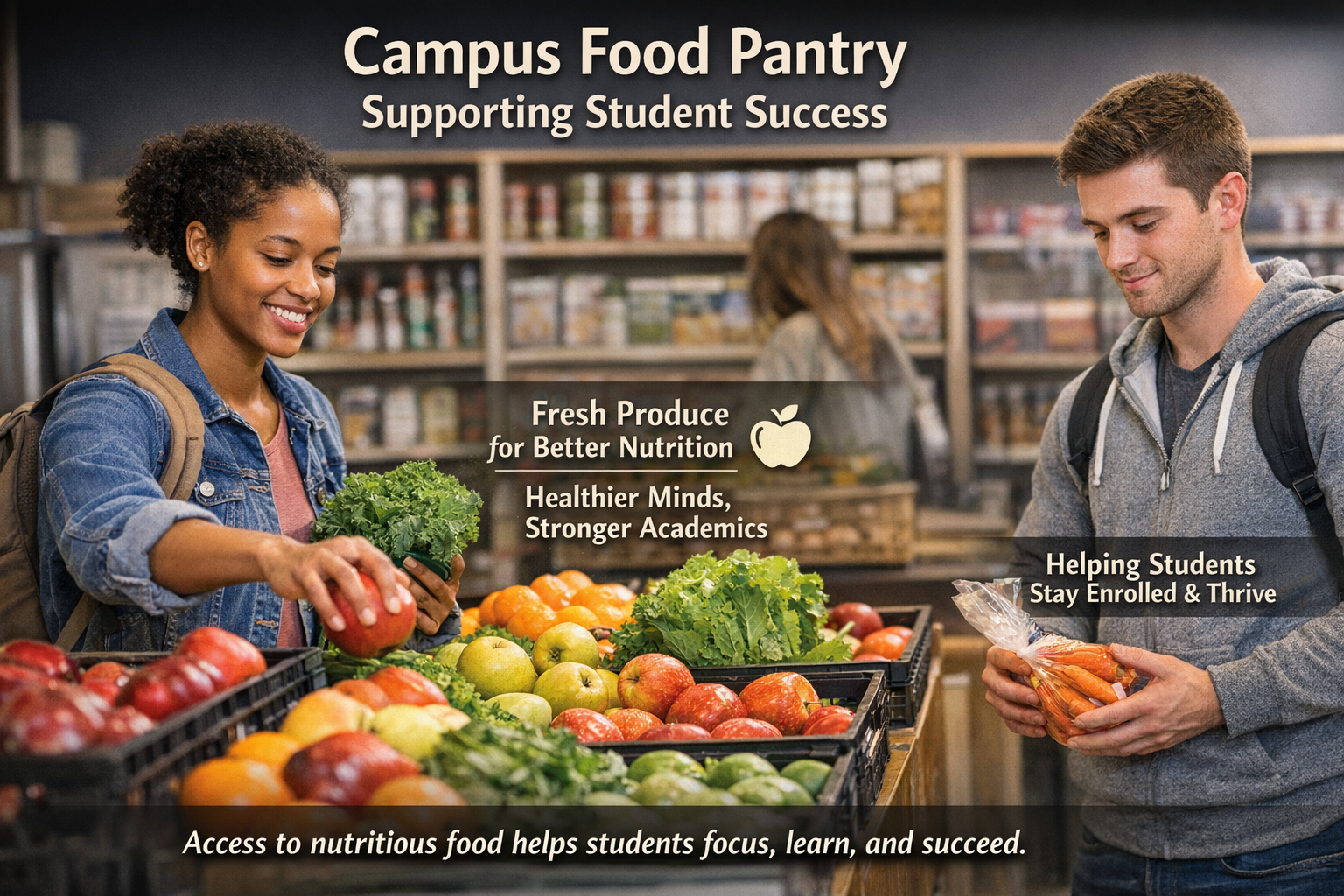
No nutrition education program succeeds when students can't afford food. Campus food pantries have expanded dramatically over the past decade, and for good reason—they address a documented barrier to persistence.
Best practices for campus food pantries include:
Discreet, stigma-free access points that don't require students to identify themselves publicly
Fresh produce alongside shelf-stable items to support actual nutritional quality
Integration with other support services (financial aid, counseling, academic advising) so staff can connect students to comprehensive support
Clear communication so students know resources exist before crisis hits
When students know they can access emergency food support, they're more likely to stay enrolled during difficult periods. This is early intervention in practice.
Practical Implementation Strategies for Campus Leaders
Institutions don't need unlimited budgets to improve student nutrition outcomes. Strategic, evidence-based interventions can create meaningful change. Here's how to approach implementation.
Conducting a Nutrition Landscape Audit
Before launching new programs, understand your current landscape:
Inventory existing dining options: What's available, when, and at what price point? Where are the gaps in hours, locations, or nutritional quality?
Survey students directly: What do students report about food access, quality, and affordability? Which populations report the greatest barriers?
Map existing resources: What food pantries, cooking facilities, or nutrition education already exists? What's utilization like?
Identify connection points: Where do students at risk of food insecurity already touch campus systems (financial aid, academic advising, health services)?
This assessment provides baseline data for measuring improvement and identifies quick wins versus longer-term initiatives.
Building Strategic Partnerships
Nutrition programming shouldn't live in isolation. Effective approaches integrate with existing campus infrastructure:
Health services for students with dietary restrictions, eating concerns, or health conditions affected by nutrition
Academic advising to identify students struggling academically who might benefit from basic needs support
Residence life for targeted programming in living communities, particularly with first-year students during the critical early weeks
Student organizations for peer education, cooking clubs, and community-building around food
Cross-departmental collaboration also helps distribute costs and increases the likelihood that students encounter nutrition support through multiple touchpoints.
Communicating Without Preaching
Students generally don't respond well to nutrition messaging that feels preachy, judgmental, or disconnected from their reality. "Eat more vegetables" isn't actionable advice for a student with $20 to last the week.
Effective communication:
Acknowledges real constraints (time, money, knowledge, access) rather than assuming students simply don't care
Offers specific, achievable suggestions ("Here's a 15-minute meal you can make in a microwave for under $3")
Connects nutrition to outcomes students care about (energy, focus, mood, sleep—not abstract "health")
Avoids shame-based messaging that can backfire and reduce engagement
Measuring What Matters
Track outcomes that connect nutrition programming to institutional priorities:
Program participation rates across different student populations
Student satisfaction with dining services (often already tracked; can be disaggregated)
Food pantry utilization trends (increasing use may indicate better awareness, not worsening need)
Correlation between meal plan participation and academic metrics (GPA, credit completion, retention)
Student feedback on barriers and effectiveness
Data helps justify continued investment and identifies opportunities for improvement. When you can demonstrate that students who engage with nutrition programming show stronger persistence, you build the case for sustained funding.

Building Sustainable Institutional Capacity
Lasting behavior change happens incrementally, not overnight. Students won't transform their eating habits because of a single workshop or informational poster.
Sustainable improvement requires:
Repeated exposure to healthy options and nutrition information across multiple touchpoints
Environmental design that makes nutritious choices easier than unhealthy ones (placement, pricing, availability)
Peer support through student-led initiatives, cooking clubs, and community building around food
Ongoing access to resources when needs arise, not just during orientation week
The goal isn't perfection—it's progress. A student who adds one serving of vegetables daily and eats breakfast before morning classes has made meaningful changes that support their academic success and likelihood of persistence.
Taking Action: Next Steps for Campus Leaders
Nutrition is one piece of the larger student success puzzle, but it's a piece institutions can directly influence. When students have access to nutritious food, understand how eating affects their performance, and possess skills to feed themselves well, they're better positioned to thrive academically and personally—and to stay enrolled.
For immediate action:
Audit your current nutrition landscape to identify gaps and quick wins
Connect with colleagues across student affairs, health services, and residence life to explore partnership opportunities
Review food pantry accessibility and promotion to ensure students know resources exist
For strategic planning:
Evaluate dining services contracts for flexibility, hours, and nutritional quality
Build nutrition education into first-year experience programming
Establish baseline metrics to measure improvement over time
Explore how CampusMind supports holistic student wellbeing
Frequently Asked Questions
What is the correlation between dining hall access and student GPA?
Research consistently shows that students with reliable meal plan access and flexible dining hours demonstrate stronger academic performance. When students can eat regular, nutritious meals that align with their class and work schedules, they maintain more consistent energy levels and cognitive function throughout the day. Institutions that have extended dining hours and increased healthy options report improved student satisfaction and engagement metrics.
How can institutions measure the ROI of nutrition programs?
Track direct metrics like food pantry utilization, meal plan participation rates, and student satisfaction scores. Then correlate these with retention and academic performance data for students who engage with nutrition programming versus those who don't. Factor in the cost of student attrition—typically $15,000+ per lost student in foregone tuition—when calculating return on investment for relatively modest nutrition intervention costs.
What should campuses prioritize when addressing food insecurity?
Start with awareness and accessibility. Many students don't know food pantries exist, and stigma prevents others from using them. Prioritize discreet access points, clear communication through multiple channels, and integration with other support services so staff can make appropriate referrals. Include fresh produce alongside shelf-stable items when possible, and connect food-insecure students with SNAP benefits and other assistance programs.
How does food insecurity affect student retention specifically?
Food-insecure students face compounding challenges: difficulty concentrating in class, increased stress and anxiety, reduced ability to participate in campus life, and lower academic performance. These factors directly correlate with dropout risk. Addressing food insecurity removes a documented barrier to persistence and supports the academic and social engagement that keeps students enrolled.
Can nutrition programs really affect mental health outcomes?
Yes—the research is increasingly clear. Dietary patterns influence gut microbiome composition, which communicates with the brain through the gut-brain axis. Diets high in processed foods, added sugars, and unhealthy fats are associated with elevated depression and anxiety risk, while Mediterranean-style eating patterns show protective effects. Good nutrition supports—but doesn't replace—comprehensive mental health services.
About This Content
This article reflects CampusMind's commitment to supporting holistic student success through evidence-based approaches. Our team synthesizes current research in higher education, student development, and health sciences to provide actionable guidance for campus leaders. We believe that understanding the full picture of what helps students thrive—including often-overlooked factors like nutrition—enables more effective retention strategies and better student outcomes.
Works Cited
[1] Ruffalo Noel Levitz — "Cost of Recruiting an Undergraduate Student Report." https://www.ruffalonl.com/papers-research-higher-education-fundraising/
[2] The Hope Center for College, Community, and Justice — "Basic Needs Insecurity in Higher Education." https://hope.temple.edu
[3] Burrows, T., et al. — "Associations between dietary intake and academic achievement in college students: a systematic review." International Journal of Environmental Research and Public Health. https://www.mdpi.com/journal/ijerph
[4] Raichle, M. & Gusnard, D. — "Appraising the brain's energy budget." Proceedings of the National Academy of Sciences. https://www.pnas.org
[5] Dighriri, I., et al. — "Effects of omega-3 polyunsaturated fatty acids on brain functions: a systematic review." Cureus. https://www.cureus.com
[6] Murray-Kolb, L. — "Iron and brain functions." Current Opinion in Clinical Nutrition and Metabolic Care. https://journals.lww.com/co-clinicalnutrition
[7] Philippou, E. & Constantinou, M. — "The influence of glycemic index on cognitive functioning: a systematic review." Advances in Nutrition. https://academic.oup.com/advances
[8] Firth, J., et al. — "The effects of dietary improvement on symptoms of depression and anxiety: a meta-analysis." Psychosomatic Medicine. https://journals.lww.com/psychosomaticmedicine
[9] CampusMind — "Student Mental Health Statistics." https://www.campusmind.org/about/
[10] The Hope Center for College, Community, and Justice — "Basic Needs Insecurity in Higher Education." https://hope.temple.edu