
For a first-generation student sitting in an introductory lecture hall, the question often isn't about intellectual curiosity. It's a calculation: Will this actually lead somewhere—and is the answer clear enough to justify staying enrolled?
That's not cynicism. It's practical decision-making. When students can't draw a line between today's coursework and tomorrow's career, they start weighing the cost of staying enrolled against the certainty of a paycheck now. For many, that math ends with them walking away.
Career readiness isn't a capstone experience reserved for seniors. It's a retention lever that institutions have significantly underutilized. When students understand how their education connects to meaningful work—and when they can see themselves in professional roles—they stay. They show up. They push through the difficult semesters.
The institutions seeing the strongest retention gains have figured this out. They've stopped treating career services as an afterthought and started integrating professional development from day one.
This guide breaks down what that integration looks like across different student populations, how to build infrastructure that scales, and how to measure whether it's working.
Key Takeaways
Students who see clear career connections to their coursework persist at significantly higher rates
Career education works best when embedded early—not saved for junior and senior year
Different student populations (traditional undergraduates, adult learners, online students) require tailored approaches
Alumni engagement and mentorship programs create belonging alongside professional development
Faculty buy-in requires more than workshops—it requires demonstrating how career integration enhances their teaching
Tracking career-related retention metrics helps justify investment and refine programming
Why Career Clarity Drives Student Retention
The conventional wisdom once held that students come to college for knowledge, personal growth, and the "college experience." Career preparation was supposed to happen organically, somewhere between graduation and the real world.
That model no longer matches student expectations or economic realities.
According to research from the National Student Clearinghouse Research Center, roughly one in four first-time students don't return for their second year [1]. When researchers examine why students leave, career uncertainty consistently emerges as a top factor—particularly for students from lower-income backgrounds and those who are first in their families to attend college.
A 2023 survey by the Association of American Colleges and Universities found that 87% of employers want colleges to place more emphasis on career preparation, while students increasingly report feeling unprepared for the workforce despite completing their degrees [2]. This disconnect creates a dangerous gap: students invest time and money without confidence that the investment will pay off.
The retention connection is direct. When students can articulate how their major leads to specific career paths, when they've had professional experiences that validate their choices, and when they've built relationships with working professionals in their fields—they persist.
Georgia State University's holistic student success initiatives, which include early career advising, contributed to a 23-percentage-point increase in graduation rates over a decade [3]. One specific mechanism they used: predictive analytics to identify students who reached certain credit thresholds without a declared major or clear career direction, triggering proactive advising outreach before those students disengaged.
The Problem with Career Services as an Afterthought
Most colleges still treat career development as a senior-year sprint. Students spend three years focused on coursework, then face a frantic few months of résumé workshops, career fairs, and interview prep before graduation.
This approach fails students in several concrete ways.
It's too late to influence major decisions. By senior year, students are locked into their academic paths. If they've chosen a major that doesn't align with their career interests—or worse, if they still have no idea what they want to do—the window for exploration has largely closed.
It misses the students who leave early. The students most at risk of dropping out often never make it to senior year. If career services primarily serve upperclassmen, the intervention comes after the attrition has already happened.
It reinforces the theory-practice divide. When career development exists in a separate silo from academic instruction, students internalize the message that coursework and careers are unrelated. They can't answer the question "Why does this class matter?" because no one has connected those dots.
It ignores how professional identity develops. Professional identity doesn't emerge overnight. Students need repeated exposure to career possibilities, role models, and professional environments to develop a clear sense of who they want to become. A single career fair can't accomplish what sustained engagement over four years can.
Integrating Career Development from Day One
What does it look like to weave professional development throughout the student experience? Here's a framework that moves beyond the traditional career services model.
First-Year Foundations: Building Career Curiosity
The first year is about exploration, not commitment. Students need permission to be uncertain while also developing tools to navigate that uncertainty productively.
First-year seminars with career components. Many institutions now include career exploration modules in required first-year courses. These aren't full career planning curricula—they're introductions. Students might complete interest inventories, research three potential career paths, or interview a professional in a field they're curious about.
Early advising conversations. Academic advisors who ask "What do you want to do after college?" in the first meeting—and who can connect majors to career outcomes—help students see their education as purposeful from the start. This requires training advisors to think beyond course requirements.
Alumni panels during orientation. Bringing recent graduates back to campus during orientation week accomplishes two things: it shows new students that people like them have succeeded, and it introduces the concept that college leads somewhere specific. Panels work best when alumni represent diverse paths—not just traditional corporate routes, but graduate school, entrepreneurship, nonprofit work, and careers students might not have considered.
Career exploration assignments in general education courses. A composition class might ask students to write a professional biography for their future selves. A statistics course might include a unit on how data analysis applies across industries. These small touches don't require redesigning entire curricula—they require intentional connections.

Mid-Degree Retention Strategies: Internships and Experiential Learning
The sophomore and junior years are where career development transitions from exploration to experiential learning.
Internship and co-op programs. Students who complete internships persist at higher rates and report greater satisfaction with their education [4]. But access to internships isn't equal—first-generation students and those from lower-income backgrounds often lack the networks and financial flexibility to pursue unpaid opportunities. Institutions serious about retention must address these barriers through funded internship programs, academic credit structures, and employer partnerships.
Undergraduate research with career connections. Research experiences don't just prepare students for graduate school. They build transferable skills—project management, data analysis, professional communication—that employers value. Faculty who help students articulate these connections enhance both the educational and career value of research.
Major-specific professional development. This is where academic departments play a crucial role. Engineering programs might require professional certification prep. Communications majors might build portfolios. Business students might participate in case competitions. The key is making professional development an expected part of the major, not an optional extra.
Mentorship programs. Formal mentorship—whether peer-based, alumni-led, or industry-sponsored—provides students with guides who've navigated similar paths. Mentorship addresses both the practical questions (How do I get an internship?) and the identity questions (Can someone like me succeed in this field?).

Senior Year: Transition Support
By senior year, career development shifts toward transition—but this shouldn't be the first time students encounter these resources.
Career courses for credit. Some institutions now offer credit-bearing career courses that cover job search strategy, salary negotiation, professional networking, and workplace success skills. These courses acknowledge that career readiness is a legitimate area of learning, not just a service.
Employer partnerships and recruiting. Strong relationships with employers who hire graduates create clear pipelines from education to employment. When students can see that companies actively recruit from their institution—and that graduates have succeeded there—the value proposition of staying enrolled becomes concrete.
Graduate school preparation. For students pursuing advanced degrees, senior-year support includes application guidance, faculty recommendations, and connections to graduate programs. This is particularly important for students from backgrounds underrepresented in graduate education, who may lack family knowledge of the process.
Career Integration for Non-Traditional and Online Students
The framework above assumes a traditional residential student timeline. But adult learners, online students, and part-time students often have different needs and constraints that require adapted approaches.
Adult learners typically come to higher education with existing work experience and clearer career goals. For this population, career integration means:
Helping them articulate and document skills they already have
Connecting coursework explicitly to advancement in their current field or transition to a new one
Offering flexible scheduling for career events (evening workshops, virtual panels)
Recognizing that their "why am I here?" question often centers on credentialing and advancement rather than exploration
Online students face unique barriers to career engagement:
They may never set foot on campus, limiting access to career fairs and networking events
Geographic distance from the institution may mean employer partnerships don't translate to their job markets
Virtual career programming (remote informational interviews, online alumni mentorship, virtual job shadows) becomes essential rather than supplemental
Part-time and commuter students often balance school with significant work and family responsibilities:
Career services hours that assume a 9-5 campus presence don't work for them
Integrating career development into required courses ensures they encounter it
Recognizing that they may already be building professional experience through their jobs—the institution's role becomes helping them connect that experience to their degree
Institutions that serve large populations of non-traditional students cannot simply replicate traditional career services models. The career-retention connection still holds, but the delivery mechanisms must adapt.
Building Faculty Buy-In for Career Integration
One of the most common obstacles to career integration is faculty resistance. Some faculty view career preparation as vocational encroachment on liberal education. Others simply don't see it as their responsibility.
Workshops alone rarely change minds. What works:
Show how career integration enhances teaching outcomes. When faculty see that students are more engaged in coursework because they understand its relevance to their futures, resistance often softens. Critical thinking, communication, and ethical reasoning are both liberal arts outcomes and career competencies. Help faculty see this isn't an either/or.
Start with willing partners. Rather than mandating career integration across all departments, identify faculty who are already doing this work and celebrate their approaches. Their colleagues' examples are more persuasive than administrative directives.
Create "Career Champion" roles within departments. Designate faculty members who serve as liaisons between academic departments and career services. These faculty can help translate career center resources into discipline-specific applications and bring employer insights back to curriculum conversations.
Reduce the burden. Faculty are stretched thin. If career integration feels like additional work, adoption will be limited. Provide plug-and-play modules, guest speaker coordination, and assignment templates that make integration easy.
Connect to outcomes faculty care about. Faculty generally want students to succeed after graduation. Framing career integration as serving that goal—rather than as a distraction from academic rigor—changes the conversation.
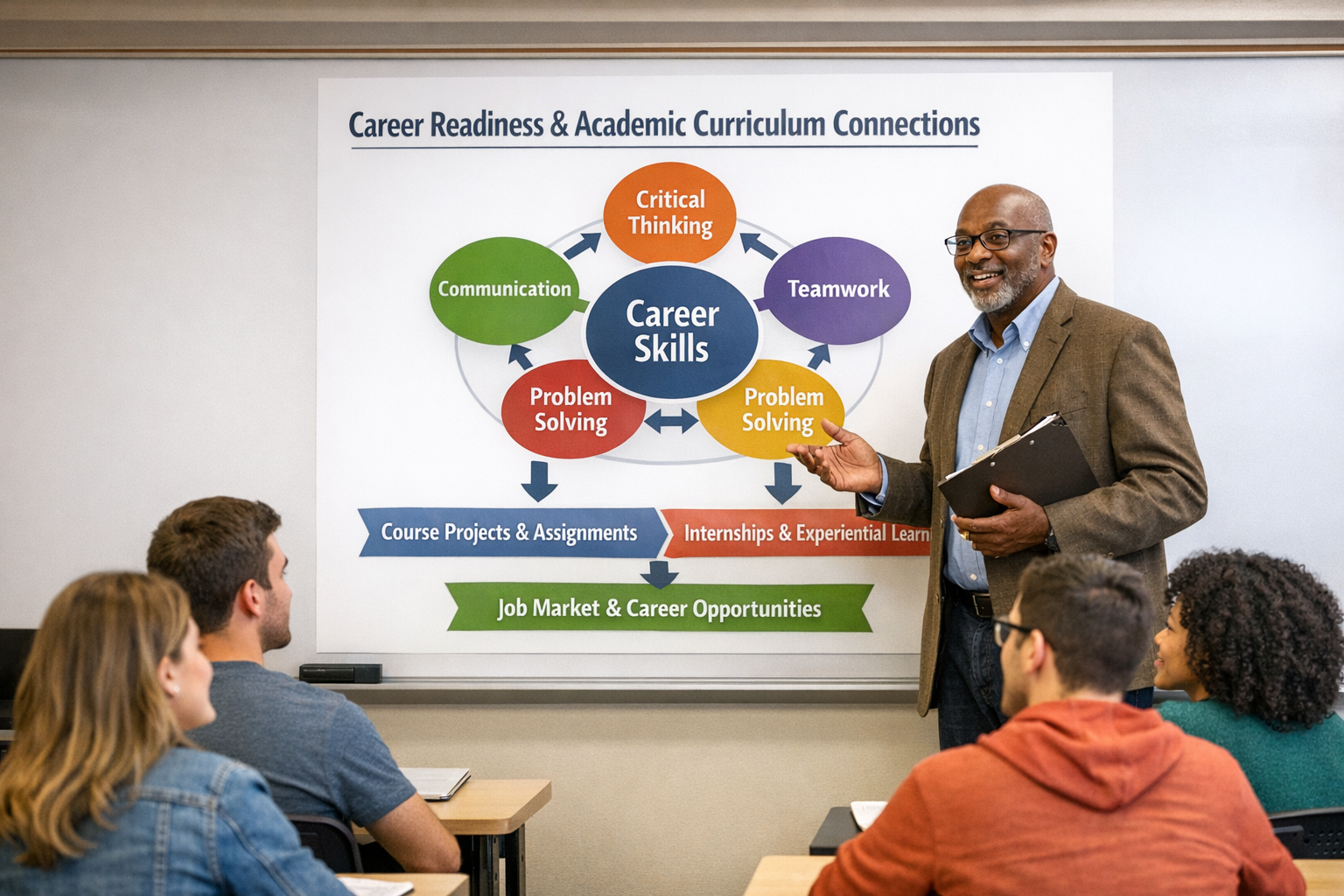
Building Career Readiness Infrastructure That Scales
Individual programs matter, but sustainable career integration requires infrastructure.
Cross-Departmental Collaboration
Career development can't live solely in the career center. Academic affairs, student affairs, advising, and employer relations must work together. This means:
Shared goals and metrics around career outcomes
Regular communication between career staff and faculty
Joint programming that brings career professionals into academic spaces
Career center staff who understand academic programs and can speak to curriculum
Technology and Data Systems
Tracking career engagement requires systems that capture student participation across programs. Modern career platforms can track:
Which students have completed career assessments
Internship participation by major, year, and demographic group
Alumni mentorship matches and engagement
Employment outcomes after graduation
This data enables targeted outreach to students who haven't engaged with career resources—the students most at risk of feeling disconnected from their educational purpose.
Employer Engagement Strategy
Employers who want to hire your graduates are natural partners in retention. Engaged employers might:
Sponsor internships and co-ops
Provide guest speakers and site visits
Offer informational interviews for students exploring career paths
Participate in advisory boards that inform curriculum
The key is treating employer relationships as educational partnerships, not just recruiting transactions.

Measuring Career Education's Impact on Retention
Any retention strategy requires measurement. Here's how to track whether career integration is working.
Leading Indicators
These metrics capture engagement before retention outcomes are known:
Career resource utilization rates: What percentage of first-year students engage with career services? How does this differ by student population?
Career assessment completion: Are students developing self-knowledge about their interests and strengths early?
Alumni mentorship participation: How many students are matched with mentors, and how active are those relationships?
Internship and experiential learning participation: Track by year, major, and demographic group to identify gaps.
Lagging Indicators
These metrics measure outcomes:
First-to-second-year retention by career engagement: Do students who participate in career programming return at higher rates?
Graduation rates by career engagement: Does career program participation correlate with degree completion?
Post-graduation employment and satisfaction: Are graduates employed in their fields? Are they satisfied with their career preparation?
Alumni giving and engagement: Graduates who feel well-prepared often become engaged alumni—a long-term indicator of program success.
Attribution Challenges
Correlation isn't causation. Students who engage with career services might be more motivated generally, which could explain both their career engagement and their persistence. Rigorous evaluation requires:
Comparison groups and quasi-experimental designs
Control for prior academic performance and demographic factors
Qualitative data on why students found career programs valuable
Longitudinal tracking to distinguish short-term and long-term effects
Case Studies: Career-Focused Retention in Action
Northeastern University built its identity around cooperative education, alternating classroom learning with full-time work experiences. Students complete up to three co-ops before graduation, creating strong career connections and industry relationships. The model requires significant infrastructure, including dedicated co-op coordinators who match students with employers, prepare them for professional environments, and track outcomes across placements. The result: graduates with substantial work experience and strong employment outcomes [5].
Georgia State University's approach combined predictive analytics with proactive advising. Rather than waiting for students to seek help, advisors received alerts when student behavior patterns suggested disengagement or uncertainty about their path. Career advising was integrated into these conversations early, not reserved for upperclassmen. The specific mechanism: flagging students who reached certain credit thresholds without clear career direction triggered outreach before those students made withdrawal decisions [3].
Purdue University's Gallup research has repeatedly found that students who had an internship, worked on a long-term project, or had a mentor who encouraged their goals report significantly higher wellbeing and engagement after graduation [6]. These experiences don't happen by accident—they require intentional program design, faculty involvement, and institutional commitment to making them accessible across student populations.
Community colleges with strong workforce partnerships—like those in career and technical education programs—often see higher completion rates than more academically-focused counterparts. When students can see a direct line from their program to a specific job, they're more likely to finish [7].
Common Obstacles and How to Address Them
"Students aren't interested in career planning as freshmen."
They are—they just don't always recognize career services as relevant to their immediate needs. Early career programming works best when it's embedded in required courses and framed as exploration, not pressure. First-year students don't need to choose careers; they need to start thinking about possibilities.
"Faculty don't see career preparation as their job."
Some faculty resist what they see as vocational encroachment. The solution isn't to abandon liberal arts values but to show how career development enhances them. Start with faculty who already make these connections, create low-burden integration tools, and frame the work in terms of outcomes faculty care about: engaged students who succeed after graduation.
"We don't have the budget for major career programming."
Start with what's free: alumni willing to volunteer, employer partnerships that provide programming at no cost, and integration into existing courses. Many career initiatives require time and coordination more than money. Tracking outcomes builds the case for future investment.
"Our career center is understaffed."
This is why integration matters. When career development is everyone's job—advisors, faculty, student affairs professionals—the burden doesn't fall solely on an understaffed career center. Technology can also extend reach through online career assessments, virtual employer events, and automated career pathway information.
Your Next Steps
If you're ready to strengthen the connection between career readiness and student retention, start here:
In the next 30 days:
Audit current career engagement by year level. What percentage of students engage with career resources before junior year? Which populations are underserved?
Identify one required first-year course where career content could be added with minimal disruption.
In the next 60 days:
Convene stakeholders from career services, academic advising, and two or three key academic departments to identify shared goals.
Establish baseline metrics for career engagement by student population so you can measure progress.
In the next 90 days:
Pilot an alumni mentorship program with a small cohort—perhaps students in one major or one residence hall.
Document what's working and what needs adjustment before scaling.
Building career-focused retention isn't about adding one more program. It's about weaving career connection throughout the student experience, so students never have to wonder whether their education leads somewhere meaningful.
If you want to explore how student engagement platforms can connect students to career resources and track their progress, schedule a conversation with CampusMind to see how other institutions are approaching this work.
Frequently Asked Questions
How early should career development programming start?
Career exploration should begin during the first year—even during orientation. This doesn't mean pressuring students to choose careers immediately. It means building awareness that college leads to career outcomes and providing tools for ongoing exploration. Research suggests that students who engage with career resources early persist at higher rates than those who wait until junior or senior year.
Does career-focused education undermine liberal arts values?
Not when done thoughtfully. Career readiness and liberal education share common ground: both value critical thinking, communication, ethical reasoning, and lifelong learning. The goal isn't to narrow education to vocational training but to help students see how their education prepares them for meaningful work. Employers consistently report wanting graduates with both technical skills and liberal arts competencies.
How do we reach students who don't engage with career services?
Embedding career content in required courses and advising ensures that all students encounter career development—not just those who self-select into career services. Technology platforms can also identify students who haven't engaged and trigger targeted outreach. The students least likely to visit the career center on their own are often those who would benefit most from early career support.
What's the relationship between career certainty and major choice?
Students don't need to be certain about careers to choose majors, but they do benefit from understanding the range of career paths each major enables. Career advising that focuses on transferable skills and diverse outcomes—rather than narrow vocational tracks—helps students make informed choices while remaining open to possibilities.
How can small institutions with limited resources prioritize career integration?
Start with high-impact, low-cost strategies: alumni mentorship programs, career content in existing first-year seminars, faculty development on career connections, and employer partnerships for guest speakers and site visits. Technology can extend limited staff capacity through online resources and automated career pathway information. Tracking outcomes builds the case for future investment.
Expertise and Trust
CampusMind works at the intersection of student engagement, retention, and career readiness, partnering with colleges and universities to create connected support systems that help students persist through graduation. Our approach combines behavioral science, real-time data, and human-centered design to address the factors that drive student departure—including the career uncertainty that causes too many capable students to question whether college is worth it. We've reviewed the research, learned from institutions leading this work, and built tools that help students see themselves as future professionals from their first semester forward.
Works Cited
[1] National Student Clearinghouse Research Center — "Persistence and Retention." https://nscresearchcenter.org/persistence-retention/
[2] Association of American Colleges and Universities — "Employer-Educator Compact." https://www.aacu.org/initiatives/employer-educator-compact
[3] Georgia State University — "Student Success Programs." https://success.gsu.edu/
[4] National Association of Colleges and Employers — "Internship and Co-op Survey." https://www.naceweb.org/talent-acquisition/internships/
[5] Northeastern University — "Cooperative Education." https://www.northeastern.edu/coop/
[6] Gallup-Purdue Index — "Great Jobs, Great Lives." https://news.gallup.com/reports/197141/gallup-purdue-index-report-2015.aspx
[7] Community College Research Center — "Career and Technical Education." https://ccrc.tc.columbia.edu/