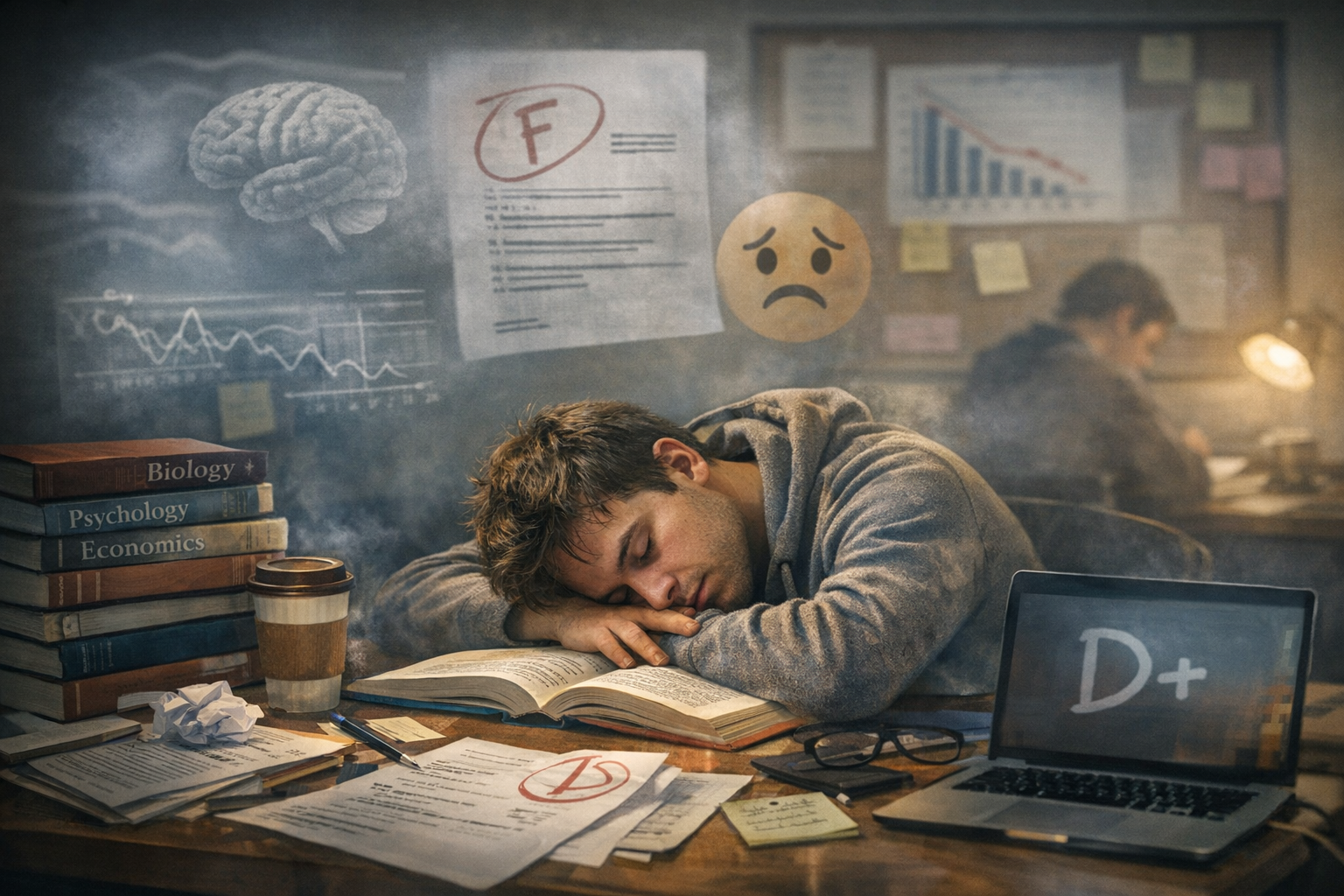
Nobody prepares you for the 58% on your first college exam. Not the admissions brochures. Not your high school guidance counselor. Not even your older sibling who swore they'd tell you "everything" about college.
That moment arrives for nearly every student—the grade that doesn't match your effort, the rejection email from a club you wanted to join, the overwhelming realization that college operates by entirely different rules than anything you've experienced before.
What happens next matters more than the setback itself. Developing college student resilience at this stage can make all the difference.
The 2024-2025 Healthy Minds Study—the nation's largest survey of student mental health, conducted by researchers at the University of Michigan, UCLA, Boston University, and Wayne State University—surveyed more than 84,000 students across 135 campuses. Their findings show that 37% of college students experience moderate to severe depressive symptoms, while 32% report anxiety symptoms [1]. Here's the encouraging part: these numbers have improved for three consecutive years. Researchers attribute the decline partly to students developing better coping skills and seeking support more readily, thereby strengthening college student resilience.
So what separates students who recover from difficulty and those who spiral? Psychologists point to one key variable: resilience. Cultivating college student resilience is the skill that helps students navigate academic and personal challenges successfully.
Understanding What Resilience Really Means
The American Psychological Association defines psychological resilience as "the process of adapting well in the face of adversity, trauma, tragedy, threats, or even significant sources of stress" [2]. Notice that word: process. Resilience isn't a personality trait you're born with or a switch you flip. It's something that develops through experience and deliberate practice—critical for building college student resilience.
For college students specifically, researchers Martin and Marsh coined the term "academic resilience" to describe the capacity to overcome challenges that threaten educational development [3]. Their work—and dozens of studies since—confirms that resilience predicts academic success even when controlling for prior achievement. College student resilience is not about avoiding failure but learning to recover and grow from it.
But the clinical definitions miss something important. Resilience isn't about being invulnerable or pretending setbacks don't hurt. Students who develop genuine college student resilience allow themselves to feel disappointed. They process difficulty rather than suppressing it. Then they take strategic action.
A 2025 study published in Frontiers in Psychology followed 440 undergraduate students and found that those with higher resilience maintained stronger academic performance and greater engagement with their coursework—even under stressful conditions [4]. The researchers noted that resilient students weren't necessarily smarter or more talented. They were simply better at seeking help early and adjusting their approach when something wasn't working. This illustrates the power of college student resilience as a practical, learnable skill.
The good news buried in all this research? These skills can be learned.
How Your Beliefs About Intelligence Shape Your Response to Failure

Stanford psychologist Carol Dweck has spent decades asking a deceptively simple question: Why do some students collapse after failure while others treat setbacks as information?
Her answer centers on what she calls "mindset"—specifically, beliefs about whether intelligence and ability are fixed traits or qualities that can be developed [5]. Students who cultivate college student resilience are more likely to adopt a growth mindset.
Students with a "fixed mindset" believe they either have ability or they don't. When these students encounter difficulty, they tend to interpret struggle as evidence of inadequacy. A poor grade becomes confirmation they don't belong in that major. A confusing lecture proves they're "just not a math person."
Students with a "growth mindset" operate from a different assumption entirely: abilities develop through effort, effective strategies, and learning from mistakes. These students respond differently when they hit obstacles. They're more likely to persist through difficulty, seek feedback, and experiment with alternative approaches [6]. Practicing college student resilience reinforces this growth mindset.
In practical terms, here's the difference. A fixed-mindset response to failing organic chemistry: "I'm not smart enough for this." A growth-mindset response: "My study approach didn't work—what should I try differently?"
Dweck's research demonstrates something even more encouraging. In studies where children were praised for effort and strategy rather than innate intelligence, they developed stronger growth mindsets and showed greater persistence after failure [7]. Mindset isn't destiny. It's malleable—and interventions teaching growth mindset principles have produced measurable improvements in academic outcomes.
This doesn't mean effort alone guarantees success. Dweck has been careful to clarify that growth mindset requires coupling effort with effective strategies and support—not just grinding harder at approaches that aren't working [7].
Six Evidence-Based Strategies for Building Resilience
Developing college student resilience requires more than positive thinking. The following strategies draw from peer-reviewed research on what actually helps students recover from difficulty.
1. Let Yourself Feel the Disappointment First
The instinct after a setback is to push past the disappointment as quickly as possible—jumping immediately into problem-solving mode or distracting yourself entirely. Research suggests this often backfires.
Processing difficult emotions, rather than suppressing them, is a component of healthy coping [8]. This doesn't mean wallowing for weeks. It means giving yourself permission to feel frustrated, disappointed, or even angry about what happened before strategizing about next steps. Trying to skip this step often means those emotions resurface at inconvenient moments later.
2. Separate What You Can Control from What You Can't
A 2024 meta-analysis examining stress and resilience among college students found that resilient individuals focus their energy on factors within their control [9]. They distinguish between what they can influence—study habits, time allocation, who they ask for help—and what they cannot change, like a professor's testing style or past performance.
This cognitive shift matters because ruminating about uncontrollable factors amplifies stress without producing useful action. When you catch yourself spiraling about things you can't change, redirect: What can I do differently going forward?
3. Find At Least One Person You Can Talk To
Harvard's Center on the Developing Child identifies having at least one stable, committed relationship with a supportive person as the single most consistent factor in developing resilience [10]. For college students, this might be a friend from home, a campus mentor, a professor who knows you, or a counselor.
You don't need an extensive social network to start building resilience. Research consistently shows that even a single trusted relationship provides meaningful protection against stress [11]. The key is having someone who listens without judgment and helps you think through options.
The 2024-2025 Healthy Minds Study found that 37% of students received therapy or counseling in the past year [1]. Stigma around seeking help continues declining—students increasingly recognize that talking to a counselor is no different from going to the health center when you're sick.
4. Look for What the Setback Can Teach You
Psychologists call this "positive reappraisal"—actively searching for what you can learn from a difficult situation. It ranks among the most effective coping strategies for reducing stress symptoms, according to research on university students [12].
This isn't toxic positivity or pretending everything is fine. It's genuinely asking: What does this experience teach me? How might working through this challenge prepare me for something I'll face later? Could this failure be redirecting me somewhere better?
Students who practice reframing report lower stress levels and greater confidence in subsequent challenges. Like most skills, it gets easier with practice.
5. Create a Specific Plan of Action

Resilience requires more than mindset work; it needs concrete next steps. Research on coping strategies found that strategic planning—identifying specific actions to address a problem—significantly reduces stress symptoms [13].
If you bombed an exam, your plan might include: schedule office hours within the next week, form a study group by Friday, review notes within 24 hours of each lecture, complete practice problems before the next test.
The specificity matters. Vague intentions like "study harder" rarely translate into changed behavior. Detailed plans with deadlines and accountability tend to stick.
6. Don't Abandon Self-Care When Pressure Increases
The relationship between physical health and psychological resilience runs in both directions. A 2025 systematic review published in Frontiers in Psychology confirmed that physical activity positively correlates with resilience in students [14]. Exercise, adequate sleep, and proper nutrition don't just support your body—they directly influence your capacity to handle stress.
When academic pressure intensifies, self-care is often the first thing students abandon. That's precisely backward. Maintaining physical health during high-stress periods isn't indulgent. It's strategic.
What Your Campus Probably Offers (That You Might Not Know About)
Colleges have invested significantly in student support infrastructure over the past decade. The Jed Foundation, which partners with over 550 campuses nationwide, reports that schools implementing comprehensive mental health approaches see measurable improvements—including significant reductions in crisis incidents among students at schools that completed their campus program [15].
Many universities now offer workshops specifically addressing resilience skills, time management, and stress coping. Students who participate report better ability to handle academic setbacks. Yet these resources often go underutilized simply because students don't know they exist.
Worth exploring on your campus: academic success workshops covering study strategies, counseling services offering coping skills groups, peer mentoring programs connecting you with students who've navigated similar challenges, and wellness apps providing support between appointments.
Taking the Long View
College inevitably involves setbacks. The exam you prepared extensively for but still failed. The internship that chose someone else. The friendship that fizzled. The semester that didn't go according to plan.
These experiences don't define your potential or predict your future. Research across multiple disciplines confirms that setbacks, when processed effectively, can become sources of growth rather than permanent limitations [16].
The students who thrive in college—and afterward—aren't those who avoid difficulty. They're the ones who develop skills for working through it. Each challenge you navigate strengthens your capacity to handle the next one.
If you're currently facing a setback, start small. Identify one thing within your control. Reach out to one person who might help. Take one step toward addressing what went wrong.
Resilience builds incrementally, through practice rather than perfection.
Ready to understand your own strengths and growth areas? Campus Mind's self-assessment helps you evaluate your wellness across multiple dimensions—including how you're handling academic challenges and building supportive connections.
Frequently Asked Questions
How can I develop resilience as a college student?
Building college student resilience involves several evidence-based practices: adopting a growth mindset that views abilities as developable rather than fixed, establishing at least one supportive relationship you can rely on during difficult times, practicing positive reappraisal to find lessons within setbacks, creating specific action plans when problems arise, and maintaining physical health through sleep, exercise, and nutrition. Research confirms these skills can be deliberately developed—resilience isn't something you either have or lack, but a capacity that strengthens through practice over time.
Why do some students recover from academic failure while others struggle?
Students who recover successfully from academic setbacks typically share several characteristics: they hold growth mindset beliefs about intelligence and ability, they have access to at least one supportive relationship, and they use active coping strategies like strategic planning and positive reappraisal rather than avoidance. Research from Stanford University shows that students who view challenges as opportunities for growth persist longer and perform better after failure than those who interpret struggle as evidence of fixed limitations.
What are warning signs that a student needs additional support?
Signs may include persistent avoidance of academic challenges, difficulty recovering emotionally from disappointments, negative self-talk after setbacks, reluctance to seek help, declining academic performance without attempts to address underlying issues, withdrawal from social activities, and expressing hopelessness about the future. If these patterns persist for more than a few weeks, connecting with campus counseling services can provide structured support for developing coping skills.
Is resilience something you're born with or can it be learned?
Resilience can absolutely be learned and strengthened. While some individuals may have temperamental tendencies that make certain aspects of resilience more natural, research consistently demonstrates that resilience-building skills—including growth mindset, social connection, self-care practices, and problem-solving approaches—respond to deliberate practice and intervention. Universities increasingly offer programs designed to develop these capacities in students who feel they're starting from behind.
How does resilience affect success after college?
Resilient students demonstrate stronger academic performance, greater persistence through difficult coursework, and higher graduation rates. Beyond college, the ability to recover from setbacks, learn from failure, and persist through challenges translates directly to professional environments where obstacles are inevitable. Research also indicates that resilience protects long-term mental health, reducing vulnerability to anxiety and depression when life presents difficult circumstances.
Author Note: This article was developed by the Campus Mind content team in collaboration with student success researchers and reviewed against peer-reviewed literature on student mental health and resilience. Campus Mind supports student engagement, belonging, and wellbeing through data-driven insights.
Editorial Standards: All statistics and claims cite primary sources including the Healthy Minds Study, American Psychological Association guidelines, Harvard University research, and peer-reviewed journals. No secondary aggregator sites were used as citation sources.
Important Disclaimer: This article provides general educational information about developing resilience skills and managing academic challenges. It is not a substitute for professional mental health care. If you're experiencing persistent symptoms of depression, anxiety, or thoughts of self-harm, please contact your campus counseling center or call/text 988 (Suicide and Crisis Lifeline) to speak with a trained counselor.
Citations
[1] Healthy Minds Network. "2024-2025 Healthy Minds Study." University of Michigan School of Public Health, UCLA Fielding School of Public Health, Boston University School of Public Health, Wayne State University. Published September 2025. https://sph.umich.edu/news/2025posts/college-student-mental-health-third-consecutive-year-improvement.html
[2] American Psychological Association. "Resilience." APA Dictionary of Psychology. https://www.apa.org/topics/resilience
[3] Martin, A.J. and Marsh, H.W. "Academic resilience and its psychological and educational correlates: A construct validity approach." Psychology in the Schools, 43(3), 267-281. 2006.
[4] Cai, Z. and Meng, Q. "Academic resilience and academic performance of university students: the mediating role of teacher support." Frontiers in Psychology, 16:1463643. Published April 2025. https://doi.org/10.3389/fpsyg.2025.1463643
[5] Dweck, C.S. Mindset: The New Psychology of Success. Random House, 2006.
[6] Stanford Teaching Commons. "Growth Mindset and Enhanced Learning." Stanford University. https://teachingcommons.stanford.edu/teaching-guides/foundations-course-design/learning-activities/growth-mindset-and-enhanced-learning
[7] Dweck, C.S. "Carol Dweck Revisits the 'Growth Mindset.'" Education Week. Published September 2015. https://www.edweek.org/leadership/opinion-carol-dweck-revisits-the-growth-mindset/2015/09
[8] American Psychological Association. "Building your resilience." APA Help Center. 2020. https://www.apa.org/topics/resilience/building-your-resilience
[9] ScienceDirect. "Association of stress and resilience in college students: A systematic review and meta-analysis." Personality and Individual Differences. Published December 2024. https://www.sciencedirect.com/science/article/abs/pii/S0191886924004665
[10] Center on the Developing Child at Harvard University. "Resilience." Harvard University. https://developingchild.harvard.edu/science/key-concepts/resilience/
[11] Nature. "Physical exercise and depression in university students with psychological resilience as mediator and family support as moderator." Scientific Reports. Published August 2025. https://www.nature.com/articles/s41598-025-17317-2
[12] Frontiers in Psychology. "Academic Stress and Mental Well-Being in College Students: Correlations, Affected Groups, and COVID-19." Published April 2022. https://www.frontiersin.org/journals/psychology/articles/10.3389/fpsyg.2022.886344/full
[13] PMC/National Institutes of Health. "Coping Strategies and Self-Efficacy in University Students." Frontiers in Psychology. 2020. https://pmc.ncbi.nlm.nih.gov/articles/PMC9169886/
[14] Frontiers in Psychology. "The correlation between physical activity and psychological resilience in young students: a systematic review and meta-analysis." Published March 2025. https://doi.org/10.3389/fpsyg.2025.1557347
[15] The Jed Foundation. "JED Campus Program." https://jedfoundation.org/jed-campus/
[16] Dweck, C.S., Walton, G.M., Cohen, G.L. "Academic Tenacity: Mindsets and Skills that Promote Long-Term Learning." Bill & Melinda Gates Foundation. 2014.
About the Author
Author Note: This article was developed by the Campus Mind content team in collaboration with student success researchers and reviewed against peer-reviewed literature on student mental health and resilience. Campus Mind supports student engagement, belonging, and wellbeing through data-driven insights.
Editorial Standards: All statistics and claims cite primary sources including the Healthy Minds Study, American Psychological Association guidelines, Harvard University research, and peer-reviewed journals. No secondary aggregator sites were used as citation sources.
Important Disclaimer: This article provides general educational information about developing resilience skills and managing academic challenges. It is not a substitute for professional mental health care. If you're experiencing persistent symptoms of depression, anxiety, or thoughts of self-harm, please contact your campus counseling center or call/text 988 (Suicide and Crisis Lifeline) to speak with a trained counselor.