It's 11:47 p.m. on a Tuesday. You're staring at a chemistry problem set due at midnight that you started twenty minutes ago. Your phone lights up—three unread texts from your group project team, a reminder about tomorrow's 8 a.m. lecture, and a notification that your shift at the campus bookstore starts in nine hours. Your half-eaten Cup Noodles sits cold on your desk. You haven't called your mom in two weeks.
This isn't a time management failure. This is what happens when you're learning to manage twenty different responsibilities for the first time in your life, and nobody handed you an instruction manual.
Here's what most advice won't tell you: time management in college isn't about squeezing more productivity into every waking hour. It's about protecting the hours that matter most—for studying, sure, but also for sleeping, eating real food, and maintaining whatever's left of your sanity.
Nearly half of college students say they don't have enough time to complete their coursework. Meanwhile, 47% identify time management as their biggest academic hurdle. But students who build actual systems—not just good intentions—report lower stress, better grades, and the radical ability to enjoy college instead of just surviving it.
Let's get into strategies that work when your schedule's a disaster and your executive function is running on fumes.
Why Your Schedule Feels Like Controlled Chaos
College dumps you into a fundamentally different time structure than high school. You've got five professors who don't coordinate deadlines. You might be working 15-20 hours a week to pay for textbooks and groceries. Student orgs want your time. Your friends want spontaneous adventures. Your body wants eight hours of sleep that it's definitely not getting.
Research confirms 72% of college students feel overwhelmed balancing academics and personal life. Add the fact that 75.5% of students procrastinate regularly, and you understand why the 11:59 p.m. deadline has become a meme.
Here's the actual problem: you're running everything out of your brain's working memory instead of building external systems. That mental load is exhausting before you even start studying. Every time you think "I need to remember to do that assignment," you're using cognitive resources you could spend actually learning organic chemistry.
The fix isn't hustling harder. It's building scaffolding that holds your life together when things get chaotic.
Building Systems That Actually Survive Finals Week
The Brain Dump: Getting Everything Out of Your Head
Before you can organize anything, you need to see the full scope of what you're managing. Grab whatever works—notebook, Google Doc, Notes app—and write down every single commitment floating in your brain.
Classes and lectures. Work shifts. That group presentation. The lab report. Club meetings. Your roommate's birthday. Laundry that's been in the dryer since Friday. The scholarship application. Everything.
This external brain clears mental space and shows you what you're actually dealing with. Most students are surprised by how much they're carrying.
Choosing Tools That Work for How You Think
Only 48% of college students use calendars to organize their time, which explains a lot about collective campus stress levels. Students who actively plan report significantly less anxiety.
Your options:
Physical planners work if you're a kinesthetic learner. Writing things down creates muscle memory. You can see your whole week at a glance without unlocking your phone and getting distracted by Instagram.
Digital calendars like Google Calendar sync everywhere and send automatic reminders. When you're running between the library and the dining hall, your phone has your schedule. You won't miss appointments because you left your planner in your dorm.
Student-specific apps like MyStudyLife integrate class schedules with assignment tracking. Notion lets you build custom dashboards for different classes. Todoist handles task prioritization with subtasks and deadlines.
The best tool is whichever one you'll use consistently for two months straight. Start with one. If it feels clunky after three weeks, try something else. There's no prize for loyalty to a system that doesn't work.
Time Blocking: Deciding Now So You Don't Decide Later

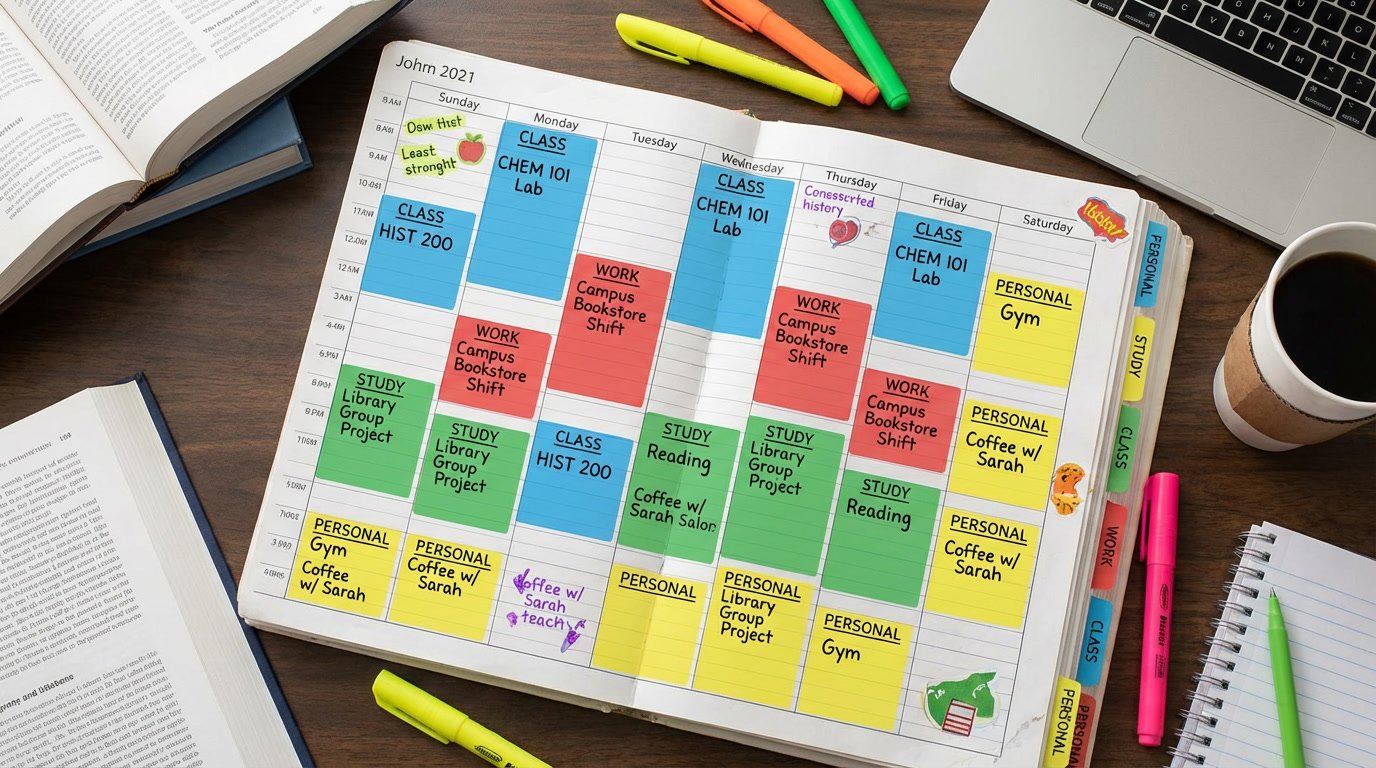
Time blocking assigns specific hours to specific activities. Instead of "I'll study sometime Tuesday," you commit: "Chemistry reading, Tuesday 2-4 p.m. in the library, second floor."
Why this works: decision fatigue is real. Every time you ask yourself "what should I work on now?" you're burning willpower. When you've pre-decided, you just execute.
Start by blocking fixed commitments—classes, work, regular meetings. Then add study blocks. Treat them like appointments you can't cancel. Include realistic time for meals, sleep, exercise, and hanging out with friends. If it's not on your calendar, it probably won't happen.
Students using time blocking report 20% productivity gains. That's essentially getting an extra day's worth of work done each week without actually working more hours.
But here's where time blocking falls apart: finals week. When everything's due simultaneously and your regular schedule implodes, you need to adjust. During high-stress periods, time block in shorter chunks—even just planning tomorrow's hours the night before helps maintain structure when chaos hits.
Techniques That Work (And When They Don't)
The Pomodoro Technique: For When You Can't Focus
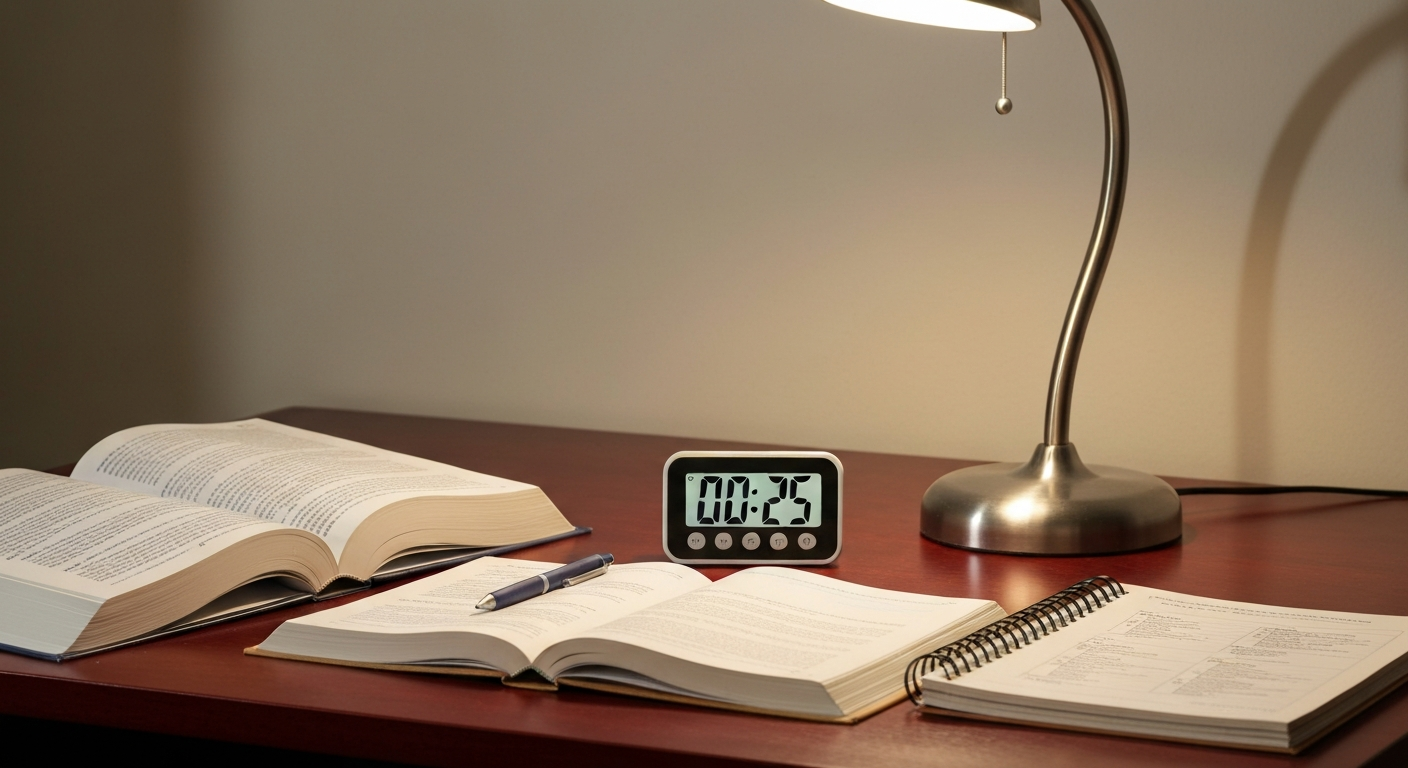
Here's how it works: set a timer for 25 minutes. Work on one thing. When the timer goes off, take a 5-minute break. After four rounds, take a longer 15-20 minute break.
Research shows students using Pomodoro report focus improvements of up to 25%. One case study documented a 46% decrease in distractions compared to unstructured studying.
Why it helps: Frequent breaks prevent your brain from frying. Twenty-five minutes feels manageable even when the task feels impossible. You can survive anything for 25 minutes.
But Pomodoro sucks for writing papers. When you're finally in flow with an argument, the timer disrupts your momentum. It's a godsend for problem sets, flashcard review, and reading dense textbooks. For creative or analytical work that requires deep immersion, consider longer focus blocks—maybe 50 minutes on, 10 minutes off.
Use a timer app, kitchen timer, or your phone. During breaks, actually step away. Stretching, getting water, or staring out the window counts. Scrolling Twitter doesn't—that's just different work for your brain.
The Eisenhower Matrix: What Actually Deserves Your Energy
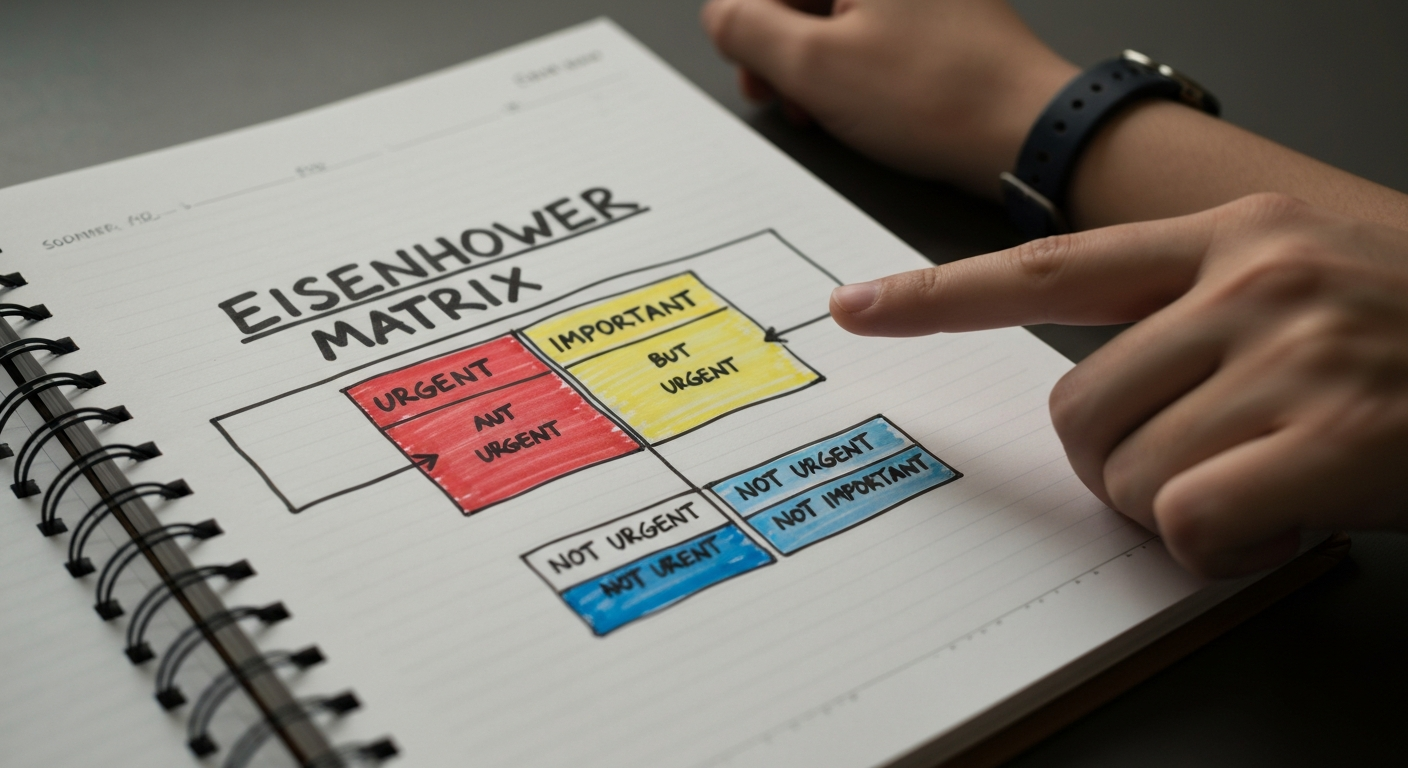
Not everything on your to-do list matters equally. The Eisenhower Matrix sorts tasks into four quadrants:
Urgent and Important: Do these immediately. Paper due tomorrow, exam you're studying for tonight, medical appointment.
Important but Not Urgent: Schedule these. Starting that research project due in three weeks, regular studying instead of cramming, career planning, maintaining friendships.
Urgent but Not Important: Minimize these when possible. Some emails, certain meetings, minor administrative tasks.
Neither Urgent nor Important: Eliminate or save for genuine downtime. Infinite social media scrolling, reorganizing your desk for the fourth time.
Students using this framework report 35% productivity increases. The key insight: most of the Important/Not Urgent stuff becomes Urgent/Important if you ignore it long enough. Scheduling it early saves you from panic later.
The Two-Minute Rule: Killing Small Tasks Instantly
If something takes under two minutes, do it now. Reply to that professor's email. Add the assignment to your calendar. Put your dirty dishes in the sink.
Small tasks accumulate into overwhelming mental clutter. This rule prevents task lists from becoming anxiety-inducing novels.
Your Biggest Time Thieves (And How to Actually Deal With Them)
Procrastination Isn't About Laziness
When you procrastinate, you're usually experiencing one of three things: the task feels overwhelming and you don't know where to start, you're afraid of doing it poorly, or you're avoiding something genuinely unpleasant.
The fix depends on the cause. If it's overwhelming, break it down into absurdly small steps. Not "write research paper"—try "open Google Scholar and find three sources." Starting is the hardest part. Momentum builds.
If it's fear, lower the stakes. Tell yourself you're just writing a terrible first draft that nobody will see. Permission to suck removes paralysis.
If it's genuinely unpleasant, do it first thing when your willpower is fresh. Or pair it with something enjoyable—studying at your favorite coffee shop, playing music you like while doing problem sets.
Research shows 76% of students who submit work early score better than those who procrastinate. Early submission isn't just less stressful—it gives you buffer time for revisions and technical disasters.
Social Media: The Three-Hour Black Hole
Average college students spend 3 hours daily on social media. That's 21 hours weekly—literally a part-time job's worth of scrolling.
During study blocks, put your phone in a different room. Seriously. Out of sight works better than willpower. Use apps like Forest, Freedom, or Cold Turkey to block distracting sites on your laptop.
Schedule specific times to check social media—during Pomodoro breaks, after finishing assignments, during lunch. You'll enjoy it more when it's intentional instead of compulsive.
Overcommitment: The Hidden Time Killer
You don't need to join every club, attend every event, or say yes to every opportunity. College rewards depth over frantic breadth.
Before committing to anything new, ask: Does this align with my actual goals? Do I realistically have time? What am I sacrificing to make room for this?
When you have a closing shift at Starbucks, an 8 a.m. Chem lab the next morning, and two midterms that week, saying no to the extra volunteer opportunity isn't failure. It's survival. Learning your limits isn't quitting—it's strategic resource allocation.
Making This Sustainable When Everything's On Fire
Schedule Downtime or Your Body Will Schedule It For You
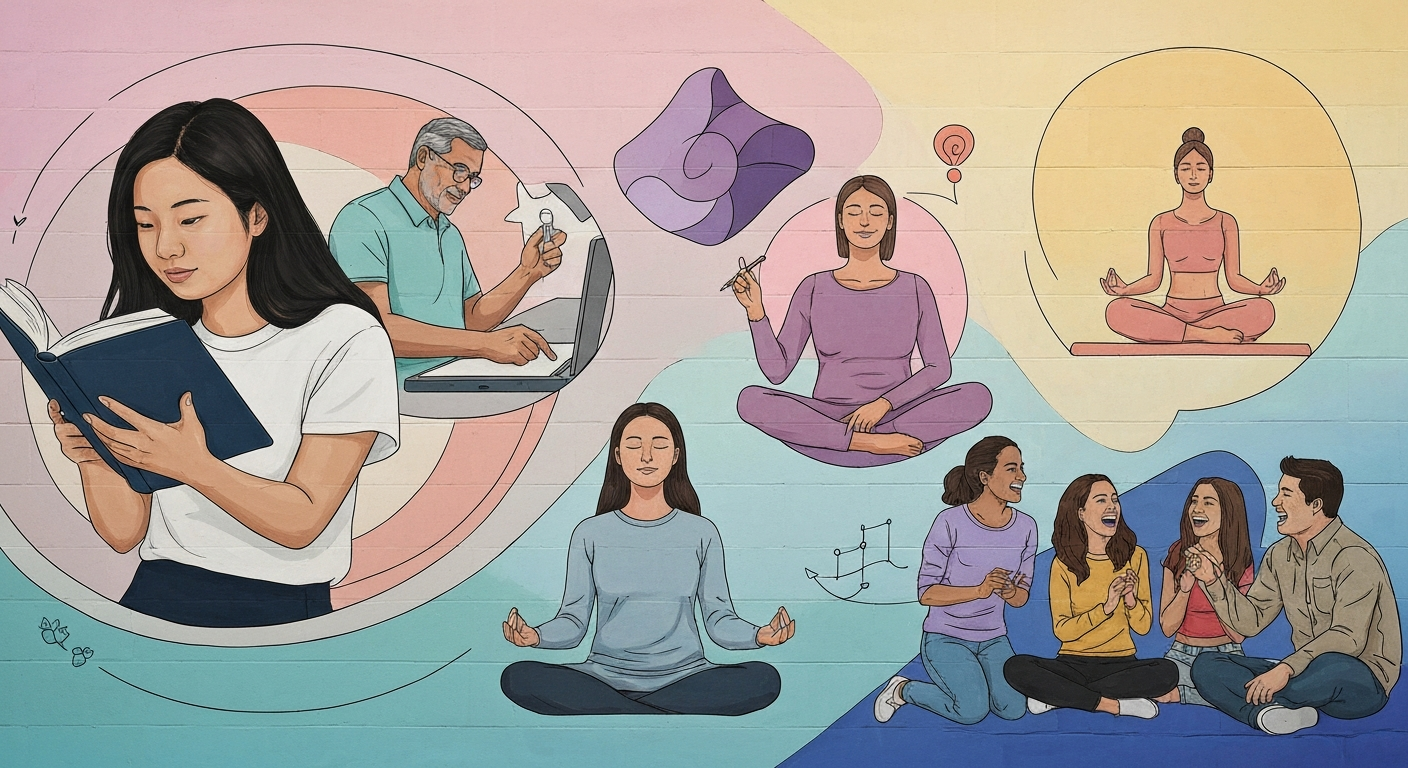
Burnout happens when you treat every waking hour as productive time. Students who schedule regular breaks and leisure activities actually outperform those who grind constantly.
Block time for things that recharge you—watching that show, gaming with friends, intramural basketball, literally lying on the quad doing nothing. Rest is productive. Your brain consolidates learning during downtime.
This also addresses "revenge bedtime procrastination"—staying up late doing fun stuff because you felt deprived all day. If you schedule actual enjoyment into your daytime hours, you're less likely to sabotage your sleep for leisure.
Build Buffer Time Because Chaos Is Guaranteed
Technology fails. You get sick. Professors extend deadlines but you didn't plan for that. Group members flake. Your laptop decides to update during finals.
When estimating task time, multiply by 1.5. If you think something takes two hours, schedule three. You'll either finish with bonus time or have the breathing room you actually needed.
This buffer time is especially critical if you're working 20+ hours while taking a full course load. Your schedule has less slack than students who aren't financially supporting themselves.
Weekly Reviews: The 15-Minute Recalibration
Every Sunday evening (or whatever works), spend 15 minutes reviewing your week. What worked? What was a disaster? Which study blocks were productive? Where did you waste time? What stressed you out?
Use these insights to adjust. Maybe you're not a morning studier despite thinking you should be. Maybe group study sessions help for bio but tank your productivity for economics. Maybe you need more breaks than the standard Pomodoro suggests.
Time management is a skill you refine through observation, not something you perfect immediately. The weekly review builds self-awareness about your actual patterns versus your idealized ones.
The Real Payoff: Time For What Actually Matters
Students with strong time management skills report lower stress, better grades, and higher satisfaction with college. But here's what matters more than GPA: you get your life back.
Time to sleep seven hours instead of four. Time to eat meals that aren't consumed while sprinting between buildings. Time to maintain friendships. Time to explore interests that have nothing to do with your major. Time to discover who you're becoming.
You came to college for growth, learning, and building the life you want. That requires space to think, experiment, and occasionally mess up without catastrophic consequences. Good time management creates that space.
Campus Mind helps students build personalized success strategies, track well-being across eight dimensions of wellness, and develop skills that make college manageable instead of overwhelming. When you're balancing classes, work, relationships, and everything else, having a system that supports your actual life—not some idealized version—makes all the difference.
Frequently Asked Questions
How much time should I actually spend studying each day in college?
The standard guideline is 2-3 hours of study time for every credit hour weekly. For a 15-credit load, that's 30-45 total hours of class and studying combined. But this varies wildly based on your major (engineering demands more than communications), course difficulty, how efficiently you study, and your personal learning speed. Focus on consistent, focused sessions rather than hitting arbitrary hour counts. An hour of distraction-free deep work beats three hours of half-focused studying every time.
What's the best time management app for college students in 2025?
The best app is the one you'll consistently use. Google Calendar works well for basic scheduling and syncs everywhere. MyStudyLife caters specifically to students with class schedules and assignment tracking built in. Notion offers complete customization—you can build your own dashboard for different classes, track readings, manage projects, and take notes in one workspace. Todoist excels at task management with subtasks and priority settings. Try one for two weeks. If it feels clunky or you keep ignoring it, switch. Tool loyalty doesn't matter—effectiveness does.
How do I balance studying with social life and mental health when everything feels urgent?
Schedule social time and self-care with the same intentionality as study blocks. They're not luxuries you earn after finishing everything—they're essential fuel that makes studying possible. Time blocking ensures you're allocating actual hours for friends, exercise, and rest. Research consistently shows students who maintain social connections and prioritize wellness outperform those who sacrifice everything for studying. Your brain needs downtime to consolidate learning. Connection and rest aren't opposed to academic success—they enable it.
What should I do when I'm constantly falling behind despite trying to manage my time?
First, track where your time actually goes for one full week. Write down everything in 30-minute blocks. Most students discover significant time leaks they didn't notice—switching between tasks constantly, underestimating how long things take, or spending way more time on low-priority activities than they realized. Second, check if you're overcommitted and need to drop activities. Third, distinguish between "busy" and "productive." Finally, ask for help from academic advisors, counseling services, or academic coaches. Sometimes an external perspective reveals patterns you can't see yourself.
How can I stop procrastinating on assignments I find difficult or boring?
Break the assignment into absurdly small first steps. Instead of "write literature review," try "open Google Scholar and search for three articles on my topic." Use the Pomodoro Technique to commit to just 25 minutes—you can endure anything for 25 minutes. Identify the root cause of procrastination. If it's fear of doing it poorly, give yourself permission to write a terrible first draft that nobody will see. If it's genuinely tedious work, do it first thing in the morning when your willpower is strongest, or pair it with something pleasant like good coffee or music. Starting is almost always the hardest part. Once you have momentum, continuing gets easier.
E-E-A-T Section
This article synthesizes peer-reviewed research on college student time management and productivity from BMC Psychology, MDPI Behavioral Sciences, and studies published in the International Journal of Multidisciplinary Research. The strategies presented reflect evidence-based practices validated through academic research on student stress management, academic achievement, and wellbeing. Campus Mind works with higher education institutions to support student engagement, retention, and success through research-informed approaches that address the real challenges students face balancing academic demands with personal wellness and life responsibilities.
Cited Works
[1] American College Health Association — "National College Health Assessment 2024." Survey data on student procrastination and stress. Referenced via multiple research sources.
[2] Clockify — "Time Management Statistics Everyone Should Know in 2025." https://clockify.me/time-management-statistics
[3] Biwer, F., et al. — "Understanding effort regulation: Comparing 'Pomodoro' breaks and self-regulated breaks." British Journal of Educational Psychology, 2023. https://pubmed.ncbi.nlm.nih.gov/36859717/
[4] Fu, Y., Wang, Q., et al. — "Unlocking academic success: the impact of time management on college students' study engagement." BMC Psychology, 2025. https://pmc.ncbi.nlm.nih.gov/articles/PMC11967054/
[5] Renacido, J.M.D., Mayordo, E.L., & Biray, E.T. — "A Comparative Study Between Pomodoro Technique and Flowtime Technique Among College Students." International Journal of Multidisciplinary: Applied Business and Education Research, 2025.
[6] Van Eerde, W., & Biwer, F. — "Investigating the Effectiveness of Self-Regulated, Pomodoro, and Flowtime Break-Taking Techniques Among Students." MDPI Behavioral Sciences, 2024. https://pmc.ncbi.nlm.nih.gov/articles/PMC12292963/
[7] Gitnux — "College Student Time Management Statistics." https://gitnux.org/college-student-time-management-statistics/
[8] The Jed Foundation — "2024 Thriving College Student Index." https://jedfoundation.org/amid-high-levels-of-stress-anxiety-2024-thriving-college-student-index-reveals-ways-students-stay-on-top-of-mental-wellness/
[9] Misra, R., & McKean, M. — "College students' academic stress and its relation to their anxiety, time management, and leisure satisfaction." American Journal of Health Studies, 2000.
[10] Reclaim.ai — "Top 5 Free Apps for Students: Time Management + Productivity." https://reclaim.ai/blog/student-time-management-app
[11] Gottschlich, D., & Atapour, N. — "Academic Stress and Coping Mechanisms in High-Achieving Students." Journal of Adolescent and Youth Psychological Studies, 2024.
[12] Hassan, S., et al. — "Impact of a strategic time management programme on burnout, anxiety, depression, and emotional regulation in university students." Ansiedad y Estrés, 2025.