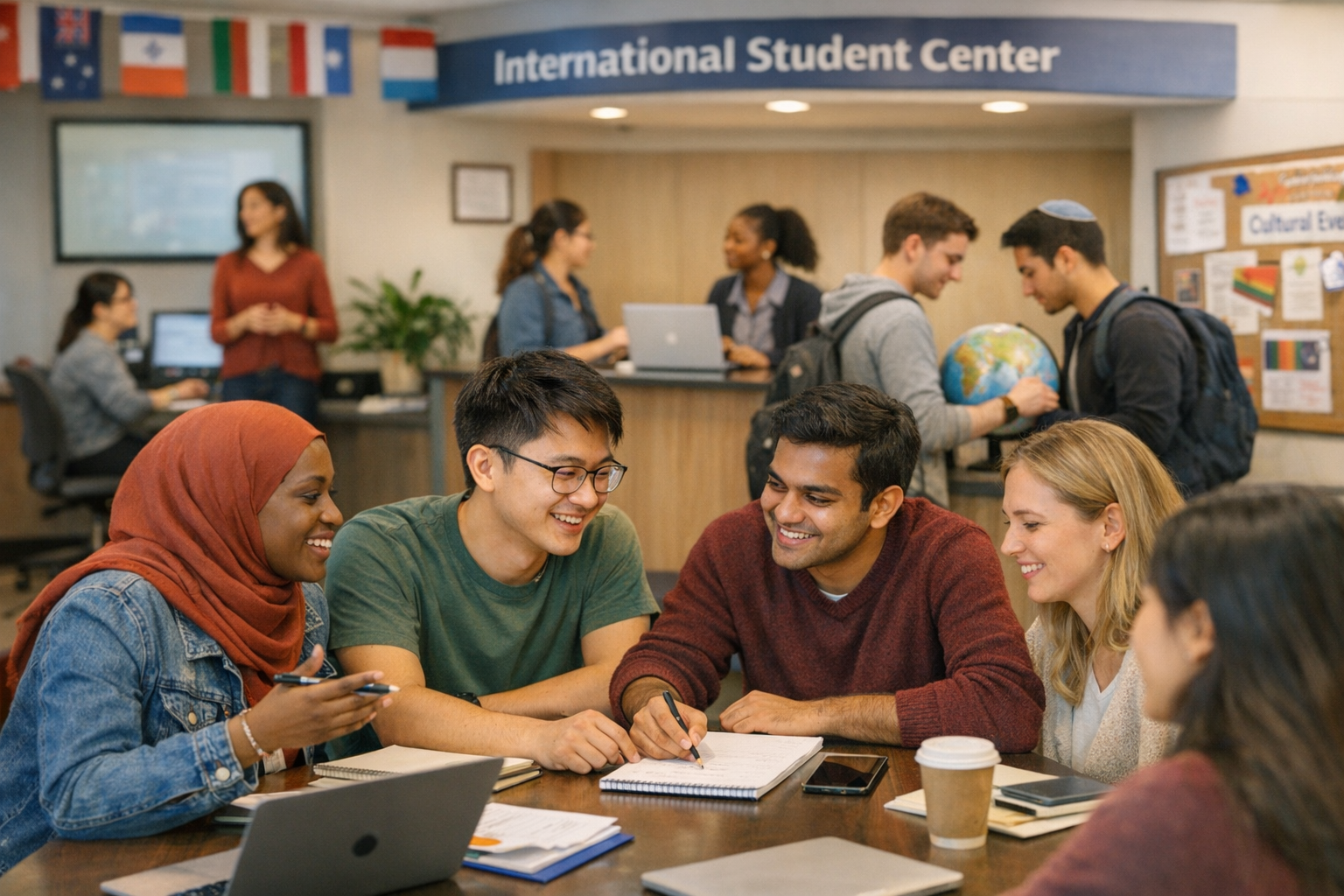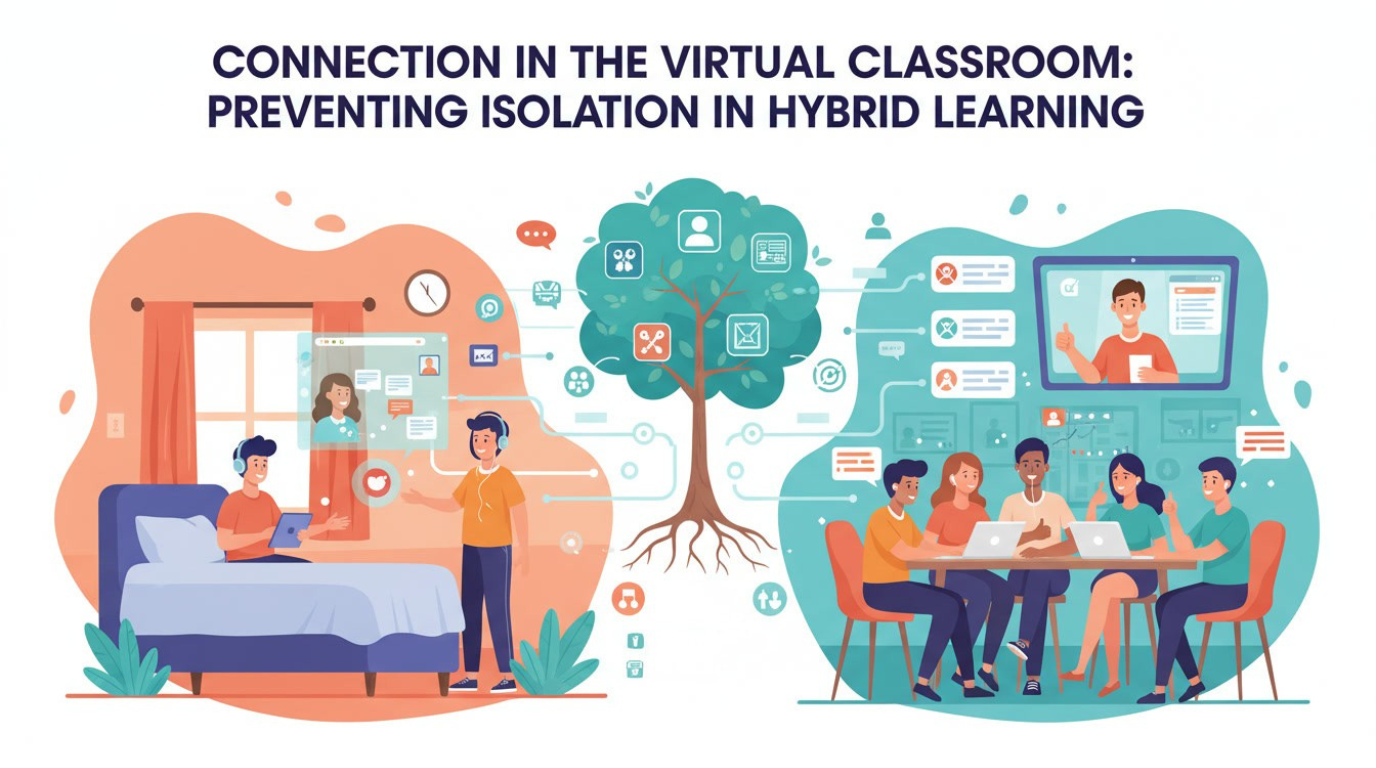
Retention in hybrid learning isn't primarily about technology. It's about whether students feel like they belong.
The research is clear: students who feel invisible in virtual settings disengage faster and leave at higher rates than their peers in face-to-face courses. With hybrid and online formats now a permanent fixture across higher education, institutions that treat connection as an afterthought are watching persistence numbers decline.
Here's what makes this addressable: isolation in virtual environments isn't inevitable. With deliberate course design and evidence-based facilitation practices, hybrid classrooms can become spaces where students genuinely connect, engage, and persist toward graduation.
Key Takeaways
Social isolation ranks among the strongest predictors of student dropout in hybrid and online programs
Simple structural changes—like persistent small groups and well-designed discussion activities—significantly improve students' sense of belonging
The most effective hybrid programs treat connection as curriculum, not an add-on
Technology enables connection but doesn't create it; human-centered design does
Why Virtual Learning Creates Isolation—And Why It Matters for Retention
Students in fully online courses continue to face meaningful challenges compared to those in face-to-face sections. The EDUCAUSE 2023 Students and Technology Report found that while students have largely adapted to digital learning environments, those in online-heavy programs consistently report lower satisfaction with peer interaction and instructor connection than their in-person counterparts [1].
This pattern persists across institution types. The CHLOE 8 Report (Changing Landscape of Online Education) documented that chief online learning officers identify "student engagement and community building" as their top instructional challenge—ahead of assessment integrity, faculty training, or technology access [2].
The National Survey of Student Engagement consistently finds that student-faculty interaction and collaborative learning rank among the most powerful predictors of student success [3]. In traditional classrooms, these interactions happen organically: before class, after class, in the hallway. In hybrid environments, they require deliberate construction.
When students feel invisible, they disengage. When they disengage, they leave.
Certain populations experience this most acutely. First-generation students, commuters, and working adults—groups already navigating college with fewer built-in support networks—report the highest rates of isolation in hybrid formats [4]. These are precisely the students institutions most need to support.
The Hidden Cost of Disconnection
Student isolation isn't just an experience problem. It carries measurable financial consequences.
Consider the math: if a mid-sized university with 10,000 students sees a 5% increase in first-year dropout rates attributable to disengagement in hybrid courses, that translates to 500 students not returning. At an average net tuition of $15,000 per student, that's $7.5 million in lost revenue—annually. And that calculation excludes recruitment costs to replace those students or the reputational impact of declining completion rates.
Institutions investing in hybrid learning infrastructure without parallel investment in connection strategies are building expensive classrooms that students walk out of.

Interactive Practices That Actually Build Connection
The evidence points toward several high-impact practices that can transform hybrid classrooms from isolation chambers into genuine learning communities.
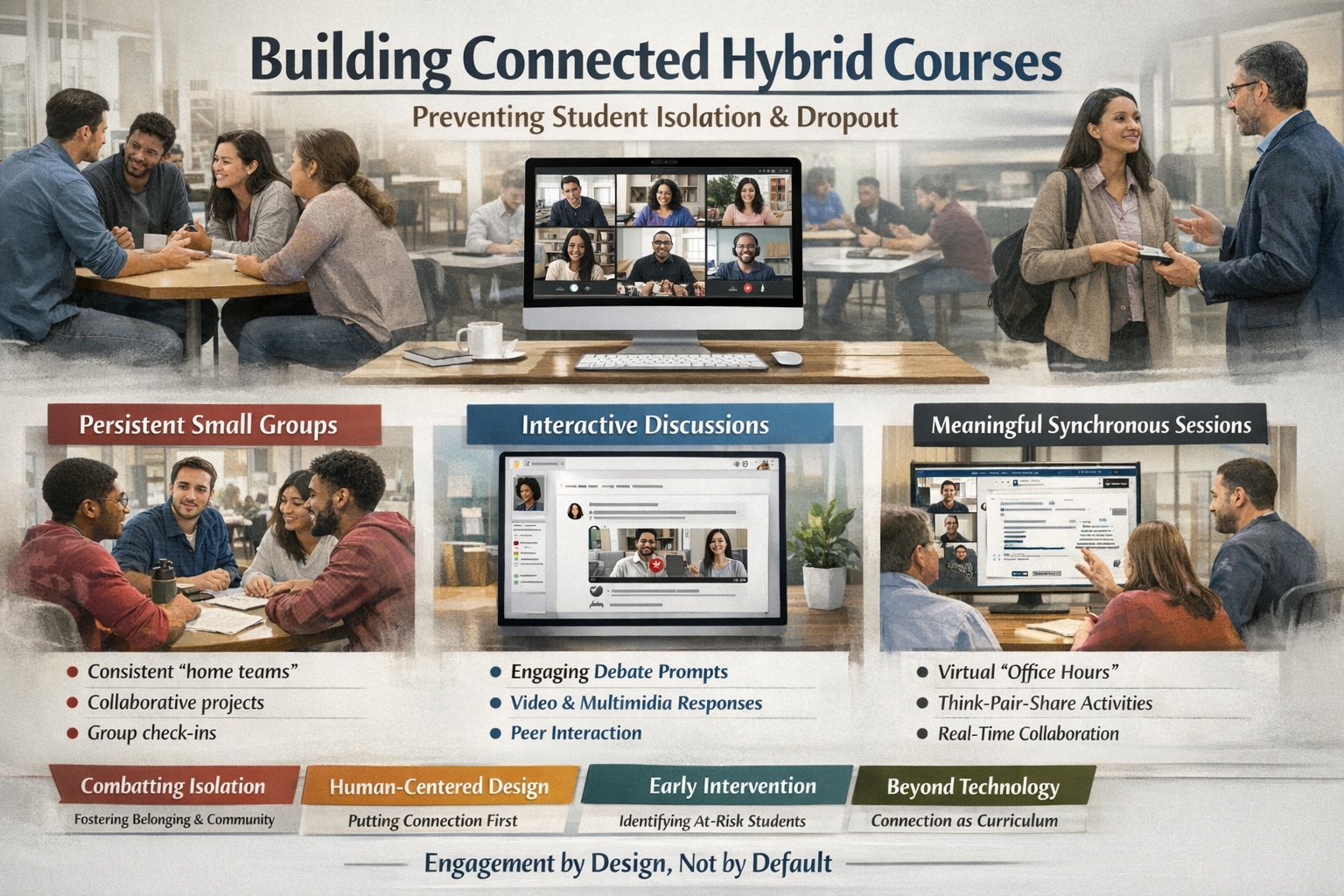
Persistent Small-Group Structures
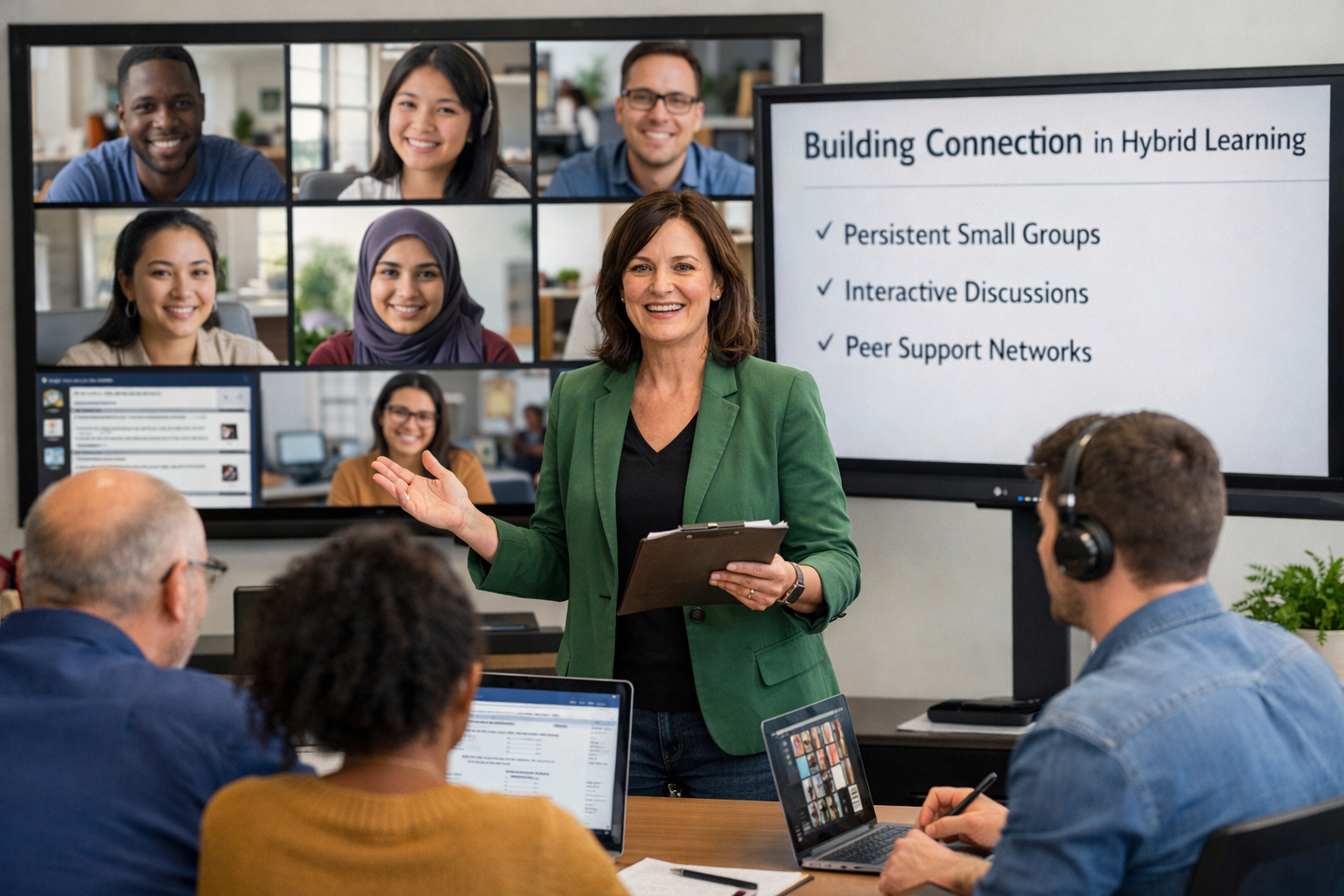
Random breakout rooms assigned differently each session create surface-level interaction at best. Students meet, complete a task, and never see those same peers again. Research on learning sciences demonstrates that persistent small groups—the same four to five students working together across multiple sessions—build the trust and familiarity that leads to deeper engagement [5].
What this looks like in practice:
Assign stable "home teams" at the start of the semester that remain consistent
Begin each synchronous session with five to seven minutes of unstructured small-group check-in before content delivery
Build cumulative projects that require ongoing collaboration rather than one-off assignments
Create private group channels (in Teams, Slack, or your LMS) for between-session communication
Making breakout rooms work: The difference between productive and useless breakout sessions often comes down to structure. Assign specific roles within each group—a discussion lead, a note-taker, a timekeeper, and a designated "skeptic" who raises counterpoints. Give groups a concrete deliverable due immediately after the breakout (a shared document, a synthesis statement, a question for the larger group). Without clear purpose and accountability, breakouts become dead air.
Asynchronous Discussion Activities (Redesigned)
Let's be direct: most discussion boards fail because they function as compliance exercises. Post once, respond twice, collect your points. Students recognize busywork immediately and engage accordingly.
Effective asynchronous interaction functions more like an ongoing conversation than an assignment submission. Research on online learning communities found that forums with clear scaffolding, visible instructor presence, and peer response requirements produced significantly higher engagement and course satisfaction [6].
Design principles that elevate asynchronous interaction:
Pose genuinely debatable questions rather than recall prompts—questions where reasonable people disagree based on evidence and interpretation
Require students to build on peers' ideas explicitly, not just react ("I agree with Jordan's point about X, and I'd add...")
Have instructors participate as fellow thinkers, not just graders—model the intellectual engagement you want to see
Consider alternatives to text-only forums: video responses through tools like Flip, collaborative annotation through Hypothesis, or shared document discussions where students comment directly on readings
The goal is interaction that students would actually miss if it disappeared—not interaction they endure because it's required.
Synchronous Moments That Matter
Not every hybrid course needs extensive live sessions. But strategic synchronous touchpoints—even brief ones—anchor students' sense of belonging to a community.
Quality matters more than quantity. A well-facilitated 20-minute weekly "office hours drop-in" where students casually connect with instructors and peers can outperform a 90-minute lecture where cameras stay off and chat windows remain silent.
High-impact synchronous strategies:
Open sessions five to ten minutes early specifically for informal conversation—and be present for it yourself
Use collaborative documents (Google Docs, shared whiteboards) where all students contribute simultaneously and can see each other's thinking in real time
Implement "think-pair-share" structures adapted for virtual breakouts: individual reflection, paired discussion, then small group synthesis
End sessions with peer appreciation or brief shout-outs that recognize contribution
On the camera question: Mandatory camera-on policies typically backfire, creating resentment rather than engagement. Students have legitimate reasons for keeping cameras off—bandwidth limitations, shared living spaces, appearance anxiety, caregiving responsibilities happening in the background. Instead of mandating cameras, design activities where being seen adds genuine value. Students are more likely to turn cameras on for a small-group discussion about a case study than for a lecture they could watch asynchronously. Create psychological safety first; visible participation follows.
What Successful Hybrid Programs Look Like
Several institutions have redesigned hybrid learning around connection-first principles. Their approaches share a common thread: treating connection as infrastructure rather than decoration.
Arizona State University's Embedded Peer Learning Model
ASU's approach to online and hybrid learning deliberately embeds peer learning specialists within courses. These near-peer mentors facilitate study groups, model engagement behaviors, and create human touchpoints throughout the student journey. The peer specialists are trained specifically in virtual engagement strategies and serve as a bridge between students and institutional support. Programs using this model have reported retention rates exceeding institutional averages for online learners [7].
Georgia State University's Proactive Advising Integration
Georgia State is known for its data-driven advising approach, but less discussed is how this integrates with course engagement. Advisors receive real-time engagement data from learning management systems, allowing intervention before disengagement becomes withdrawal. Students flagged in early-alert systems receive personalized outreach—not generic emails, but specific invitations to tutoring, study groups, or instructor office hours that address the actual barriers they're facing [8].
The key insight: data-driven systems work when they connect to human intervention. An alert means nothing if no one acts on it with compassion and specificity.
Cohort-Based Scheduling in Community Colleges
Several community college systems have moved toward cohort-based scheduling for hybrid programs, where the same group of students progresses through multiple courses together rather than signing up independently for disconnected sections. Data from institutions implementing guided pathways with cohort structures show persistence improvements of eight to fifteen percentage points compared to traditional open-enrollment sections [9].
Why it works: students develop relationships that carry across courses. They become accountable to peers, not just to grades. The "I can't miss class because my group is counting on me" effect—something that happens naturally in residential programs—gets built into the structure.
Building Connection Into Hybrid Course Design
For faculty and instructional designers, preventing isolation requires rethinking course architecture from the ground up.
Before the Semester Begins
Create a low-stakes "welcome" activity that lets students introduce themselves in multiple modalities (video, text, images)—give them options rather than requiring a single format
Establish clear communication norms: response time expectations, preferred channels, and camera policies that respect student circumstances
Design a "getting to know your classmates" activity in the first week that requires genuine interaction, not just posting into a void
During the Semester
Embed regular collaborative activities that cannot be completed alone—individual accountability within group structures
Use polling, collaborative annotation, and shared documents to make participation visible to everyone, including students who don't speak up verbally
Schedule periodic "connection check-ins" where students briefly reflect on their sense of belonging—and take what they report seriously
Rotate between whole-class, small-group, and individual activities to create varied interaction patterns
When Students Disengage
Establish early alert protocols that flag declining participation before it becomes absence
Train instructors on personalized, non-punitive outreach—messages that express genuine concern rather than administrative compliance
Offer multiple re-engagement pathways (synchronous and asynchronous options) so students can reconnect in ways that fit their circumstances
Connect disengaging students with peer mentors or success coaches who can offer support outside the instructor relationship

The Role of Technology—And Its Limits
Learning management systems, video conferencing platforms, and student engagement applications all have roles to play. But institutions often expect technology to solve a fundamentally human problem.
A discussion forum cannot create belonging on its own. Neither can a wellness check-in bot. These tools work when they're designed around human needs—and when real people are monitoring, responding, and adapting based on what students actually experience.
The most effective technology implementations share common characteristics:
They reduce friction for human connection rather than replacing it
They surface actionable data that leads to personalized intervention
They integrate across systems rather than creating additional silos
They respect student privacy while enabling support
Data-driven insights matter. But data without compassionate action is just surveillance.
This represents one of the hardest challenges in hybrid learning: tracking engagement metrics manually across dozens or hundreds of students is nearly impossible at scale, yet automated systems without human follow-through feel hollow to students. The institutions seeing results have found ways to use technology to identify who needs support while ensuring that support comes from people who actually know the student's name.
Your Next Steps
Whether you're a faculty member, instructional designer, or campus leader, isolation in hybrid learning is addressable. Here's where to start:
For Faculty:
Audit your current course for how many opportunities exist for meaningful peer interaction—not just discussion posts, but interaction where students actually learn each other's names
Implement one new connection-building strategy this semester—persistent groups, structured breakouts, or redesigned discussion activities
Survey students mid-semester about their sense of belonging in the course—and adjust accordingly based on what they tell you
For Instructional Designers:
Build connection activities into course templates as default elements, not optional add-ons
Create faculty development resources specifically on facilitating virtual engagement—this is a skill that requires training
Establish quality standards that include interaction metrics alongside content coverage
For Campus Leaders:
Examine retention data disaggregated by course modality—what patterns emerge between face-to-face, hybrid, and fully online sections?
Invest in training and ongoing support for faculty teaching hybrid courses—and recognize this work in tenure and promotion considerations
Consider cohort models for high-enrollment hybrid programs where relationship continuity matters
Implement early alert systems that flag disengagement in virtual environments—and ensure intervention capacity to act on those alerts
Connection in the virtual classroom doesn't happen by accident. It happens by design.
Tracking engagement across hybrid environments—and intervening before students disengage—requires seeing patterns that manual monitoring can't catch. Book a call with CampusMind to learn how institutions are using data-driven approaches to strengthen student connection across all learning formats.
Frequently Asked Questions
What's the ideal ratio of synchronous to asynchronous activities in hybrid courses?
There's no universal formula, but research suggests quality matters more than quantity. Even one well-designed synchronous touchpoint per week—where students interact meaningfully with peers and instructors—can anchor a sense of community. The key is ensuring asynchronous activities include genuine interaction (collaborative projects, threaded discussions that build on each other) rather than isolated individual work that happens to be submitted to the same digital space.
How can institutions identify students experiencing isolation before they withdraw?
Early warning signs include declining participation in discussion forums, missed synchronous sessions, late or missing assignments, and reduced login frequency. Effective early alert systems aggregate these signals and route them to advisors or success coaches who can conduct personalized outreach. The goal is intervention during the "zone of ambivalence"—while students are still uncertain about staying, before they've mentally checked out completely.
Do peer mentoring programs work in online and hybrid environments?
Yes, when structured with intention. Near-peer mentors who share similar backgrounds or program experiences can bridge the gap between students and institutions effectively. Successful virtual peer mentoring includes regular check-ins through accessible channels, clear expectations for both mentors and mentees, and specific training for mentors on virtual engagement strategies. Programs that simply pair students without structure report weaker outcomes than those with intentional design.
What's the biggest mistake institutions make when trying to improve connection in hybrid courses?
Treating technology as the solution rather than the tool. Purchasing a new platform or adding features to the LMS accomplishes nothing if faculty aren't trained in facilitation, if courses aren't designed for interaction, or if no one follows up when students show signs of disconnection. Connection is fundamentally human—technology should reduce barriers to human interaction, not attempt to replace it.
How do we address faculty resistance to redesigning courses for connection?
Start by acknowledging the legitimate challenge: facilitating hybrid courses well takes more effort than lecturing to a room, and most faculty received no training in virtual pedagogy. Provide concrete support—templates, examples, and protected time for course redesign. Recognize this work in performance evaluations. And share evidence: when faculty see that connection-focused design improves both student outcomes and their own teaching experience (fewer disengaged students, more substantive discussions), resistance often shifts to adoption.
About CampusMind
CampusMind was founded on the belief that student success depends on more than academics—it requires genuine connection, timely support, and a sense of belonging. Our team combines expertise in student affairs, behavioral science, and education technology to help institutions identify and support students before challenges become crises. We work with colleges and universities to transform engagement data into meaningful intervention, ensuring every student has the opportunity to thrive. Learn more about our approach.
Works Cited
[1] EDUCAUSE — "2023 Students and Technology Report: Rebalancing the Student Experience." EDUCAUSE. https://www.educause.edu/ecar/research-publications/students-and-technology/2023/introduction
[2] Quality Matters & Eduventures — "CHLOE 8: Student Demand Moves Higher Ed Toward the Mainstream." The CHLOE Report. https://www.qualitymatters.org/qa-resources/resource-center/articles-resources/CHLOE-project
[3] National Survey of Student Engagement — "Engagement Indicators & High-Impact Practices." Indiana University Center for Postsecondary Research. https://nsse.indiana.edu/nsse/survey-instruments/engagement-indicators.html
[4] Means, B., et al. — "Learning Online: What Research Tells Us About Whether, When and How." Routledge. https://www.routledge.com/Learning-Online-What-Research-Tells-Us-About-Whether-When-and-How/Means-Bakia-Murphy/p/book/9780415630290
[5] Darling-Hammond, L., et al. — "Implications for Educational Practice of the Science of Learning and Development." Applied Developmental Science. https://www.tandfonline.com/doi/full/10.1080/10888691.2018.1537791
[6] Online Learning Consortium — "Quality Scorecard for Online Student Support." Online Learning Consortium. https://onlinelearningconsortium.org/consult/olc-quality-scorecard-suite/
[7] Arizona State University — "ASU Sync and Peer Learning Specialists." EdPlus at ASU. https://edplus.asu.edu/
[8] Renick, T. — "Georgia State University's Student Success Programs." Georgia State University. https://success.gsu.edu/
[9] Community College Research Center — "Redesigning Community Colleges for Student Success: Overview of the Guided Pathways Approach." Columbia University. https://ccrc.tc.columbia.edu/publications/redesigning-community-colleges-student-success.html