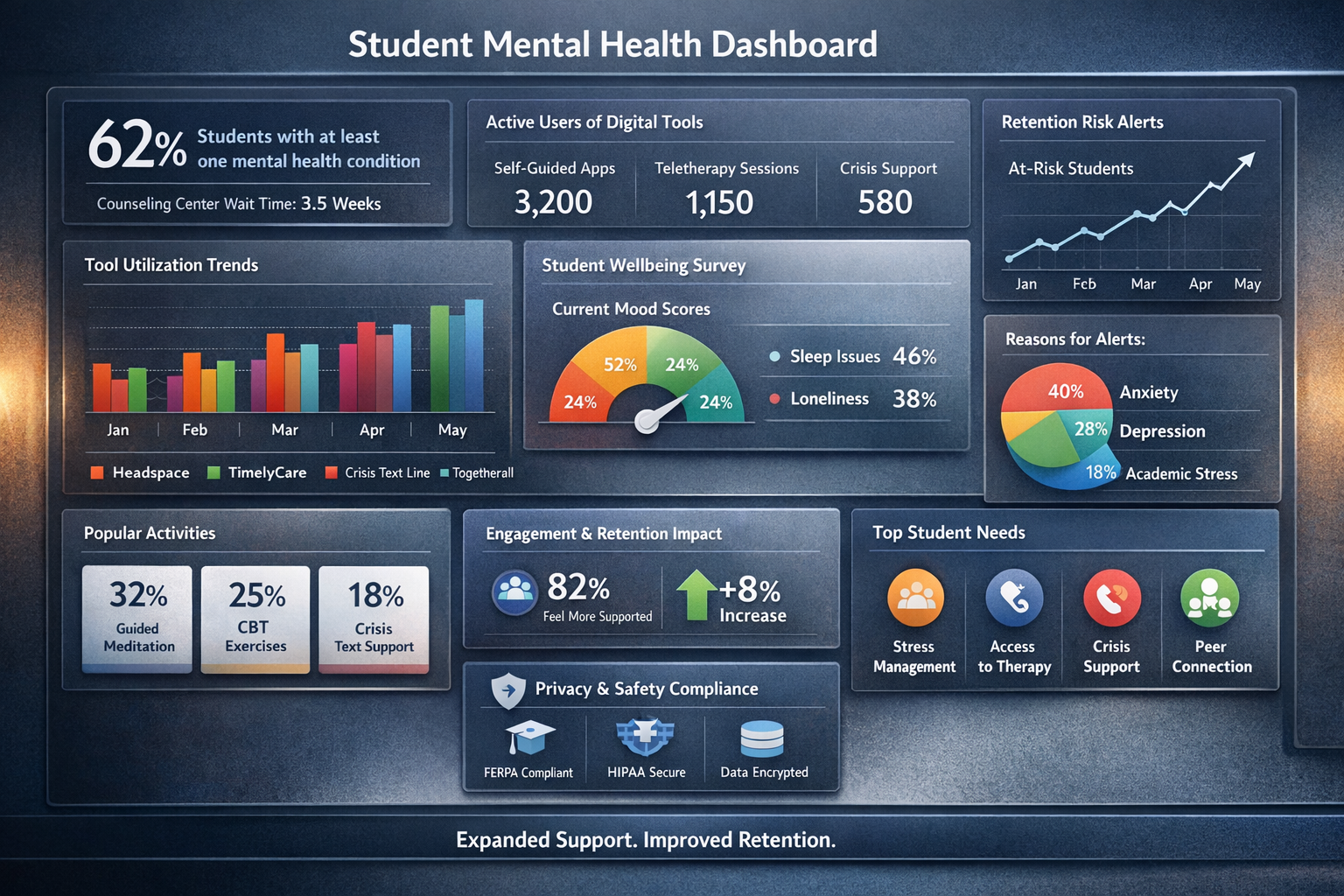
More than 60% of college students now meet criteria for at least one mental health condition, yet campus counseling centers remain stretched thin—often with weeks-long waitlists and limited hours. For Vice Presidents of Student Affairs, Deans of Students, and Directors of Retention, this gap between student need and available support represents one of the most pressing challenges in higher education today.
Digital mental health tools have emerged as a practical solution to bridge this gap. But here's the challenge your institution likely faces: the mental health app marketplace is overwhelming. Thousands of options exist, and not all are created equal. Some are backed by rigorous research; others are little more than digital mood trackers with questionable efficacy.
This guide provides a framework for campus leaders evaluating digital mental health platforms. You'll learn how to assess these tools against your institutional needs, understand what your students are actually looking for in digital support, and implement solutions that complement—rather than strain—your existing counseling services.
Why Digital Mental Health Tools Matter for Your Retention Strategy
The connection between student mental health and retention is well-documented. Students struggling with untreated anxiety, depression, or other mental health concerns are significantly more likely to withdraw. For many institutions, mental health challenges have become a leading factor in first-year attrition.
The traditional model of campus mental health support—walk into a counseling center, schedule an appointment, wait—no longer matches how students live and learn. Your students face unique pressures: academic demands, financial stress, social isolation (particularly post-pandemic), and the constant comparison culture fueled by social media.
Digital tools address several structural problems that traditional services cannot solve alone:
Extended support beyond office hours. Mental health struggles don't follow a 9-to-5 schedule. Anxiety spikes at 2 a.m. before an exam. Loneliness hits hardest on Sunday evenings. Digital platforms can provide support during these vulnerable moments when counseling centers are closed—reducing the likelihood that a difficult night becomes a withdrawal decision.
Reduced stigma barriers. Despite progress, many students still hesitate to walk into a counseling center. The perceived stigma of "needing help" remains real. Apps and online platforms offer a private entry point—students can explore coping strategies, complete self-assessments, or connect with support without feeling watched or judged. For first-generation students or those from cultural backgrounds where mental health stigma is particularly strong, this privacy can be the difference between seeking help and suffering in silence.
Scalability for overwhelmed systems. Most campus counseling centers operate with counselor-to-student ratios far below recommended levels. The International Association of Counseling Services recommends one counselor per 1,000–1,500 students, but many institutions fall short. Digital tools can handle initial triage, provide psychoeducation, and support students with mild-to-moderate concerns—freeing up clinical staff for students with more acute needs.
Meeting students where they are. College students spend significant time on their devices. Integrating mental health support into that digital environment aligns with their existing behavior patterns rather than requiring them to adopt entirely new help-seeking habits.
Categories of Digital Mental Health Tools: What's Available
Not all digital mental health tools serve the same purpose. Understanding the different categories helps match solutions to your institution's specific gaps.
Self-Guided Wellness Apps
These apps focus on building skills and promoting daily mental wellness habits. They typically don't involve direct human interaction but use evidence-based techniques delivered through exercises, journaling prompts, and educational content.
Common features include guided meditation, cognitive behavioral therapy (CBT) skill-building modules, mood tracking and journaling, sleep improvement programs, and stress reduction techniques.
Apps like Headspace, Calm, and Woebot fall into this category. Many have partnerships with universities, offering free or discounted subscriptions to enrolled students. Woebot, for example, uses conversational AI to deliver CBT-based interventions and has published peer-reviewed research demonstrating its effectiveness for reducing symptoms of depression and anxiety.
What this means for your institution: These tools work best for prevention and for supporting students with mild-to-moderate concerns. They can reduce demand on your counseling center by giving students self-service options for stress management and skill-building. However, they require minimal integration with your existing systems.
Teletherapy and Counseling Platforms
These platforms connect students with licensed mental health professionals through video, phone, or text-based sessions. They function as an extension of—or alternative to—traditional counseling services.
Platforms commonly used in higher education include BetterHelp and Talkspace (consumer platforms with university partnerships), TimelyCare (specifically designed for higher education), and Uwill (focused on college student populations).
What this means for your institution: The key advantage here is expanded capacity. When your counseling center has a three-week waitlist, a teletherapy partnership can provide immediate access to care. Some institutions use these platforms to extend services during evenings, weekends, and academic breaks when on-campus staff are unavailable. Budget considerations are significant—these platforms typically involve per-student or per-session costs.
Crisis Support and Safety Planning Tools
For students in acute distress, specialized tools provide immediate intervention and connection to emergency resources. These aren't replacements for crisis hotlines or emergency services but serve as additional touchpoints.
Examples include Crisis Text Line (text HOME to 741741), The Trevor Project (for LGBTQ+ youth), MY3 app (safety planning and support network identification), and notOK app (allows users to alert trusted contacts when struggling).
What this means for your institution: These tools should be integrated into your broader crisis response protocols. Many comprehensive campus mental health platforms incorporate crisis escalation features—automatically flagging when assessment scores indicate high risk or when students use concerning language. Your counseling staff should be trained on how these tools connect to your existing emergency procedures.
Peer Support and Community Platforms
These tools facilitate connection between students, reducing isolation through community features, peer coaching, and group support spaces.
This category includes Togetherall (formerly Big White Wall), an anonymous peer support community moderated by trained clinicians, as well as campus-specific peer support apps integrated with broader engagement platforms.
What this means for your institution: Research consistently shows that belonging and social connection protect against mental health decline in college students. Peer support platforms operationalize this insight, creating structured opportunities for students to support one another. They can complement clinical services without requiring additional counseling staff—though clinical oversight of these platforms is essential for safety.
Integrated Student Engagement Platforms
A newer category combines mental health support with broader student success features. Rather than positioning mental health as a separate concern, these platforms embed wellness check-ins, resource recommendations, and early intervention into the overall student experience.
Platforms like CampusMind take this integrated approach—connecting wellbeing assessments with personalized recommendations for campus resources, gamified engagement, and real-time insights for campus staff. The philosophy behind this approach: mental health isn't siloed from academic success, social connection, or overall campus engagement. It's interconnected.
What this means for your institution: Integrated platforms address a common frustration among campus leaders: fragmented systems that create gaps where students fall through. When wellness data, academic engagement, and campus involvement are visible in one place, staff can identify concerning patterns before crisis occurs. For example, if a residential community shows declining engagement and worsening wellness scores, staff can proactively reach out rather than waiting for a crisis referral.
Understanding the Student User Journey: What Your Students Are Looking For
When evaluating digital mental health tools, it helps to understand what makes students actually engage with these platforms—and what causes them to abandon them.
Students Want Evidence That Tools Actually Work
Your students are more discerning than you might expect. Many have tried mental health apps before and been disappointed by vague promises of "reducing stress" without any measurable benefit. The most effective platforms can point to peer-reviewed research demonstrating effectiveness, a clinical foundation based on established therapeutic approaches (CBT, DBT, mindfulness-based interventions), and outcomes data showing measurable improvement in symptoms or wellbeing.
When evaluating platforms, ask vendors to provide their evidence base. If they can't point to published research or concrete outcomes data, consider that a red flag.
Privacy Concerns Are Real and Must Be Addressed
Students are increasingly aware that mental health data is sensitive. Before engaging with any platform, they want to know: What information does the app collect? How is it stored? Is it encrypted? Does the app sell or share data with advertisers or other companies? Can they use the app without providing identifying information?
Your institution should thoroughly review privacy terms before implementation. Platforms should meet FERPA compliance standards for education records and HIPAA compliance for any clinical services. Data ownership terms should be clear—the institution and students should own the data, not the vendor. Consent processes should be transparent so students understand what they're agreeing to.
Students will only use tools they trust. Privacy missteps damage that trust and can expose your institution to legal liability.

Different Students Need Different Solutions
One platform won't serve every student's needs. Consider what your students are looking for:
| Student Need | Solution Category |
| Daily stress management | Mindfulness apps (Headspace, Calm) |
| Structured skill-building | CBT-based apps (Woebot, Sanvello) |
| Regular access to a therapist | Teletherapy platforms |
| Community and peer support | Peer support platforms (Togetherall) |
| Crisis support | Crisis Text Line, campus crisis resources |
| Connection to campus resources | Integrated engagement platforms |
Your digital mental health strategy likely needs to include multiple tools addressing different points on this spectrum—not a single solution expected to serve everyone.
Students Abandon Apps That Feel Like Extra Work
Mental health apps often see high initial downloads but low sustained use. Students won't stick with something that feels like another obligation on top of their academic load. The platforms that maintain engagement tend to use gamification and rewards thoughtfully, integrate with students' existing routines, provide personalized recommendations rather than generic content, and build community and social connection.
Institutional endorsement and promotion also matter significantly. Students are more likely to use tools that their campus visibly supports through orientation, residence life, and ongoing communication.
Evaluating Digital Mental Health Tools: A Framework for Campus Leaders
For Vice Presidents of Student Affairs, counseling directors, and student success teams, the stakes of platform selection are high. A poorly chosen tool wastes budget, frustrates students, and can even cause harm. A well-chosen platform expands capacity and improves outcomes.
Step 1: Clarify Your Institutional Needs
Before evaluating specific platforms, define what problem you're solving:
Capacity expansion: Do you need more therapy hours than your staff can provide? If your counseling center waitlist is consistently two weeks or longer, teletherapy platforms may be the priority.
Prevention and wellness: Are you looking to build resilience and coping skills across the student population? Self-guided wellness apps can reach students who would never contact your counseling center.
Crisis response: Do you need better after-hours or emergency support? Crisis tools and 24/7 teletherapy options address this gap.
Early identification: Are you trying to identify struggling students before they reach crisis? Integrated platforms with analytics capabilities can surface concerning patterns in real-time.
Specific populations: Are you targeting particular groups (first-year students, student-athletes, commuter students)? Some platforms are designed with specific populations in mind.
Different tools excel at different purposes. A teletherapy platform solves capacity problems but doesn't address campus-wide wellness culture. A wellness app builds skills but doesn't replace clinical services. Your strategy should match your most pressing gaps.
Step 2: Demand Evidence and Outcomes Data
Require vendors to demonstrate effectiveness. Ask:
What peer-reviewed research supports this platform?
What outcomes data do you have from comparable institutions?
How do you measure student engagement and clinical improvement?
What's the expected utilization rate based on your experience at similar institutions?
Be skeptical of platforms that can't provide concrete evidence. Mental health is too important for untested solutions. The best vendors will be transparent about both their successes and limitations.
Step 3: Assess Integration Capabilities
The best digital tools don't operate in isolation. They connect to your existing ecosystem:
Can the platform integrate with your student information system?
Does it allow referral pathways to and from your counseling center?
Can it share appropriate data (with student consent) with your early alert system?
Does it coordinate with your crisis protocols?
Fragmented systems create gaps where students fall through. Integrated platforms ensure continuity of care. For example, if a student completes a concerning self-assessment on a wellness app, can that information flow to someone who can follow up? Or does it disappear into a data silo?

Step 4: Prioritize Student Privacy
Any platform handling student mental health data must meet rigorous privacy standards:
FERPA compliance for education records is non-negotiable. Your legal counsel should review any platform's data handling practices.
HIPAA compliance applies if the platform involves any clinical services. This includes teletherapy platforms and potentially crisis support tools.
Clear data ownership terms should specify that the institution and students own the data, not the vendor. Watch for terms that allow vendors to use aggregate or de-identified data for their own purposes.
Transparent consent processes ensure students understand what they're agreeing to. Consent forms should be written in plain language, not buried in legal jargon.
Aggregate-only reporting to administrators protects individual students. You should be able to see trends across populations without accessing individual student data unless there's a specific crisis protocol triggered.
Step 5: Plan for Adoption and Sustainability
Even excellent platforms fail without proper implementation. Plan for:
Launch and marketing: How will students learn about the tool? Who will promote it? How will you reach students who most need it but are least likely to seek help? Consider orientation programming, residence life integration, and ongoing communication throughout the academic year.
Staff training: Do counselors, advisors, and residence life staff know how to refer students to the platform? Do they understand how it connects to existing services?
Ongoing engagement: What strategies will maintain engagement beyond the initial download? Consider integration with campus events, partnerships with student organizations, and regular communication about available features.
Assessment and iteration: How will you measure success? What data will you collect? How will you adjust based on what you learn? Set specific metrics before launch so you can evaluate honestly.
Budget sustainability: Is this a pilot or a permanent addition? What's the long-term funding plan? If the pilot succeeds, do you have the budget to scale it?
Step 6: Start with a Pilot
Rather than campus-wide rollout, consider piloting with a specific population:
First-year students during orientation
A particular residence hall or learning community
Student-athletes through your athletics department
Students returning from academic leave
A pilot allows you to test implementation, measure outcomes, and refine your approach before scaling. It also generates evidence you can use to justify broader investment if the pilot succeeds.
Addressing Common Concerns About Digital Mental Health Tools
Campus leaders often raise legitimate concerns about digital mental health tools. Here's how to think through the most common objections:
"Can an app really help with mental health?"
The evidence is clear: it depends on the app and the severity of the concern. Evidence-based digital tools have demonstrated effectiveness for mild-to-moderate depression and anxiety, stress management, and building coping skills. A systematic review published in the Journal of Medical Internet Research found that digital mental health interventions can produce meaningful symptom improvement for college students.
However, apps are not appropriate as standalone treatment for severe mental illness, active suicidality, or complex trauma. Think of them as part of a continuum of care—not a replacement for clinical services, but a valuable complement that expands your reach.
"Will students actually use these tools?"
Engagement varies significantly based on platform design, marketing, and integration. Passive apps with no accountability tend toward abandonment. Platforms that use gamification thoughtfully, integrate with students' existing routines, provide personalized recommendations, and build community sustain engagement more effectively.
Your institution's visible endorsement matters significantly. When students hear about a tool through orientation, see it promoted by RAs, and receive reminders from advisors, they're far more likely to engage than if the tool is simply listed on a counseling center website.
"What about students who need more than an app?"
Digital tools should always include clear pathways to human support. Look for platforms that screen for severity and automatically flag high-risk students, provide easy handoffs to campus or community services, never claim to replace clinical care, and integrate crisis protocols for students in immediate danger.
The goal is expanding access, not replacing the mental health professionals who serve students with complex needs. Digital tools should reduce the burden on your counseling center for students with mild-to-moderate concerns, freeing up clinical staff for students who need intensive support.
"How do we justify the budget?"
Frame the investment in terms of outcomes your leadership cares about:
Retention impact: Mental health concerns are a leading factor in student attrition. The Healthy Minds Study consistently shows that students with untreated mental health conditions are more likely to withdraw. Even small improvements in support can yield significant retention gains—and each retained student represents substantial tuition revenue.
Counseling center efficiency: Digital triage and self-help options can reduce burden on clinical staff. Rather than hiring additional counselors (a significant ongoing expense), digital tools can extend your existing staff's reach.
Risk mitigation: Early intervention can prevent crises that carry human and institutional costs. The liability exposure of a preventable tragedy far exceeds the cost of proactive support tools.
Student expectations: Students increasingly expect digital wellness support. It's becoming part of the expected campus experience, and institutions that don't provide it may face competitive disadvantage in recruitment.
When possible, build measurement into implementation so you can demonstrate concrete ROI after the pilot.
How Digital Tools Expand Mental Health Access for Specific Populations
One of the strongest arguments for digital mental health tools is their ability to reach students who wouldn't otherwise seek support. Traditional counseling services miss a significant portion of struggling students—research from the American College Health Association suggests that less than half of students with mental health conditions receive treatment.
Digital tools can reach populations that face additional barriers:
First-generation college students who may be unfamiliar with campus resources or hesitant to use services their families didn't have access to. A digital tool feels less intimidating than walking into a counseling center for the first time.
Commuter students who spend limited time on campus and may not pass by the counseling center regularly. Mobile-first platforms are accessible wherever students are.
Students from cultural backgrounds where mental health stigma is particularly strong. Digital platforms offer privacy that reduces cultural and familial barriers to seeking help.
Students with packed schedules (working students, student-athletes, parents) who struggle to fit appointments into rigid time blocks. Asynchronous tools and flexible scheduling options accommodate their constraints.
International students who may face language barriers, cultural adjustment challenges, and hesitation to use unfamiliar systems. Some platforms offer multilingual support and culturally adapted content.
Each of these entry points can lead to deeper engagement—either through the digital tool itself or by building readiness to pursue in-person services when needed.
Moving Forward: An Integrated Approach to Student Mental Health
Digital mental health tools aren't a silver bullet. They're one component of a comprehensive approach to student wellbeing that includes adequately staffed counseling centers, prevention and wellness programming, training for faculty and staff to recognize concerns, peer support networks, and accessible basic needs support (food, housing, financial aid).
The most effective institutions treat mental health as interconnected with everything else: academic engagement, social belonging, physical health, financial stability. Platforms that integrate wellness into the broader student experience—rather than isolating it—align with this holistic approach.
For campus leaders, digital mental health tools offer genuine potential to expand access and improve outcomes. The key is thoughtful selection, careful implementation, and ongoing assessment. Start with your specific needs, demand evidence, protect privacy, and plan for sustainability.
The mental health challenges facing college students are significant. But the tools available to address them have never been more sophisticated or accessible. The question isn't whether digital platforms have a role to play—it's how your institution will leverage them thoughtfully to support every student on their journey.
Ready to explore how an integrated student engagement platform can support mental health and wellbeing on your campus? Book a CampusMind demo call to learn how data-driven insights and personalized student support can strengthen your retention efforts.
Frequently Asked Questions
How do digital mental health tools integrate with existing campus counseling services?
The best platforms complement rather than compete with your counseling center. Look for tools that allow bidirectional referrals—counselors can recommend digital resources to students on waitlists or with mild concerns, while the platform can flag students who need in-person clinical care. Integration with your early alert system is particularly valuable, allowing concerning patterns to surface to appropriate staff. Most quality vendors will work with your counseling director during implementation to establish referral protocols that match your existing workflows.
What utilization rates should we expect from digital mental health platforms?
Utilization varies significantly based on platform type, marketing effort, and integration. Self-guided wellness apps typically see 15-30% of students downloading, with 5-10% becoming regular users. Teletherapy platforms often see higher engagement among students who use them, but lower overall adoption. Integrated platforms that embed wellness into broader student engagement tend to sustain usage more effectively. The key metric isn't just downloads—it's meaningful engagement that produces outcomes. Ask vendors for utilization data from comparable institutions and set realistic expectations based on your campus context.
How do we ensure FERPA compliance when implementing digital mental health tools?
Work with your legal counsel and registrar's office before implementation. Key considerations include: ensuring the vendor's data handling practices meet FERPA standards, establishing clear policies about what data is collected and how it's used, defining who on campus can access what information, and ensuring student consent processes are transparent. Most reputable vendors have experience with FERPA compliance and can provide documentation of their practices. Be especially careful with platforms that integrate with your student information system—that integration creates additional compliance requirements.
What's the ROI calculation for investing in digital mental health tools?
The primary ROI driver is retention. Calculate the average tuition revenue from one retained student (including multi-year impact), then estimate how many additional students you might retain through improved mental health support. Even modest retention improvements can generate significant returns. Secondary factors include reduced counseling center burden (potentially avoiding new hires), decreased crisis response costs, and improved student satisfaction scores. Ask vendors for case studies with measurable outcomes from comparable institutions, and build measurement into your pilot so you can calculate your own ROI after implementation.
How do we get student buy-in for digital mental health tools?
Students are more likely to engage with tools that their campus visibly endorses. Integrate the platform into orientation programming, train RAs and peer mentors to recommend it, and feature it in ongoing communication throughout the year. Consider involving students in platform selection through focus groups or pilot testing. Student ambassadors who have benefited from the tool can be powerful advocates. Most importantly, ensure the platform actually delivers value—students will abandon tools that feel like administrative obligations rather than genuine support.
About CampusMind
CampusMind is a purpose-driven student engagement platform helping colleges improve retention through real-time wellbeing insights, personalized resource recommendations, and gamified engagement. Built with student privacy as a core value and guided by advisory panels on inclusion and ethical AI, CampusMind partners with institutions to support the whole student—academically, socially, and emotionally. The platform integrates behavioral science and technology to help campus leaders act on data before small concerns become big problems. Learn more at campusmind.io.
Works Cited
Healthy Minds Network — "Healthy Minds Study." https://healthymindsnetwork.org/research/hms/
International Association of Counseling Services — "Statement Regarding Recommended Staff to Student Ratios." https://iacsinc.org/
Fitzpatrick, K.K., Darcy, A., & Vierhile, M. — "Delivering Cognitive Behavior Therapy to Young Adults With Symptoms of Depression and Anxiety Using a Fully Automated Conversational Agent." JMIR Mental Health. https://mental.jmir.org/
American College Health Association — "National College Health Assessment." https://www.acha.org/NCHA
Lattie, E.G., Adkins, E.C., Winquist, N., Stiles-Shields, C., Wafford, Q.E., & Graham, A.K. — "Digital Mental Health Interventions for Depression, Anxiety, and Enhancement of Psychological Well-Being Among College Students." Journal of Medical Internet Research. https://www.jmir.org/CampusMind — "A Connected College Journey—for Students, Parents, and Campuses." https://www.campusmind.org/