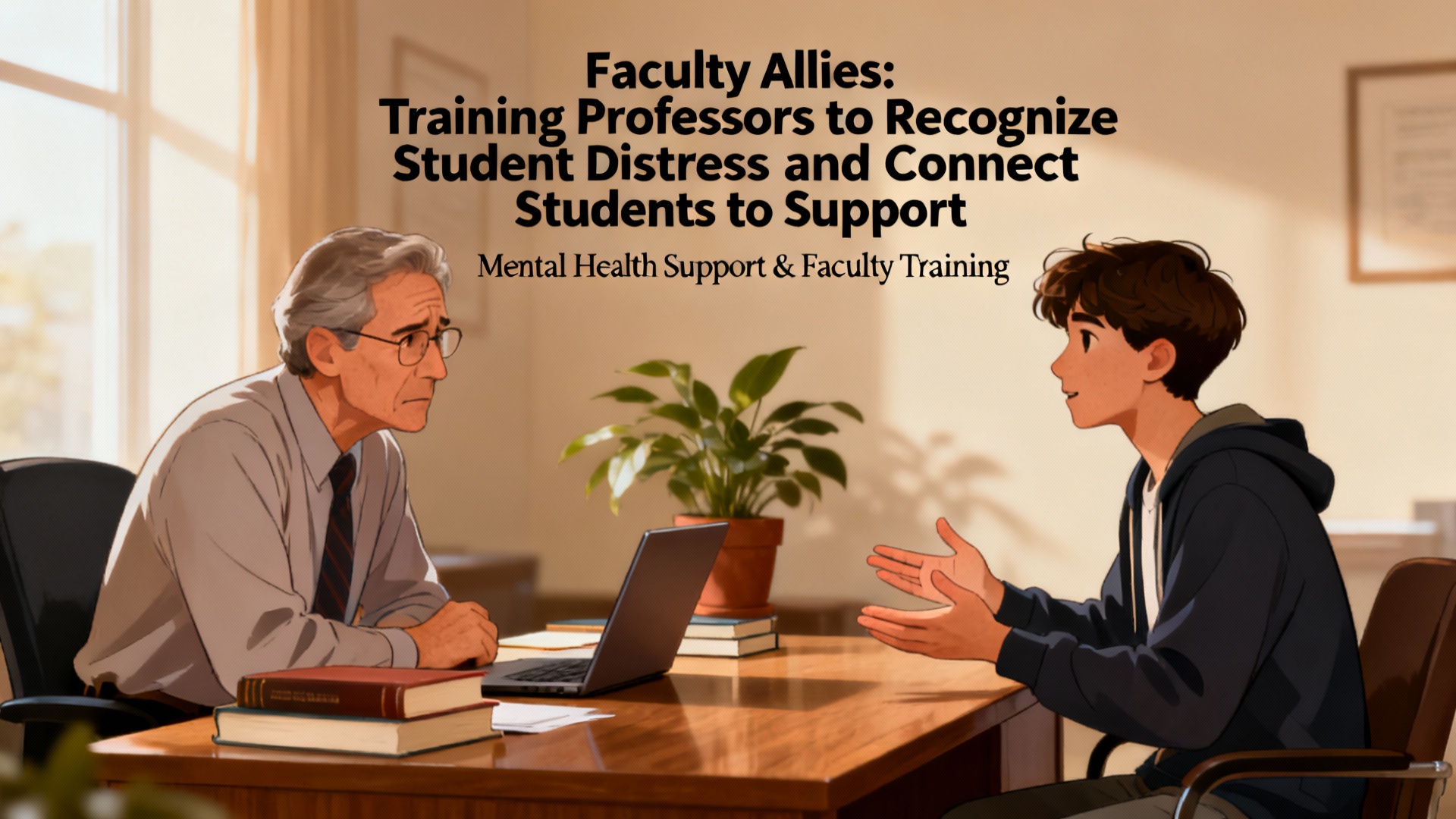
It's 11:47 PM on a Tuesday. A professor finishes grading and notices an email from a student—sent at 3 AM the night before—apologizing for missing class again. The tone feels off. The excuses have been piling up. Something's wrong, but what should they do? Reply with concern? Loop in someone from student affairs? Pretend they didn't notice and hope it resolves?
This moment of hesitation happens thousands of times each week on college campuses across the country. Faculty members increasingly find themselves on the front lines of student mental health—whether they feel prepared for that role or not.
Here's the truth: professors aren't therapists, and no one expects them to be. But they occupy a unique position in students' lives. They notice attendance patterns. They read written work that sometimes reveals deeper struggles. They interact with students during formative, high-pressure years when early intervention can change everything.
For institutional leaders responsible for student success and retention, this represents both a challenge and an opportunity. With the right training, clear boundaries, and sustainable support systems, faculty can become powerful allies in identifying distress early and connecting students to appropriate help—without overstepping their professional role or burning out.
This guide explores how institutions can empower professors to support student mental health through practical training, clear referral pathways, and campus-wide systems that benefit everyone involved.
Key Takeaways
Faculty are often the first to notice signs of student distress—but most lack formal training to respond effectively
Mental Health First Aid and similar programs give professors practical, confidence-building skills without asking them to become counselors
Simple practices like wellness check-ins and supportive syllabus language can create meaningful connections
Clear referral protocols and warm handoff systems make faculty more likely to act when they notice warning signs
Institutions must address faculty wellbeing alongside these expectations to avoid burnout and ensure sustainability
Why Faculty Are Critical to Early Intervention—and Why Institutions Should Care
College counseling centers are stretched thin. The average student-to-counselor ratio at U.S. colleges is approximately 1,411 to 1—far above the recommended ratio of 1,000 to 1 for optimal care [1]. Wait times for appointments can stretch weeks, and many students never seek formal help at all.
Meanwhile, faculty interact with students multiple times per week. They notice when someone stops showing up. They read reflective essays that sometimes reveal anxiety, grief, or hopelessness. They observe body language during office hours.
Research from the American Council on Education found that 73% of college presidents identified student mental health as a pressing concern on their campuses [2]. Yet the response burden often falls disproportionately on counseling staff, leaving an enormous gap between students in distress and available professional support.
The Retention Connection
For campus leaders tracking student success metrics, faculty involvement in early identification isn't just a wellness initiative—it's a retention strategy.
Students who feel connected to at least one faculty member are significantly more likely to persist through challenges and stay enrolled. When a professor notices a struggling student and facilitates a connection to support services, that intervention can be the difference between a student who drops out and one who graduates.
Consider the math: if early faculty intervention helps retain even a small percentage of at-risk students, the institutional return—in tuition revenue, reputation, and mission fulfillment—far exceeds the cost of training programs. This isn't about asking faculty to do more with less. It's about equipping them with skills that serve students, support retention goals, and create a more connected campus culture.
The Reality: Most Professors Feel Unprepared
Despite their front-line position, most faculty receive little to no training in recognizing or responding to student mental health concerns. A survey by the Healthy Minds Network found that while 86% of faculty had encountered a student in psychological distress, fewer than half felt confident in their ability to help [3].
This creates a difficult situation. Professors genuinely want to support their students, but they worry about:
Overstepping professional boundaries and doing more harm than good
Saying the wrong thing during a sensitive conversation
Taking on responsibilities they're not qualified to handle
Not knowing campus resources well enough to make appropriate referrals
Liability concerns if something goes wrong after they intervene
Privacy regulations like FERPA and what they can or cannot share
The result? Many faculty either avoid the topic entirely or attempt to help in well-meaning but potentially counterproductive ways.
Institutions that want faculty to serve as allies must address this preparation gap directly—and that starts with training.
Mental Health First Aid: Building Practical Skills
One of the most effective approaches for preparing faculty is Mental Health First Aid (MHFA), an evidence-based training program developed in Australia and now used in more than 25 countries [4].
The eight-hour course teaches participants to:
Recognize signs and symptoms of mental health challenges
Approach someone who may be struggling
Listen without judgment
Provide appropriate reassurance and information
Encourage professional help-seeking
Know when and how to involve emergency services
Studies show that MHFA training increases mental health literacy, reduces stigmatizing attitudes, and improves participants' confidence in providing initial help [5]. For faculty, this translates into practical skills they can apply immediately—without stepping outside their professional role.
What MHFA Training Looks Like in Practice
A typical MHFA session for faculty covers:
Common mental health conditions students experience, including depression, anxiety, eating disorders, and substance use
Crisis situations such as panic attacks, suicidal thoughts, and psychotic episodes
The ALGEE action plan:
Approach, assess for risk of suicide or harm
Listen nonjudgmentally
Give reassurance and information
Encourage appropriate professional help
Encourage self-help and other support strategies
Campus-specific resources and referral pathways customized to your institution
Self-care for helpers, acknowledging the emotional weight of supporting students in distress
After training, faculty report feeling more comfortable initiating conversations, more knowledgeable about available resources, and more confident that they can make a positive difference [6].
Implementation Considerations for Campus Leaders
When rolling out MHFA or similar training, consider:
Offer multiple formats: In-person sessions, online modules, and department-based workshops accommodate different schedules
Provide meaningful incentives: Professional development credit, modest stipends, or course release time signal institutional commitment
Include all faculty: Adjuncts and part-time instructors often teach high-enrollment courses; excluding them creates gaps
Refresh regularly: Annual updates keep skills sharp and introduce new campus resources
Track participation: Know which departments have trained faculty and where gaps remain
Addressing the "Legal Fear" Gap: FERPA, Privacy, and Faculty Concerns
One of the biggest barriers to faculty engagement isn't lack of caring—it's fear of doing something wrong. Many professors worry that reaching out to a struggling student, or sharing concerns with support staff, might violate privacy regulations.
Here's what faculty need to understand:
What FERPA Does and Doesn't Restrict
FERPA (the Family Educational Rights and Privacy Act) protects students' educational records from unauthorized disclosure. However, it does not prevent faculty from:
Observing and noting behavioral changes (attendance, class participation, quality of work)
Expressing concern directly to a student about what they've observed
Sharing observations with appropriate campus officials (such as a Dean of Students office, counseling center, or student affairs team) on a "need to know" basis when there's a legitimate educational interest or safety concern
Making referrals to campus support services
FERPA is about protecting records, not preventing human connection and concern. A professor who says, "I've noticed you've seemed withdrawn lately and I wanted to check in," isn't violating any regulation—they're being a responsible educator.
When Safety Concerns Override Privacy Defaults
FERPA includes a health and safety exception that permits disclosure of student information without consent when there's an "articulable and significant threat" to the health or safety of the student or others. Faculty don't need to make that determination alone—that's what student support professionals are for—but they should know that erring on the side of reporting concerns is both legally appropriate and institutionally expected.
Building Faculty Confidence Through Clear Guidelines
Institutions can reduce "legal fear" by:
Providing a one-page reference document explaining what faculty can and cannot share, with specific examples
Establishing a clear "when in doubt, report it" protocol that removes the burden of judgment from individual faculty
Hosting Q&A sessions with student affairs professionals who can address specific scenarios
Including FERPA basics in MHFA training so faculty understand the intersection of privacy and care
Making Referrals Work: The Mechanics of Warm Handoffs
Faculty are more likely to make referrals when the process is simple and they trust the receiving services. Vague instructions like "refer them to counseling" aren't enough. Institutions need to operationalize what a referral actually looks like.
What a Warm Handoff Looks Like
A warm handoff is more than handing a student a phone number. It's a supported transition from one caring adult to another. Here's a practical example:
Step 1: Faculty identifies concernProfessor notices a student has missed three classes in a row, submitted work that seems unusually disorganized, and sent an email mentioning "not doing well."
Step 2: Faculty initiates conversationAfter class or during office hours: "I've noticed some changes lately and wanted to check in. How are you doing—really?"
Step 3: Faculty offers connection"I'm not a counselor, but I know people on campus who can help. Would you be open to me introducing you to someone in the Dean of Students office? I can send them a quick note so they know to expect you."
Step 4: Faculty sends introductionA brief email to the appropriate campus contact:
Subject: Student Introduction - [Name]Hi [Support Staff Name],I'm reaching out about [Student Name], a student in my [Course]. They've given me permission to connect them with you. I've noticed [brief, factual observations—missed classes, mention of struggling in email, etc.] and thought they might benefit from a conversation with your office.[Student Name], I've cc'd you here so you can follow up directly. [Support Staff Name] is great and can help connect you with whatever support might be useful.Best,[Professor]
Step 5: Faculty follows upA week later, the professor checks in briefly: "Hey, were you able to connect with [Support Staff Name]? Just wanted to make sure you're getting what you need."
Infrastructure That Makes Referrals Easier
Institutions can support this process by:
Creating a single point of contact: A dedicated email or form for faculty concerns (e.g., studentconcern@university.edu) that routes to appropriate staff
Providing business cards or handouts listing key campus resources, with names and direct contacts—not just department phone numbers
Establishing "consultation hours" where faculty can discuss concerns with counseling or student affairs staff confidentially before making a formal referral
Closing the loop: When possible, letting referring faculty know that a student connected with services (without sharing details) reinforces that their effort mattered
Using care management platforms that allow faculty to flag concerns and track whether students followed through on referrals
Beyond Training: Creating a Culture of Care in the Classroom
Workshops are essential, but they're not sufficient on their own. Faculty need practical tools they can integrate into their regular teaching practice—low-lift strategies that normalize conversations about wellbeing and create opportunities for connection.
Wellness Check-Ins
Simple, low-barrier check-ins can help faculty identify students who might be struggling before crisis hits.
Examples include:
A brief one-question survey at the start of class: "On a scale of 1-5, how are you doing this week?"
"Temperature check" discussions where students share one word describing their current state
Anonymous digital polls that gauge class stress levels before major assignments
Open invitations in syllabi encouraging students to share personal circumstances affecting their work
These practices accomplish several things simultaneously. They signal that the professor cares about students as whole people. They normalize discussion of wellbeing. And they create low-stakes opportunities for students to flag concerns before they become crises.
Supportive Messaging in Course Materials
The language professors use in syllabi, emails, and announcements shapes how students perceive their approachability.
Consider the difference:
Traditional approach: "Late assignments will result in a 10% grade reduction per day."
Supportive approach: "Life happens. If you're struggling to meet a deadline, please reach out before the due date so we can discuss options."
Small shifts in tone communicate that faculty understand students face challenges beyond academics and are willing to work with them through difficult periods—without abandoning academic standards.
Other supportive messaging strategies:
Including mental health resources in the syllabus alongside academic policies
Acknowledging high-stress periods (finals, holidays, return from breaks) in class announcements
Sending periodic "just checking in" emails during especially demanding stretches
Responding to concerning student submissions with compassion rather than only grade-focused feedback
Office Hours as Connection Points
Traditional office hours focus on course content, but they can also serve as spaces for deeper connection.
Faculty can:
Begin conversations by asking how students are doing generally, not just academically
Notice and gently name changes they've observed: "I've noticed you've seemed quieter lately—is everything okay?"
Keep campus resource cards visible in their office
End difficult conversations with concrete next steps, even if that's simply "Check in with me next week"
The goal isn't to conduct therapy. It's to create moments of human connection that might prompt a struggling student to seek appropriate help.
Establishing Clear Boundaries
Empowering faculty doesn't mean asking them to handle mental health concerns alone. Effective institutional support requires clear boundaries and well-communicated expectations.
What Faculty Should Do
Listen with empathy and without judgment
Express genuine concern and care
Share information about campus resources
Make warm referrals to appropriate support services
Follow up to ensure students connected with support
Report concerns through established channels when appropriate
Maintain appropriate confidentiality while fulfilling duty-of-care obligations
What Faculty Shouldn't Do
Attempt to diagnose mental health conditions
Provide ongoing counseling or therapy
Promise complete confidentiality when safety may be at risk
Take sole responsibility for a student's wellbeing
Ignore concerning behavior hoping it resolves on its own
Share student information inappropriately or with unauthorized parties
A Note on Balancing Support with Academic Standards
Supporting student mental health doesn't mean abandoning academic expectations. It means recognizing that students facing challenges may need flexibility in how they meet standards, not whether they meet them.
Clear policies, proactive communication, and documented accommodations protect both students and faculty while maintaining rigor. When faculty work with disability services and other campus offices, they can provide appropriate support without making ad-hoc decisions that create inconsistency or resentment.
Addressing Faculty Wellbeing
Here's an uncomfortable reality: you can't pour from an empty cup.
Faculty face their own mental health challenges—workload pressures, job insecurity, work-life balance struggles, and the emotional labor of supporting students. Asking professors to take on additional responsibilities without addressing their own wellbeing is neither sustainable nor fair.
Many faculty members carry these expectations home with them. They check email at midnight wondering if they should have said something to that struggling student. They replay conversations, second-guessing their responses. They absorb the emotional weight of students' disclosures with no formal outlet for processing.
Institutions serious about faculty involvement in student mental health support must also:
Provide mental health resources specifically for faculty and staff—and communicate them clearly
Acknowledge the emotional toll of supporting students in distress through professional development and departmental conversations
Offer debriefing opportunities after difficult situations, either through counseling services or peer support
Build student support responsibilities into workload calculations rather than treating them as invisible add-ons
Create peer support networks among faculty who share this work
Recognize and celebrate faculty who demonstrate exceptional care for students
This isn't just about preventing burnout. It's about modeling the wellness-centered approach institutions claim to value.
Implementation: A Phased Approach for Campus Leaders
If your institution is ready to empower faculty as mental health allies, consider this framework:
Phase 1: Assessment and Buy-In (Months 1-2)
Survey faculty about current comfort levels, training needs, and barriers to engagement
Identify faculty champions who are already engaged in this work informally
Secure leadership commitment and necessary resources (training budget, staff time)
Partner with counseling services to establish or clarify referral protocols
Review existing policies for gaps or contradictions
Phase 2: Training Rollout (Months 3-6)
Offer MHFA or similar training through multiple formats to maximize participation
Provide meaningful incentives for participation (professional development credit, stipends)
Create training specifically tailored to your campus context, resources, and referral pathways
Develop quick-reference materials (resource cards, one-pagers on FERPA, referral templates)
Train student affairs staff on how to receive and respond to faculty referrals
Phase 3: Ongoing Support (Months 6-12)
Establish regular refresher trainings and updates on new resources
Create communities of practice where trained faculty share experiences and strategies
Collect feedback from faculty and students to continuously improve
Track referral patterns to identify gaps or departments needing additional support
Recognize faculty contributions to student wellbeing
Phase 4: Culture Shift (Year 2 and Beyond)
Integrate student wellbeing considerations into course design conversations and new faculty orientation
Include student support in tenure and promotion criteria where appropriate
Share success stories that normalize faculty involvement
Build wellness-centered practices into institutional identity and strategic planning
Measure impact on retention and student success outcomes
The Bigger Picture: Faculty as Part of the Ecosystem
Faculty allies don't replace counseling centers, student affairs professionals, or peer support programs. They extend the reach of existing resources and catch students who might otherwise fall through the cracks.
Think of it as a layered system:
Students learn self-advocacy and help-seeking skills
Peers provide front-line informal support
Faculty notice warning signs and make connections
Staff (advisors, residence life, etc.) coordinate wraparound support
Professional counselors provide clinical care
Crisis services respond to emergencies
Each layer serves a distinct function, and each relies on the others. Faculty who understand their specific role within this ecosystem can contribute effectively without overstepping or burning out.
For campus leaders, the goal is building systems that support this coordination—platforms that connect engagement data across touchpoints, referral protocols that close the loop, and training that prepares everyone to play their part.
Moving Forward with Intention
The student lingering after class—the one from our opening scenario—deserves a professor who knows what to say. Not a perfect response, but a human one. A response that communicates care, offers connection, and opens a door to appropriate support.
With proper training, clear guidelines, and institutional backing, faculty across every discipline can provide exactly that. They can become the allies students need during some of the most challenging years of their lives.
The goal isn't to transform professors into mental health professionals. It's to ensure that every student who needs help has multiple pathways to find it—and that faculty feel confident being one of those pathways.
Ready to strengthen faculty-student connections and improve early intervention on your campus? Learn how integrated engagement platforms can support proactive identification and connection to resources. Book a CampusMind demo to explore solutions designed for student success and retention.
Frequently Asked Questions
What if a faculty member encounters a student in immediate crisis?
If a student expresses suicidal intent or poses an immediate danger, faculty should stay calm, avoid leaving the student alone, and contact campus security or crisis services immediately. MHFA training covers these situations specifically. Faculty should have emergency numbers readily accessible—saved in their phones, posted in offices, and included in syllabi. The priority in a crisis is safety, not solving the underlying problem.
How can faculty balance supporting students with maintaining academic standards?
Supporting student mental health doesn't mean abandoning academic expectations. It means recognizing that students facing challenges may need flexibility in how they meet standards, not whether they meet them. Clear policies, proactive communication, and documented accommodations through appropriate campus offices protect both students and faculty while maintaining rigor. Faculty should work with disability services and dean of students offices rather than making ad-hoc decisions alone.
What should faculty do if a student refuses help or denies struggling?
Respect the student's autonomy while leaving the door open. Faculty might say: "I hear you. Just know that if things change, I'm here and resources are available." Planting seeds matters—students often return weeks or months later when they're ready to accept support. Faculty can also still report concerns through appropriate channels if they believe the student may be at risk, even if the student has declined direct help.
How can adjunct or part-time faculty participate in student support?
Institutions should extend training opportunities and resource access to all faculty, regardless of employment status. Adjuncts often teach high-enrollment introductory courses and interact with large numbers of first-year students—exactly the population most at risk for early departure. Excluding part-time faculty from training creates significant gaps in the support system. At minimum, provide quick-reference materials and clear referral contacts to all instructors.
Does faculty involvement in mental health support require additional compensation?
This depends on institutional context and how responsibilities are framed. At minimum, time spent in training should be compensated or count toward professional development requirements. Where student support becomes a significant documented duty, formal recognition through workload adjustments or compensation is appropriate. The key is avoiding the perception that this work is an unfunded mandate layered on top of existing responsibilities.
About This Article
This article was developed by CampusMind, a student-centered engagement platform connecting students, families, and campus resources to support wellbeing and improve retention. Our team combines expertise in higher education technology, behavioral science, and student success research to provide actionable insights for campus leaders navigating today's student support challenges.
Works Cited
[1] International Accreditation of Counseling Services — "Standards for University and College Counseling Centers." https://iacsinc.org/
[2] American Council on Education — "College and University Presidents Respond to COVID-19: 2020 Fall Term Survey." https://www.acenet.edu/
[3] Healthy Minds Network — "The Healthy Minds Study: 2021-2022 Data Report." https://healthymindsnetwork.org/
[4] Mental Health First Aid USA — "About MHFA." https://www.mentalhealthfirstaid.org/about/
[5] Hadlaczky, G., et al. — "Mental Health First Aid is an effective public health intervention for improving knowledge, attitudes, and behaviour: A meta-analysis." International Review of Psychiatry. https://pubmed.ncbi.nlm.nih.gov/
[6] Lipson, S.K., et al. — "Mental health conditions among community college students: A national study of prevalence and use of treatment services." Psychiatric Services. https://ps.psychiatryonline.org/