Moving thousands of miles from home to pursue a college degree takes courage. For international students, the transition involves far more than adjusting to a new campus—it means navigating an unfamiliar culture, communicating in a second language, managing complex F-1 or J-1 visa requirements, and building an entirely new support network from scratch.
Many institutions treat international student support as an afterthought, offering orientation week resources that fade quickly and leaving students to figure out the rest alone. But colleges that intentionally design welcoming, responsive systems for international students see measurable gains—not just in retention, but in campus culture, academic outcomes, and global reputation.
According to research published in Higher Education, international students who receive dedicated, culturally-informed support show significantly stronger persistence rates than those navigating systems designed primarily for domestic populations [8]. The difference often comes down to whether institutions treat international student success as a campus-wide priority or a peripheral concern.
This guide explores the real challenges international students face, the support systems that produce results, and how institutions can create environments where students from around the world don't just survive—they thrive.
Key Takeaways
International students face overlapping stressors including cultural adjustment, language barriers, and immigration anxiety that compound typical college challenges
Institutions with dedicated international student support see higher retention and graduation rates among this population
Effective support combines proactive outreach, peer connections, accessible services, and ongoing engagement beyond orientation
Building inclusive campus communities benefits all students, not just those from abroad
The first 100 days are critical—students who don't form connections early often struggle to build them later

The Unique Challenges International Students Face
Understanding the specific pressures international students navigate is the first step toward meaningful support. These challenges don't exist in isolation—they layer on top of each other and intensify during critical transition periods.
Cultural Adjustment and Homesickness
The excitement of arriving in a new country often gives way to a quieter, more difficult reality. Research from the Journal of Studies in International Education found that homesickness among international students tends to peak several weeks into the semester, once the novelty fades and the distance from family becomes visceral [1].
Cultural adjustment goes beyond missing familiar food or holidays. It includes navigating different social norms, classroom expectations, and communication styles. American academic culture often emphasizes class participation, direct communication with professors, and collaborative group work—practices that may feel foreign or uncomfortable for students from educational systems that value deference to authority or independent study [2].
What does this mean in practice? A student who excelled academically back home might suddenly feel uncertain about how to participate in class, approach a professor during office hours, or join a study group. That uncertainty, left unaddressed, can spiral into isolation.

Language Barriers Beyond the Classroom
Even students with strong English proficiency face challenges that test administrators often underestimate. Academic English differs significantly from conversational English, and technical vocabulary in specific disciplines creates additional hurdles. Students report that understanding lectures, participating in discussions, and writing papers require far more cognitive effort than they anticipated [3].
But the impact extends beyond academics. Social interactions—casual conversations, understanding jokes, picking up on cultural references—can feel exhausting. Many international students describe "language fatigue," where the mental effort of constant translation leaves them drained by the end of each day [4].
This fatigue often leads to self-isolation. It becomes easier to retreat to a dorm room and video call family than to expend energy navigating unfamiliar social situations—a pattern that, once established, becomes increasingly difficult to break.
Visa Stress and Immigration Anxiety
International students carry a burden their domestic peers don't fully appreciate: maintaining legal status. F-1 and J-1 visa requirements dictate enrollment status, work eligibility, travel limitations, and timelines. A dropped class, a delayed graduation, or even a misunderstanding about CPT or OPT employment rules can jeopardize a student's ability to remain in the country [5].
This creates a persistent low-level anxiety that touches everything. Students may hesitate to seek help for academic struggles because they fear consequences for their enrollment status. They may avoid mental health services because of stigma or concerns about documentation. And they often face these stressors with limited understanding of where to turn for accurate information [6].
SEVIS compliance isn't just paperwork—it's a constant background stress that shapes how international students approach every academic decision.
Financial Pressures and Limited Work Options
International students typically pay higher tuition rates and face significant restrictions on employment. Most F-1 students cannot work off-campus during their first year, and on-campus job opportunities are limited and competitive. NAFSA research indicates that while international students contribute over $40 billion annually to the U.S. economy, many face significant personal financial strain [7].
When unexpected expenses arise—a flight home for a family emergency, medical costs, or simply running out of funds mid-semester—international students have fewer options than their domestic peers. This financial precarity adds another layer of stress to an already demanding experience and can become a hidden driver of attrition.
Support Systems That Produce Results
The good news: institutions that invest in comprehensive international student support see measurable improvements. Research consistently shows that targeted programming improves retention, academic performance, and student satisfaction among international populations [8]. Here's what effective support looks like in practice.
Pre-Arrival Engagement and Orientation
Support should begin before students set foot on campus. Pre-arrival communication that addresses practical concerns—housing, transportation, banking, what to pack, how to navigate airport immigration—reduces anxiety and helps students feel prepared [9].
Effective pre-arrival programs include:
Virtual orientation modules covering academic expectations, campus culture, and local resources
Connections with current international students who can answer questions and offer reassurance
Clear, accessible information about visa requirements and arrival logistics
Online communities where incoming students can connect with each other before arriving
Practical guides addressing concerns like cell phone plans, weather-appropriate clothing, and grocery shopping
Extended orientation programming matters too. A single orientation week cannot address the complexity of international student transition. Institutions seeing the strongest retention outcomes provide ongoing programming throughout the first semester—and beyond—as new challenges emerge [10].

Dedicated International Student Services
Generic student services don't always meet international student needs. Dedicated advisors who understand visa regulations, cultural adjustment patterns, and the specific challenges this population faces make a significant difference [11].
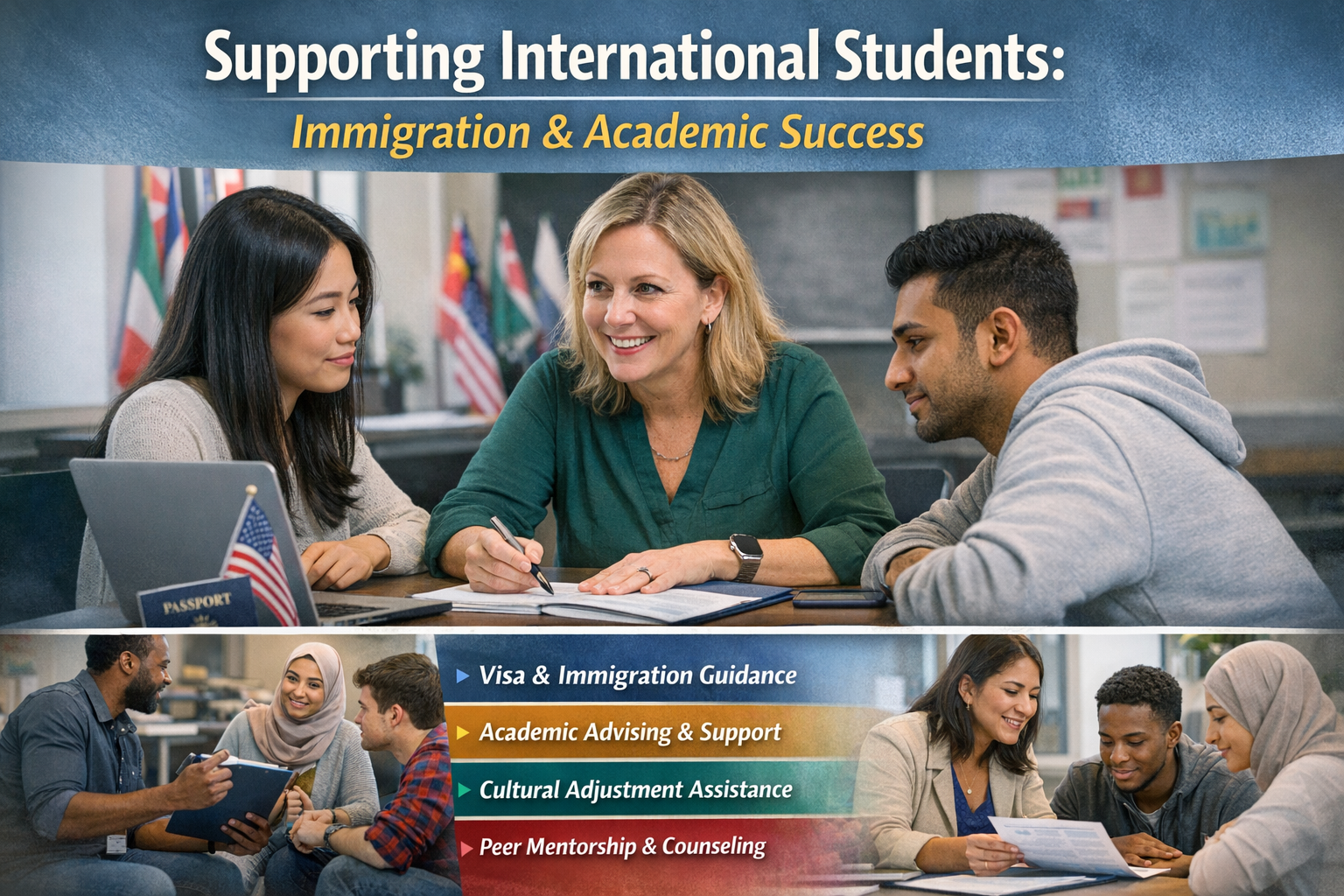
Effective international student offices provide:
Immigration advising with accurate, up-to-date guidance on maintaining legal status, including SEVIS requirements, CPT/OPT timelines, and travel documentation
Crisis support for unexpected situations (visa issues, family emergencies, financial hardship)
Advocacy and referrals to other campus services, with warm handoffs rather than cold referrals
Programming specifically designed for international student concerns, from tax workshops to cultural adjustment sessions
The key is accessibility. When students know exactly where to go with questions—and trust that the staff understand their situation—they're more likely to seek help early rather than waiting until problems escalate.
Language Support Beyond ESL Classes
Language support should extend beyond formal coursework. Writing centers with tutors trained to work with multilingual writers, conversation partners for practice with informal English, and academic support that addresses discipline-specific vocabulary all contribute to student success [12].
Some institutions have found success with:
Supplemental instruction sessions for courses with high international enrollment
Language exchange programs that pair international and domestic students for mutual benefit
Writing workshops focused on American academic conventions (citation styles, argument structure, email etiquette)
Faculty development on inclusive teaching practices for multilingual classrooms
Pronunciation workshops that build confidence for class participation
The goal isn't to "fix" international students' English—it's to provide scaffolding that helps them succeed while their language skills continue developing naturally.
Building Peer Connections
Peer relationships are among the strongest predictors of international student retention and wellbeing. Students who form meaningful friendships—with both international and domestic peers—report higher satisfaction and are more likely to persist [13].
Structured programs that facilitate these connections include:
Peer mentoring programs pairing new international students with experienced ones who share language or cultural background
International student organizations and cultural clubs with adequate funding and institutional support
Intentional programming that brings international and domestic students together around shared interests (not just "international nights")
Living-learning communities with international focus
Study groups facilitated by student affairs staff or peer leaders
The emphasis on "intentional" matters. Left to chance, international and domestic students often cluster separately. Structured activities that create genuine interaction—not just proximity—build bridges that might not form organically.
Mental Health Services with Cultural Competence
International students underutilize mental health services at higher rates than their domestic peers, often due to stigma, unfamiliarity with Western counseling models, or concerns about confidentiality and visa implications [14].
Culturally competent mental health support includes:
Counselors trained in cross-cultural counseling approaches who understand how mental health is conceptualized differently across cultures
Outreach that normalizes help-seeking and explains what counseling involves in concrete terms
Group programming that addresses common international student concerns (homesickness, cultural adjustment, imposter syndrome, family pressure)
Multilingual services or interpretation when possible
Clear communication that counseling records are separate from academic records and won't affect visa status
Some institutions have found success with peer support models—trained student ambassadors who can recognize signs of struggle and connect peers with resources in a less formal context.
Creating Inclusive Campus Communities
Individual services matter, but the broader campus environment shapes international student experience just as powerfully. Institutions that genuinely welcome students from around the world embed that value into their culture—not just their international office.
Faculty and Staff Engagement
Faculty often have the most consistent contact with international students, yet many feel unprepared to support them effectively. Professional development that helps faculty understand international student challenges and adapt their teaching accordingly benefits everyone [15].
Practical faculty strategies include:
Explicitly explaining classroom expectations and participation norms rather than assuming students understand unwritten rules
Providing written instructions alongside verbal directions and making slides available before class
Creating opportunities for participation beyond real-time discussion (online forums, written reflections, think-pair-share)
Learning to pronounce student names correctly and using name tents or pronunciation guides
Understanding that office hours may feel intimidating for students from different educational cultures—and creating alternative ways to connect
Recognizing that plagiarism concerns may sometimes reflect cultural differences in how knowledge attribution is taught
Connecting struggling students with resources proactively rather than waiting for them to ask
When faculty signal that they understand and value international students' perspectives, those students are more likely to engage academically and seek help when needed.
Involving International Students as Campus Contributors
The most effective programs don't treat international students as recipients of services—they engage them as contributors to campus life. International students bring perspectives, skills, and experiences that enrich the entire community [16].
Opportunities for meaningful contribution include:
Global ambassador or peer mentor roles with real responsibility and recognition
Cultural programming led by international student organizations with adequate budget and administrative support
Inclusion in research opportunities, student government, and leadership positions
Guest presentations in classes where their background offers relevant expertise
Employment in campus offices where their multilingual skills and international perspectives add value
When international students see themselves as valued contributors rather than visitors to be accommodated, their sense of belonging deepens—and so does their commitment to persisting.
Addressing Isolation Before It Takes Root
The critical window for international student engagement is the first semester—particularly the first several weeks. Students who don't form connections early often struggle to build them later. Proactive outreach during this period can prevent the isolation that leads to disengagement and dropout [17].
This might look like:
Regular check-ins from peer mentors or advisors during the first semester, not just during orientation week
Early alert systems that flag international students showing signs of disengagement (missed classes, declining grades, low participation)
Targeted invitations to events and activities (not just mass emails that disappear in cluttered inboxes)
Structured opportunities to connect in low-pressure settings
Follow-up with students who attend initial events but then disappear
The goal is to intervene before isolation becomes entrenched—when a missed connection is still a small problem rather than a semester-long pattern.
Measuring Success and Demonstrating Impact
Support for international students requires resources—and those resources require justification. Institutions that track outcomes can demonstrate impact and make the case for sustained investment.
Key metrics to monitor include:
| Metric | What It Tells You |
| First-year retention rates (international vs. overall) | Whether your support systems are working for this population |
| Graduation rates for international students | Long-term success of your approach |
| Utilization of support services | Whether students know about and trust available resources |
| Time to first service contact | How early students engage with support |
| Student satisfaction surveys (with international-specific questions) | Qualitative experience data |
| Focus groups and exit interviews | Root causes of challenges and departures |
Data should inform continuous improvement. Which programs are students actually using? Which challenges persist despite current efforts? Where are the gaps between what you offer and what students need?
Building Systems for International Student Success
Enhancing support for international students isn't just about adding programs—it's about building responsive systems that adapt to student needs. Siloed services create fragmented experiences. Integrated support, where information flows between advisors, faculty, and student services, creates a safety net that catches students before they fall through the cracks.
The institutions getting this right share common characteristics:
They treat international student success as a campus-wide priority, not just an international office concern
They invest in dedicated expertise while also building capacity across departments
They continuously learn from the students they serve rather than assuming they know what's needed
They measure outcomes, not just activities—tracking whether students are succeeding, not just whether programs exist
For students who have traveled across the world to pursue education, that institutional commitment makes the difference between surviving and thriving.
Ready to create more connected, supportive experiences for all your students? Book a call to explore how CampusMind helps institutions identify student needs early and build the engagement systems that support retention.
Frequently Asked Questions
What are the biggest challenges international students face in college?
International students navigate overlapping challenges including cultural adjustment, homesickness, language barriers, visa stress, and financial constraints. These stressors compound typical college pressures and often peak during the first semester when students are simultaneously adjusting to academic expectations, social norms, and daily life in an unfamiliar environment. The layering effect means that what might be manageable challenges individually can become overwhelming in combination.
How can colleges better support international student mental health?
Effective mental health support for international students requires cultural competence. This includes counselors trained in cross-cultural approaches, outreach that normalizes help-seeking and explains what counseling actually involves, programming that addresses common concerns like homesickness and cultural adjustment, and clear communication that counseling won't affect visa status. Peer support models can also create less formal pathways to resources for students hesitant to use traditional services.
Why do international students sometimes have lower retention rates?
When retention gaps exist, they typically stem from unaddressed challenges: isolation, language difficulties, financial strain, or insufficient support navigating complex visa requirements. Institutions with dedicated international student services, proactive first-semester engagement, and systems that help students build peer connections generally see stronger retention among this population. The key is early intervention before small struggles become insurmountable barriers.
What campus services help international students succeed?
Key services include dedicated international student advising, immigration support with accurate SEVIS guidance, language assistance beyond ESL classes, culturally competent counseling, and programming that facilitates genuine peer connections. Pre-arrival engagement and extended orientation (beyond just the first week) also significantly impact student adjustment and success. The most effective approach integrates these services rather than treating them as separate silos.
How can domestic students help welcome international students?
Domestic students can participate in peer mentoring programs, language exchange partnerships, and cultural events. Simple gestures matter: including international students in study groups, explaining cultural references or campus traditions, inviting them to social activities, and being patient with language differences. These small acts of inclusion help build the connections that support wellbeing and retention for everyone involved.
About This Resource
This article was developed by CampusMind, a student engagement platform designed to help colleges support student wellbeing, build belonging, and improve retention. Our approach combines behavioral science, real-time engagement data, and personalized support tools to help institutions identify student needs early and respond effectively. We work with student affairs professionals, retention specialists, and campus leaders committed to creating environments where every student can succeed.
Works Cited
[1] Sawir, E., Marginson, S., Deumert, A., Nyland, C., & Ramia, G. — "Loneliness and International Students: An Australian Study." Journal of Studies in International Education. https://journals.sagepub.com/doi/10.1177/1028315307299699
[2] Institute of International Education — "Open Doors Report on International Educational Exchange." https://opendoorsdata.org/
[3] Andrade, M.S. — "International Students in English-Speaking Universities: Adjustment Factors." Journal of Research in International Education. https://journals.sagepub.com/doi/10.1177/1475240906065589
[4] NAFSA: Association of International Educators — "Supporting International Student Success." https://www.nafsa.org/
[5] U.S. Immigration and Customs Enforcement — "Student and Exchange Visitor Program (SEVP)." https://www.ice.gov/sevis
[6] American Council on Education — "Internationalization in Action: Supporting International Students." https://www.acenet.edu/
[7] NAFSA — "The Economic Value of International Students." https://www.nafsa.org/policy-and-advocacy/policy-resources/nafsa-international-student-economic-value-tool-v2
[8] Mamiseishvili, K. — "International Student Persistence in U.S. Postsecondary Institutions." Higher Education. https://link.springer.com/journal/10734
[9] Smith, R.A. & Khawaja, N.G. — "A Review of the Acculturation Experiences of International Students." International Journal of Intercultural Relations. https://www.sciencedirect.com/journal/international-journal-of-intercultural-relations
[10] Gebhard, J.G. — "International Students' Adjustment Problems and Behaviors." Journal of International Students. https://www.ojed.org/index.php/jis
[11] Glass, C.R. & Westmont, C.M. — "Comparative Effects of Belongingness on the Academic Success and Cross-Cultural Interactions of Domestic and International Students." International Journal of Intercultural Relations. https://www.sciencedirect.com/journal/international-journal-of-intercultural-relations
[12] Ferris, D.R. & Hedgcock, J. — "Teaching L2 Composition: Purpose, Process, and Practice." Routledge. https://www.routledge.com/
[13] Hendrickson, B., Rosen, D., & Aune, R.K. — "An Analysis of Friendship Networks, Social Connectedness, Homesickness, and Satisfaction Levels of International Students." International Journal of Intercultural Relations. https://www.sciencedirect.com/journal/international-journal-of-intercultural-relations
[14] Mori, S.C. — "Addressing the Mental Health Concerns of International Students." Journal of Counseling & Development. https://onlinelibrary.wiley.com/journal/15566676
[15] Trice, A.G. — "Faculty Perceptions of Graduate International Students: The Benefits and Challenges." Journal of Studies in International Education. https://journals.sagepub.com/doi/10.1177/1028315303260832
[16] Lee, J.J. & Rice, C. — "Welcome to America? International Student Perceptions of Discrimination." Higher Education. https://link.springer.com/journal/10734
[17] Menzies, J.L. & Baron, R. — "International Postgraduate Student Transition Experiences: The Importance of Student Societies and Friends." Innovations in Education and Teaching International. https://www.tandfonline.com/toc/riie20/current