
Key Takeaways:
Autonomy-supportive parenting (guidance + respect for independence) correlates with better college outcomes
Controlling behaviors like helicopter parenting can harm student development and increase anxiety
Quality of involvement matters more than frequency of contact
Students need support, not management—your role is evolving from director to consultant
Financial leverage and cultural norms add complexity to the "right amount" of involvement
When your child heads off to college, figuring out your role as a parent suddenly gets complicated. Should you check in daily or step back completely? Help with course selection or let them figure it out? Text them their schedule reminders or trust they'll manage?
Here's the truth: the answer isn't binary, and anyone selling you a simple solution is lying.
Parental involvement in college success has become a flashpoint as smartphones make constant contact effortless. You can track your student's location, text during every class break, and email their professors—but should you? Research offers surprising insights about when involvement supports success and when it sabotages it.
The difference between helpful support and suffocating interference can determine whether your student thrives or struggles. Let's explore what the actual data reveals, beyond the think-pieces and parenting hot takes.
What Does the Research Actually Say About Parental Involvement?
The relationship between parental involvement and college outcomes isn't straightforward—it's maddeningly nuanced.
A 2014 study by Schiffrin and colleagues in the Journal of Child and Family Studies found that students with helicopter parents reported significantly higher depression and lower life satisfaction, even when controlling for other factors [1]. These weren't students with uninvolved parents—they were students whose parents were too involved in the wrong ways.
But here's where it gets interesting: The same body of research shows that autonomy-supportive parenting produces opposite results. When parents provided emotional support while respecting their student's decision-making authority, those students showed higher academic motivation and better adjustment to college [2].
Laura Padilla-Walker's research at Brigham Young University revealed that emerging adults whose parents practiced what she calls "warm control"—high expectations paired with emotional support and respect for autonomy—had better psychological adjustment than those with either uninvolved or hovering parents [3].
The National Survey of Student Engagement data shows something that should reassure anxious parents: frequency of contact alone doesn't predict outcomes. Students who communicated daily with parents performed no worse than those who talked weekly—what mattered was whether those interactions felt supportive or intrusive [4].
Translation? You're not damaging your kid by texting often. You're damaging them if those texts function as surveillance rather than connection.

How Often Should You Communicate With Your College Student?
There's no magic number.
Some parent-student pairs naturally communicate daily and both parties enjoy it. Others check in weekly. Neither pattern is inherently healthier—context matters.
Research from the Journal of Adolescence indicates that student-initiated contact correlates with better outcomes than parent-initiated contact [5]. When students reach out because they want to share something, that's healthy connection. When they respond out of obligation or fear of parental anxiety, that's problematic.
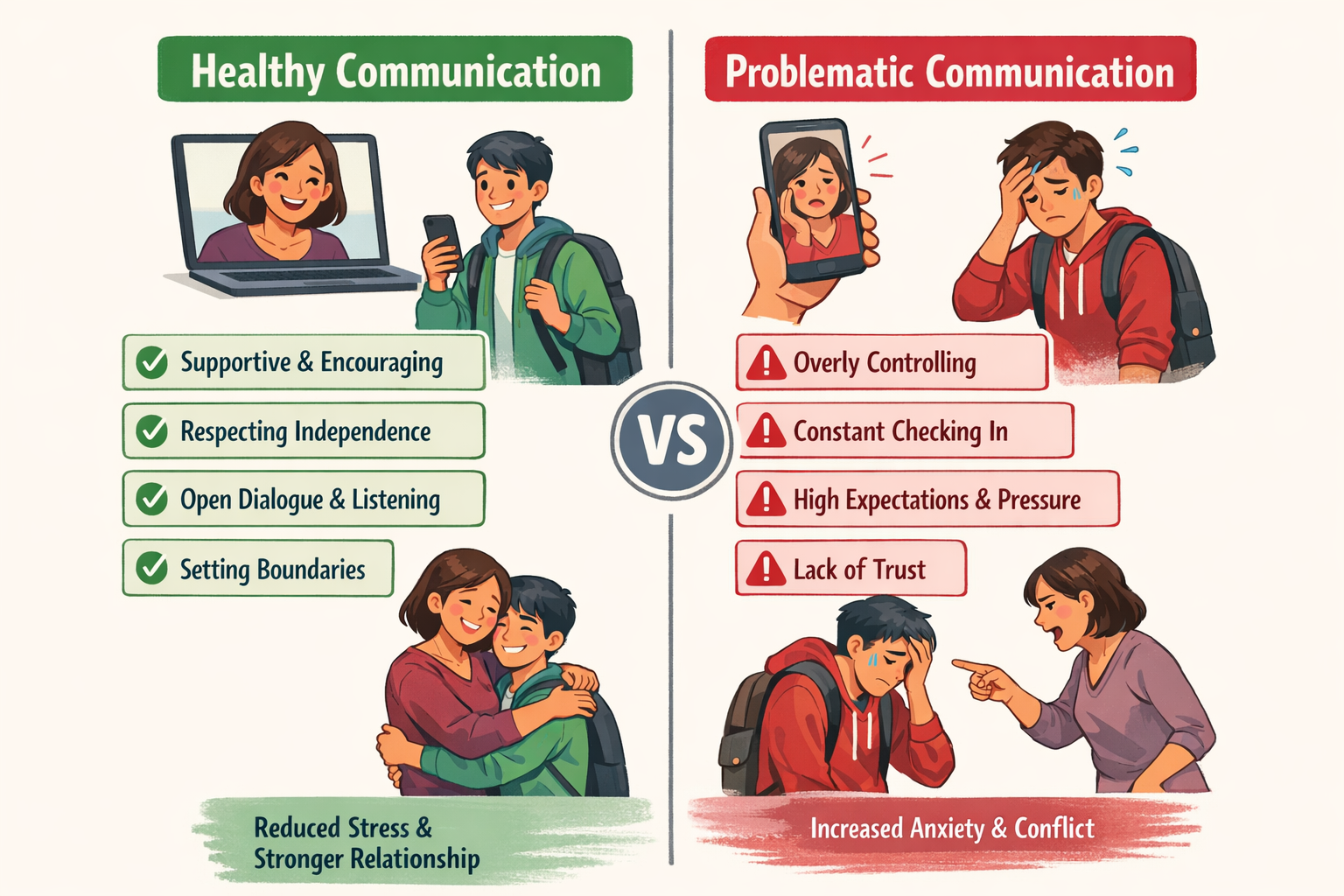
Signs Your Communication Pattern Is Healthy:
Your student initiates contact regularly
Conversations feel reciprocal (you share about your life too)
Your student answers honestly when you ask how they're doing
You can go a day or two without contact without feeling anxious
Your student volunteers information rather than only answering questions
Signs Your Communication Pattern Needs Adjustment:
You panic if you haven't heard back within a few hours
Your student's responses are short and obligatory
You're always the one initiating
Your questions feel like status reports rather than genuine interest
You know their schedule better than they do
The healthiest approach? Follow your student's lead on frequency while maintaining consistent availability.
Can I Help Without Hovering? The Support vs. Control Distinction
This is the question that actually matters.
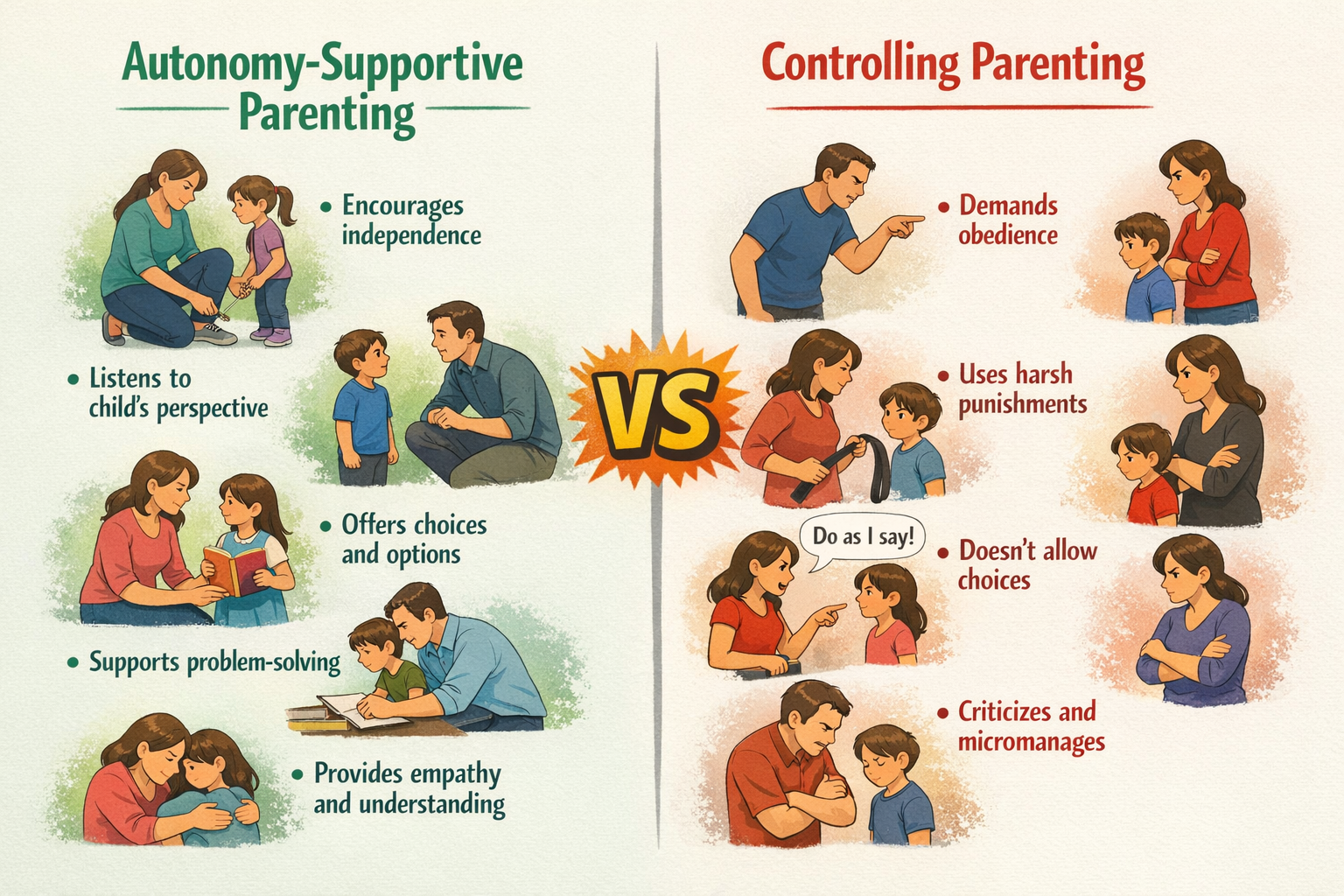
Autonomy-Supportive Behaviors (These Help):
Asking about their goals and genuinely listening without imposing your agenda
Offering perspective when requested, not delivering unsolicited advice
Encouraging them to attempt solutions before you provide answers
Validating their emotions while expressing confidence in their capability
Sharing information but letting them make final decisions
Celebrating their successful problem-solving, not just final outcomes
Controlling Behaviors (These Harm):
Making decisions for them without their input
Contacting professors or administrators without permission
Using guilt or financial pressure to influence their choices
Monitoring constantly through tracking apps you didn't mutually agree upon
Solving their problems before they've tried
Treating their life choices as reflections on you
Here's a real scenario that illustrates the difference:
Your daughter calls upset because she got a C on her first college exam. The controlling response: "What happened? Did you study enough? Maybe you should drop that class. Let me email your professor to see if there's extra credit." The autonomy-supportive response: "That sounds really disappointing. Tell me what happened... What do you think went wrong?... What resources does the class have for students who want to improve?... How can I support you?"
Notice the difference? One treats the student as incapable. The other treats the problem as an opportunity for them to build skills.
Signs You're Helicopter Parenting (Even If You Don't Mean To)
Let's be direct: most helicopter parents don't realize they're doing it. They genuinely believe they're being helpful.
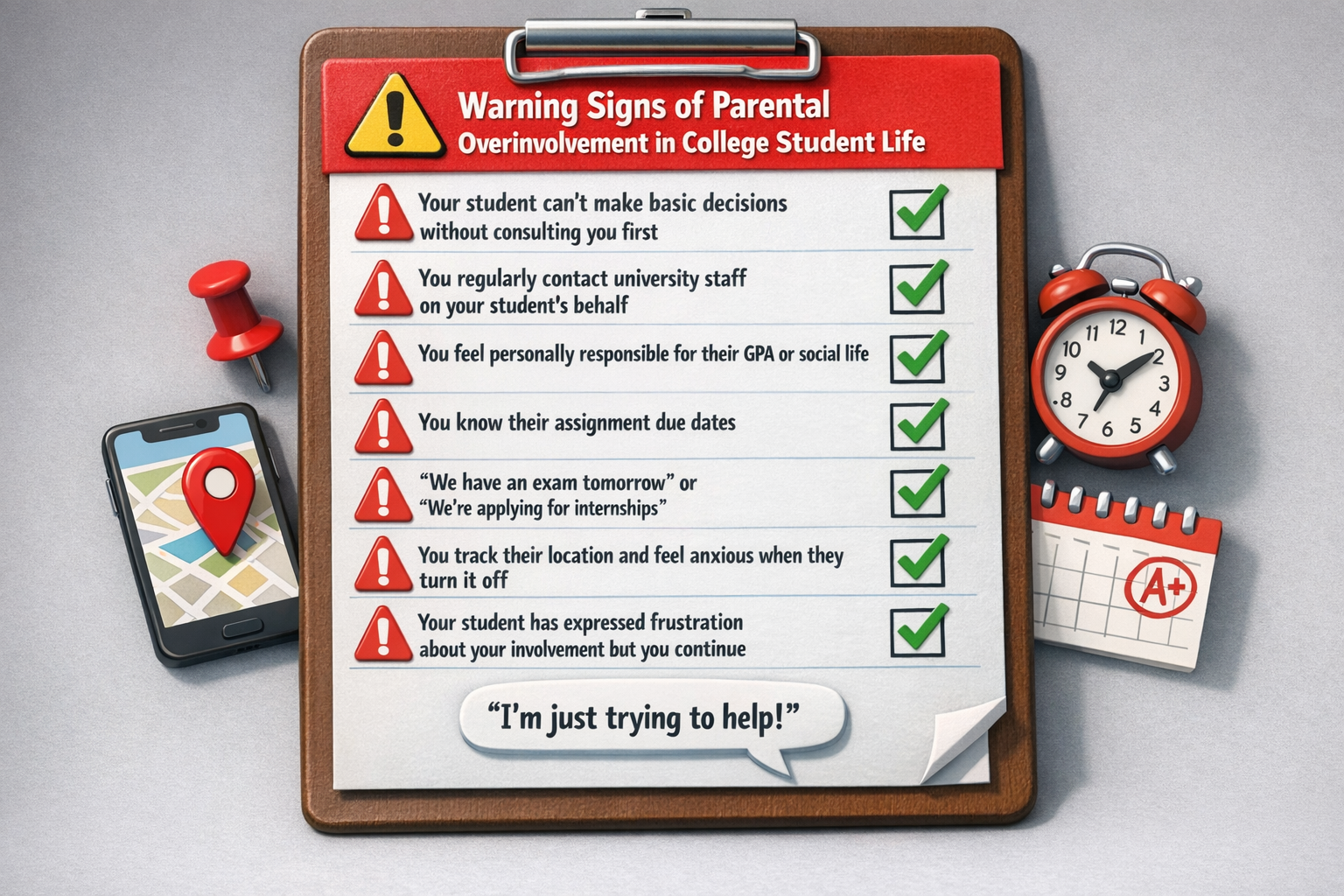
Warning Signs You've Crossed Into Unhealthy Territory:
Your student can't make basic decisions without consulting you first
You regularly contact university staff on your student's behalf
You feel personally responsible for their GPA or social life
You know their assignment due dates
You use phrases like "We have an exam tomorrow" or "We're applying for internships"
You track their location and feel anxious when they turn it off
Your student has expressed frustration about your involvement but you continue
You justify overstepping with "I'm just trying to help"
A 2016 study in the Journal of Child and Family Studies found that students with highly controlling parents showed decreased academic motivation over time and were significantly more likely to change majors multiple times—not because they discovered their passion, but because they struggled to identify their own preferences separate from parental expectations [6].
The irony cuts deep: Parents who over-function out of love often create the exact vulnerabilities they're trying to prevent.
What About Money? The Uncomfortable Reality of Financial Leverage
Let's address what many articles politely avoid: you're likely paying for this education.
This creates legitimate complexity. When you're covering $30,000+ per year, doesn't that buy you some say in decisions? The short answer: sort of, but less than you think.
Financial support does not equal decision-making authority over your adult child's life. But it does create appropriate boundaries for discussion.
Reasonable Financial Boundaries:
Expecting reasonable academic progress (not perfection, but effort)
Requiring transparency about major changes (switching majors, dropping below full-time)
Setting basic behavioral expectations (no legal trouble, substance abuse issues)
Discussing career planning and return on investment
Unreasonable Financial Leverage:
Dictating their major based on your career preferences
Requiring they pursue a path they've expressed opposition to
Using financial threats to control social lives or daily choices
Demanding perfect grades to continue support
Making support contingent on breaking up with partners you don't like
The healthiest approach treats financial support as enabling their education and development, not purchasing control over their decisions. If you can't afford to give that gift without strings attached, you need honest conversations about what you can afford.
Cultural Context: One Size Does Not Fit All
Western research on parental involvement overwhelmingly favors independence and autonomy—but that framework doesn't map cleanly onto all cultural contexts.
For students from collectivist cultures, high parental involvement may not just be normal—it may be beneficial. Research on Asian American college students found that parental involvement patterns that would be classified as "enmeshed" in white populations didn't show the same negative correlations [7].
The key variable wasn't involvement level—it was whether that involvement aligned with cultural expectations and family communication norms. When students expected and valued high parental involvement, it supported rather than undermined their success.
If you come from a culture where family decisions are collective and interdependence is valued, the "American independence model" may feel wrong because it is wrong for your context. The research isn't culture-neutral, even when it pretends to be.
Real Parents, Real Patterns: Beyond Stock Examples
Research identifies several common parental approach patterns in college:
The Consultant stays available and informed but lets their student drive decisions. They might say: "Here are three things I'd consider if I were you, but this is your call." Their students report feeling supported and confident.
The Manager maintains oversight of schedules, assignments, and decisions. They might email their student's advisor to check on progress without asking. Their students report feeling infantilized and develop slower.
The Crisis-Only Parent trusts their student completely until something goes wrong, then swoops in intensively. They might ignore months of declining grades, then demand meetings with the dean when academic probation hits. Their students report confusion about expectations.
The Anxious Tracker needs constant reassurance their student is okay. They might call multiple times daily or use location tracking to monitor movements. Their students report guilt and fatigue.
None of these parents are villains. They're humans navigating an ambiguous transition with genuine love and real fears. But outcomes differ significantly based on which pattern dominates.
How to Stay Connected Without Overstepping
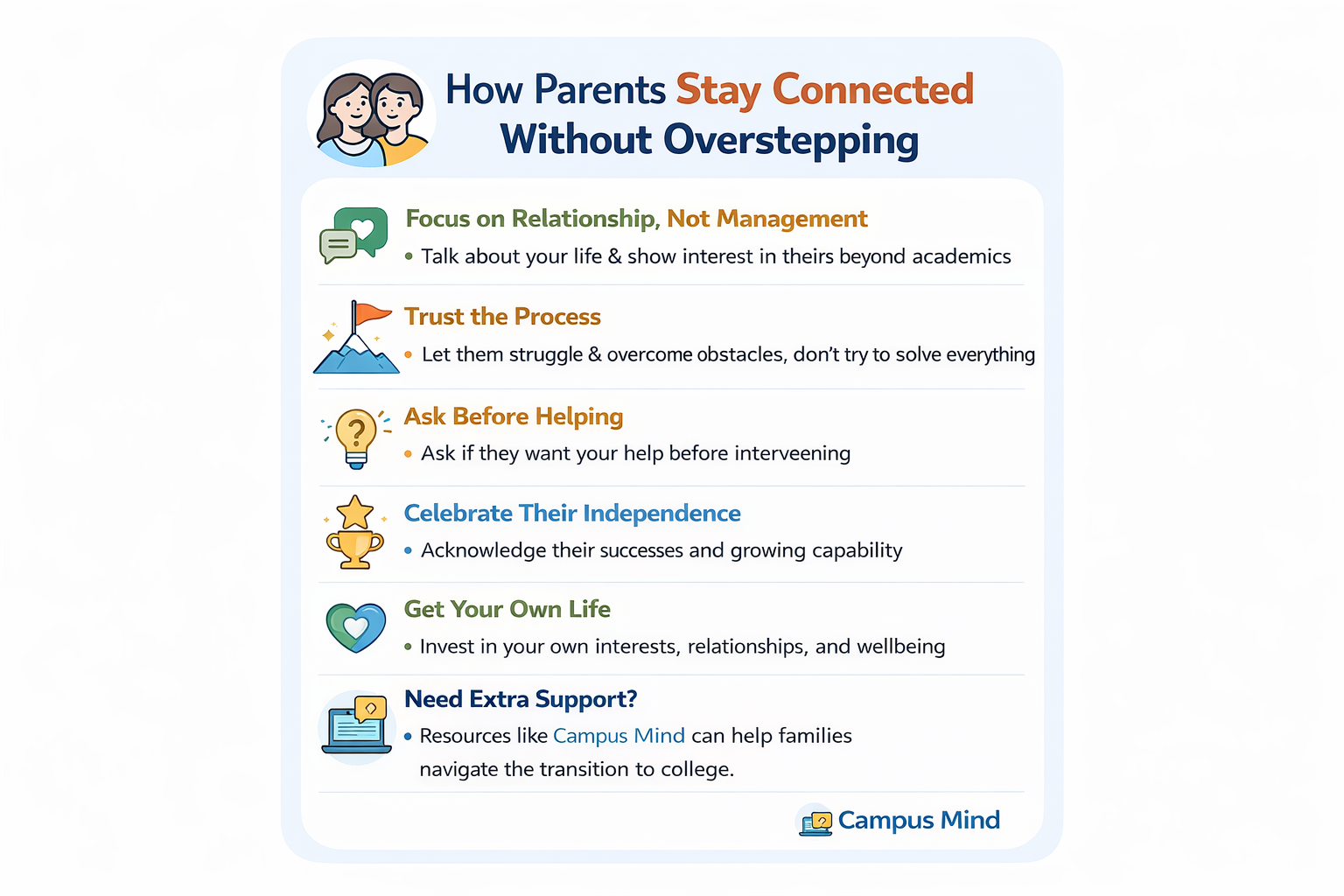
Your role is evolving from manager to consultant. That's terrifying and necessary.
Focus on relationship over management. Share what's happening in your life. Be someone your student wants to talk to because conversations are enjoyable, not obligatory. Ask about their interests beyond academics. Treat them like the adult they're becoming.
Trust the process, even when it hurts. Some struggle is not just normal—it's required for growth. Your job isn't to eliminate all obstacles from their path. Your job is to believe they can overcome obstacles while being available if they genuinely can't.
Ask permission before acting. If you think intervention might help, ask first: "Would it be helpful if I called?" or "Do you want my thoughts on this?" Respect their answer even if you disagree with it.
Celebrate their independence. When your student handles a challenge successfully on their own, celebrate that victory. Your pride in their growing capability reinforces their confidence and encourages more independent problem-solving.
Get your own life. If your emotional wellbeing depends entirely on your student's daily status updates, that's a you problem, not a them problem. Invest in your own relationships, interests, and identity beyond parenthood.
The goal isn't perfect balance—it's responsive adjustment. Pay attention to how your student responds to your involvement and be willing to recalibrate.
Frequently Asked Questions
Can I help without hovering?
Absolutely—support without control is entirely possible and it's what the research says works best. Focus on being genuinely available when your student reaches out rather than monitoring constantly. Ask questions that invite real sharing ("How are you feeling about your classes?" "What's been interesting lately?") rather than interrogating ("Did you submit that assignment?" "Why haven't you called?"). Offer your perspective when specifically requested, but resist delivering unsolicited advice. The key shift is positioning yourself as a trusted resource they can access rather than a supervisor managing their every move. When your student successfully navigates a challenge independently, celebrate that—your pride reinforces their growing confidence.
What's too much involvement?
You've crossed into unhealthy territory when your student can't make routine decisions without consulting you first, when you regularly contact professors or university staff without their permission, or when you use financial pressure or guilt to control their choices. Other red flags include knowing their class schedule and assignment deadlines better than they do, tracking their location obsessively, managing their calendar remotely, or continuing to intervene even after your student has expressed frustration about your involvement. Pay attention to your student's responses. If they're avoiding your calls, giving short answers, or seem frustrated, that's feedback. The goal is support that empowers, not management that infantilizes.
How often should I actually call or text my college student?
There's no universal "right" frequency—healthy communication patterns vary dramatically based on personality and family culture. What matters is quality and who's initiating. Research shows student-initiated contact correlates with better outcomes than parent-initiated contact. Some families naturally communicate daily and both parties enjoy it. Others connect weekly. Neither pattern is inherently problematic. The key is whether your student seems to welcome the contact or whether they're responding out of obligation. Follow your student's lead on frequency while maintaining consistent availability. If a day passes without contact, can you tolerate that without anxiety? If not, that's information about your needs, not evidence your student needs more oversight.
Does parental involvement affect whether students stay in college?
Yes, but it depends entirely on the type of involvement. Autonomy-supportive parenting—where parents provide emotional support while respecting their student's decision-making authority—correlates with higher persistence rates and better academic motivation. These students develop stronger problem-solving skills and greater self-efficacy, both protective factors against dropout. However, controlling involvement can actually increase dropout risk by fostering dependency and undermining student confidence. Students who rely on parents to manage their college life struggle more when faced with challenges they must navigate independently. The healthiest approach builds student capability rather than parental management systems.
How can I tell if my student is really struggling or just adjusting normally?
Normal adjustment includes occasional stress, minor homesickness, academic challenges that improve with effort, and some social uncertainty—these typically resolve within weeks. Concerning signs include persistent mood changes lasting more than two weeks, dramatic grade drops across multiple classes, withdrawing from activities they previously enjoyed, expressing hopelessness about their ability to succeed, significant changes in sleep or eating patterns, or mentioning thoughts of leaving school. If you notice these patterns, ask open-ended questions about how they're really doing. Encourage them to access campus counseling and academic support services. Trust your gut—if something feels seriously wrong, it probably deserves attention beyond "they just need to adjust."
E-E-A-T Section
This article synthesizes peer-reviewed research from developmental psychology, family studies, and higher education to provide evidence-based guidance for families navigating the college transition. The recommendations reflect current scientific consensus on emerging adult development and align with best practices endorsed by student affairs professionals and university counseling centers. Campus Mind partners with higher education institutions to support student success through research-driven interventions that strengthen resilience, belonging, and wellbeing while respecting student autonomy.
Cited Works
[1] Schiffrin, H. H., Liss, M., Miles-McLean, H., Geary, K. A., Erchull, M. J., & Tashner, T. — "Helping or Hovering? The Effects of Helicopter Parenting on College Students' Well-Being." Journal of Child and Family Studies, 23(3), 548-557. https://doi.org/10.1007/s10826-013-9716-3
[2] Soenens, B., & Vansteenkiste, M. — "A Theoretical Upgrade of the Concept of Parental Psychological Control: Proposing New Insights on the Basis of Self-Determination Theory." Developmental Review, 30(1), 74-99. https://doi.org/10.1016/j.dr.2009.11.001
[3] Padilla-Walker, L. M., & Nelson, L. J. — "Black Hawk Down? Establishing Helicopter Parenting as a Distinct Construct from Other Forms of Parental Control During Emerging Adulthood." Journal of Adolescence, 35(5), 1177-1190. https://doi.org/10.1016/j.adolescence.2012.03.007
[4] National Survey of Student Engagement — "Engagement Insights: Survey Findings on the Quality of Undergraduate Education." Indiana University Center for Postsecondary Research. https://nsse.indiana.edu/
[5] Wartman, K. L., & Savage, M. — "Parental Involvement in Higher Education: Understanding the Relationship Among Students, Parents, and the Institution." ASHE Higher Education Report, 33(6). https://doi.org/10.1002/aehe.3306
[6] Reed, K., Duncan, J. M., Lucier-Greer, M., Fixelle, C., & Ferraro, A. J. — "Helicopter Parenting and Emerging Adult Self-Efficacy: Implications for Mental and Physical Health." Journal of Child and Family Studies, 25(10), 3136-3149. https://doi.org/10.1007/s10826-016-0466-x
[7] Kwon, K., Yoo, G., & De Gagne, J. C. — "Does Culture Matter? A Qualitative Study of Helicopter Parenting in Korean American College Students." Journal of Child and Family Studies, 26(7), 1979-1990. https://doi.org/10.1007/s10826-017-0694-8