
When a student accepts a resident advisor position, joins an orientation team, or becomes a peer mentor, they rarely think about retention statistics. They're drawn to the opportunity to help others, build skills, or simply find their place on campus. What they often don't expect is how much the role will change them—building confidence, deepening their connection to the institution, and developing competencies that carry into their careers.
Here's the truth: these students aren't outliers. They're evidence of something higher education has known for decades but often underutilizes—student leadership roles are among the most powerful tools colleges have for improving engagement, building belonging, and keeping students enrolled through graduation.
The research supports this consistently. A multi-institutional study published in the Journal of College Student Development found that students who participated in leadership experiences showed higher rates of persistence and stronger institutional commitment compared to peers who didn't hold such roles [1]. The National Survey of Student Engagement has repeatedly documented that participation in high-impact practices—including leadership activities—correlates with significantly higher levels of learning gains and satisfaction [2].
The mechanism isn't complicated. When a student shifts from consumer to contributor, their relationship with the institution fundamentally changes. They're no longer just receiving the college experience—they're actively shaping it for others.
Key Takeaways
Students in leadership roles show measurably higher persistence rates compared to non-involved peers, with research linking co-curricular leadership to both first-to-second-year retention and eventual degree completion
Leadership positions accelerate social integration by connecting students across departments, class years, and social groups—creating multiple institutional touchpoints
Peer mentor models create multiplier effects, extending engagement benefits beyond leaders themselves to the students they serve
Effective programs balance structure with autonomy, giving student leaders real responsibility while providing training and ongoing support
Equity in access matters—institutions must examine who has opportunities to lead and actively remove barriers for underrepresented students
Why Student Leadership Matters for Engagement
Student engagement isn't just about attending class or showing up to campus events. It's about feeling like your presence matters—like your contributions have impact and you belong somewhere.
Leadership roles deliver that sense of purpose in ways that passive participation simply can't match.
According to NSSE's most recent engagement indicators, students who participate in high-impact educational practices report substantially higher perceived gains in personal and social development, practical competence, and general education [2]. Leadership activities consistently rank among the most transformative of these practices.
Why does leadership create such strong effects?
The shift in identity plays a central role. When a student becomes responsible for others' experiences—whether as a peer mentor helping first-years navigate course registration or an orientation leader introducing new students to campus culture—they develop what researchers call "institutional ownership." They see campus challenges as problems they can help solve, not just obstacles to endure.
This ownership creates psychological bonds that casual participants don't develop. A student who has invested time and energy into improving campus life becomes more invested in the institution's success—and more likely to persist through their own challenges.

The Retention Connection: What the Evidence Shows
Let's talk specifics, because campus leaders need evidence to justify investment in leadership programs.
Research examining the relationship between co-curricular involvement and student success has consistently found positive associations. A foundational study by Alexander Astin, tracking over 20,000 students across hundreds of institutions, established that involvement in campus life—particularly in activities requiring sustained engagement and responsibility—was one of the strongest predictors of persistence and degree completion [3].
More recent work has reinforced these findings. A 2019 study in the Journal of Student Affairs Research and Practice examined peer mentoring programs specifically and found that both mentors and mentees showed retention advantages over comparison groups [4]. The benefits weren't one-directional—leadership roles helped the leaders themselves persist.
Several factors converge to explain why:
Social integration accelerates. Student leaders form relationships across departments, class years, and social groups. These expanded networks provide multiple points of connection to the institution. If one relationship falters—a roommate conflict, a dropped class—others remain. This redundancy in social ties provides stability during difficult transitions.
Academic motivation increases. Many leadership programs require minimum GPA thresholds, creating built-in accountability. But beyond requirements, students often report that their leadership responsibilities give them stronger reasons to succeed academically. They're modeling behavior for peers, representing the institution, and developing professional identities tied to their academic success.
Identity development occurs. Leadership roles help students answer the question "Who am I becoming?"—a critical developmental task during the college years. Students who can see their growth through concrete achievements and meaningful contributions are more likely to persist through challenges because they can envision a future self worth working toward.
Institutional commitment deepens. When you've invested time building something—a mentoring program, a residence hall community, a student organization—you become more committed to seeing it succeed. This investment creates switching costs that make leaving feel more consequential.
Models That Work: Peer Mentoring and Beyond
Peer mentor programs represent one of the most scalable approaches to student leadership. They create leadership opportunities while simultaneously extending support to incoming or at-risk students—a multiplier effect that makes them particularly attractive to resource-constrained institutions.
First-Year Experience Mentors
Many institutions pair trained upperclassmen with incoming students during their first semester. These mentors help new students navigate everything from course registration to finding the dining hall to understanding unwritten campus norms.
The benefits flow in both directions. Mentees receive personalized guidance from someone who recently faced similar challenges. Mentors develop coaching, communication, and problem-solving skills while strengthening their own campus connections.
Effective first-year mentor programs share common features:
Structured training before the semester begins, covering topics like active listening, boundary-setting, campus resources, and when to refer to professional staff
Regular touchpoints with professional staff for ongoing support and debriefing
Clear expectations paired with meaningful autonomy—mentors know their responsibilities but have latitude in how they fulfill them
Recognition systems that acknowledge mentor contributions, whether through compensation, course credit, or formal awards
A study of peer mentoring at a large public university found that first-year students with mentors were 12% more likely to return for their second year compared to similar students without mentors—and the mentors themselves showed even higher persistence rates [4].
Academic Peer Tutoring
Peer tutoring programs transform high-achieving students into learning resources for their classmates. Beyond the obvious academic benefits for those receiving support, these programs build leadership capacity in the tutors themselves.
The tutors often report that teaching material deepens their own understanding. They're not just reviewing content—they're developing patience, adaptability, and the ability to meet others where they are. These skills translate directly to professional contexts.
Structured peer tutoring programs, when well-implemented, have shown positive effects on both tutee academic performance and tutor retention [5].
Residential Life Leadership
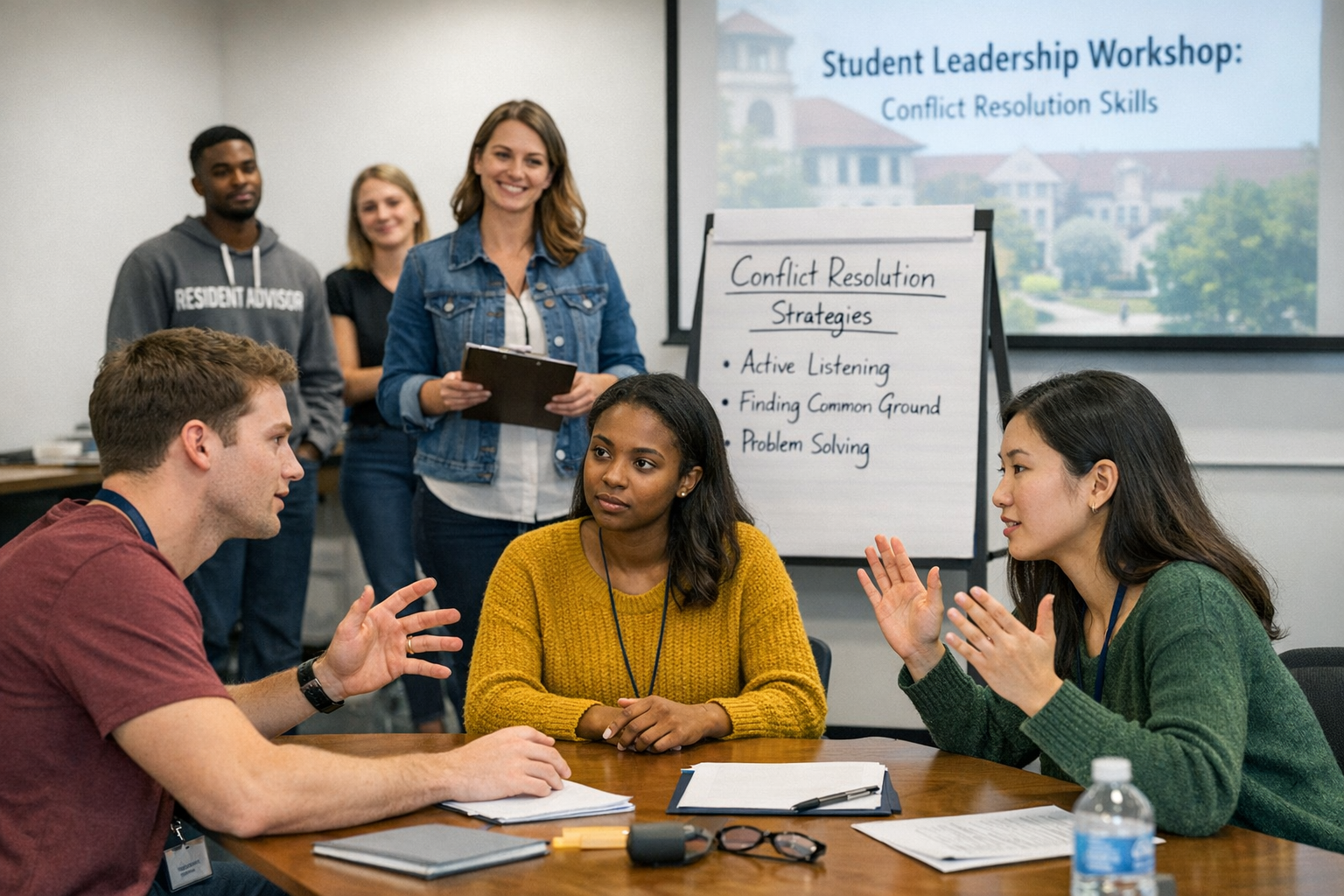
Resident advisors remain one of the most recognizable student leadership roles on college campuses. These positions require students to balance authority with approachability, crisis response with community building, policy enforcement with relationship development.
The intensity of RA work creates particularly strong developmental outcomes. Students learn:
Conflict resolution through handling roommate disputes and community tensions
Emergency response through managing crises ranging from medical emergencies to mental health concerns
Event planning through organizing floor programs and community activities
Boundary-setting through navigating dual roles as peer and authority figure
These skills have clear professional applications, which partly explains why RA experience appears frequently on post-graduate resumes and interview narratives.
Orientation Leadership
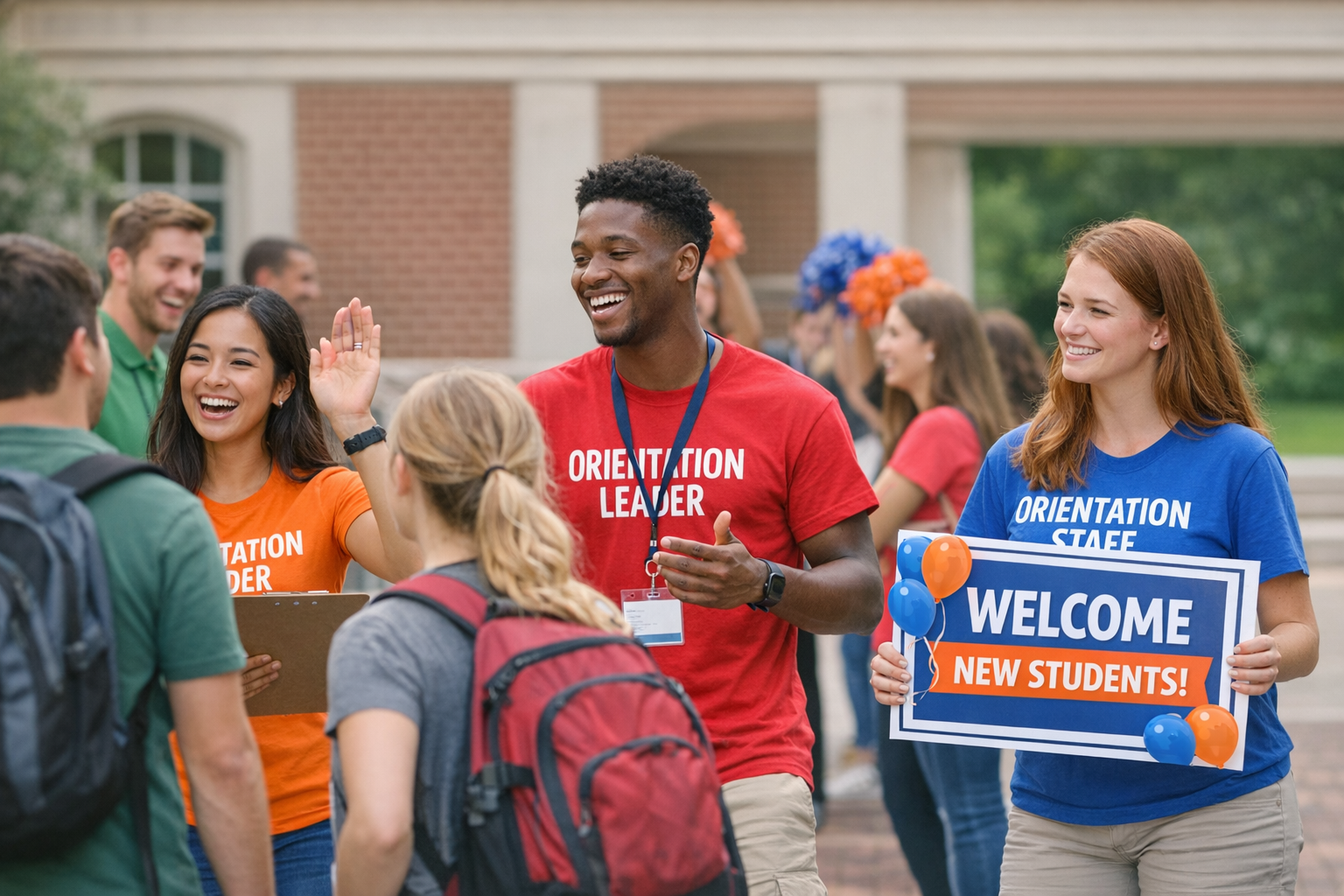
Orientation leaders shape first impressions for incoming students. The role requires energy, enthusiasm, and the ability to make strangers feel welcome—all while managing logistics and representing institutional values.
What makes orientation leadership particularly valuable is its intensity and visibility. Students in these roles become campus ambassadors, which strengthens their own identification with the institution while building presentation and facilitation skills.
Mini Case Study: Gamified Engagement and Student Leadership at Scale
Montclair State University implemented a gamified engagement program that incorporated student leaders as peer ambassadors and activity facilitators. During one semester, the program logged over 20,000 engagement activities among participating students. First-year retention among active participants improved by 9–13 percentage points compared to non-participants [6].
While the program involved multiple elements beyond leadership, the peer ambassador model was central to driving participation. Student leaders served as both role models and personal connectors—demonstrating that the platform was worth using and helping peers navigate it.
This example illustrates how student leadership can amplify the effects of other retention interventions. The technology alone wasn't sufficient; it required human connectors to drive adoption and sustained engagement.
Building Effective Student Leadership Programs
Not all leadership programs produce equal outcomes. The difference between a transformative experience and a resume-padding exercise often comes down to program design.
Give Real Responsibility
Students know the difference between meaningful work and busywork.
Effective programs trust student leaders with decisions that actually matter—budget allocations, program design, peer support conversations, community standards enforcement. When students understand their actions have real consequences, they rise to meet expectations.
Programs that limit student leaders to task execution without decision-making authority miss the developmental power of leadership. The growth comes from navigating ambiguity, weighing tradeoffs, and owning outcomes—not from following scripts.
Provide Training and Ongoing Support
Throwing students into leadership roles without preparation sets them up for failure and burnout.
Strong programs invest in pre-service training and continue providing development throughout the experience. This might include:
Skill-building workshops on communication, time management, conflict resolution, and crisis response
Regular supervisor check-ins that provide feedback, troubleshoot challenges, and monitor wellbeing
Peer cohort meetings where student leaders share strategies and normalize difficulties
Clear escalation pathways so leaders know when and how to involve professional staff
The ongoing support matters as much as initial training. Leadership challenges evolve over the semester, and students need space to process difficult situations with knowledgeable guidance.
Create Clear Pathways
Students should see how one leadership experience can lead to another.
Maybe a first-year mentor becomes a lead mentor as a junior, then joins the student government executive board as a senior. Perhaps a peer tutor advances to coordinate the tutoring program before graduating into a graduate assistantship.
These progression pathways create sustained engagement across the college experience. They also help students build cumulative skills rather than repeating entry-level experiences.
Recognize and Celebrate Contributions
Recognition matters. This doesn't require elaborate ceremonies or expensive awards—though those have their place.
Simple acknowledgment from faculty, staff, and administrators reminds student leaders that their work is seen and valued. A personal thank-you email, public recognition at a meeting, or a recommendation letter builds the relationship between leader and institution.
The recognition should be specific. "Thanks for being a great RA" is less meaningful than "Your handling of the roommate conflict on third floor last week showed real skill—you de-escalated a tense situation while keeping both students' dignity intact."
Connect Leadership to Learning
The most effective programs help students articulate what they're learning through their leadership experiences.
Reflection exercises, portfolio development, and connections to academic content transform activities into intentional learning. When students can name the competencies they're building—"I'm developing my ability to give difficult feedback" or "I'm learning to adapt my communication style for different audiences"—they extract more value from the experience.
Some institutions offer course credit for structured leadership experiences, which creates formal space for this reflection while signaling institutional value.
The Skills Students Gain
Student leadership roles function as laboratories for professional skill development. The competencies students build transfer directly into post-graduation success.
Communication: Leading peers requires clarity, persuasion, and the ability to adapt messages for different audiences. Student leaders practice these skills in high-stakes, real-world contexts—explaining policies to frustrated residents, motivating reluctant participants, or delivering difficult news to peers.
Problem-solving: When the event budget falls short, two residents have an escalating conflict, or a mentee stops responding to messages, student leaders can't wait for someone else to fix it. They develop creative problem-solving through necessity.
Time management: Balancing leadership responsibilities with academic demands teaches prioritization and planning. Students learn to manage competing commitments before they face similar challenges in careers and graduate programs.
Emotional intelligence: Working closely with peers builds awareness of others' needs, perspectives, and reactions. Student leaders develop empathy and interpersonal sensitivity through repeated practice—and occasional mistakes.
Resilience: Not every program succeeds. Not every conversation goes well. Student leaders learn to process setbacks, adjust approaches, and move forward. These recovery skills prove essential in any career.
Gallup-Purdue research has found that graduates who had a mentor and were involved in campus activities reported higher wellbeing and workplace engagement years after graduation—suggesting these experiences have lasting effects [7].
Addressing Equity in Leadership Access
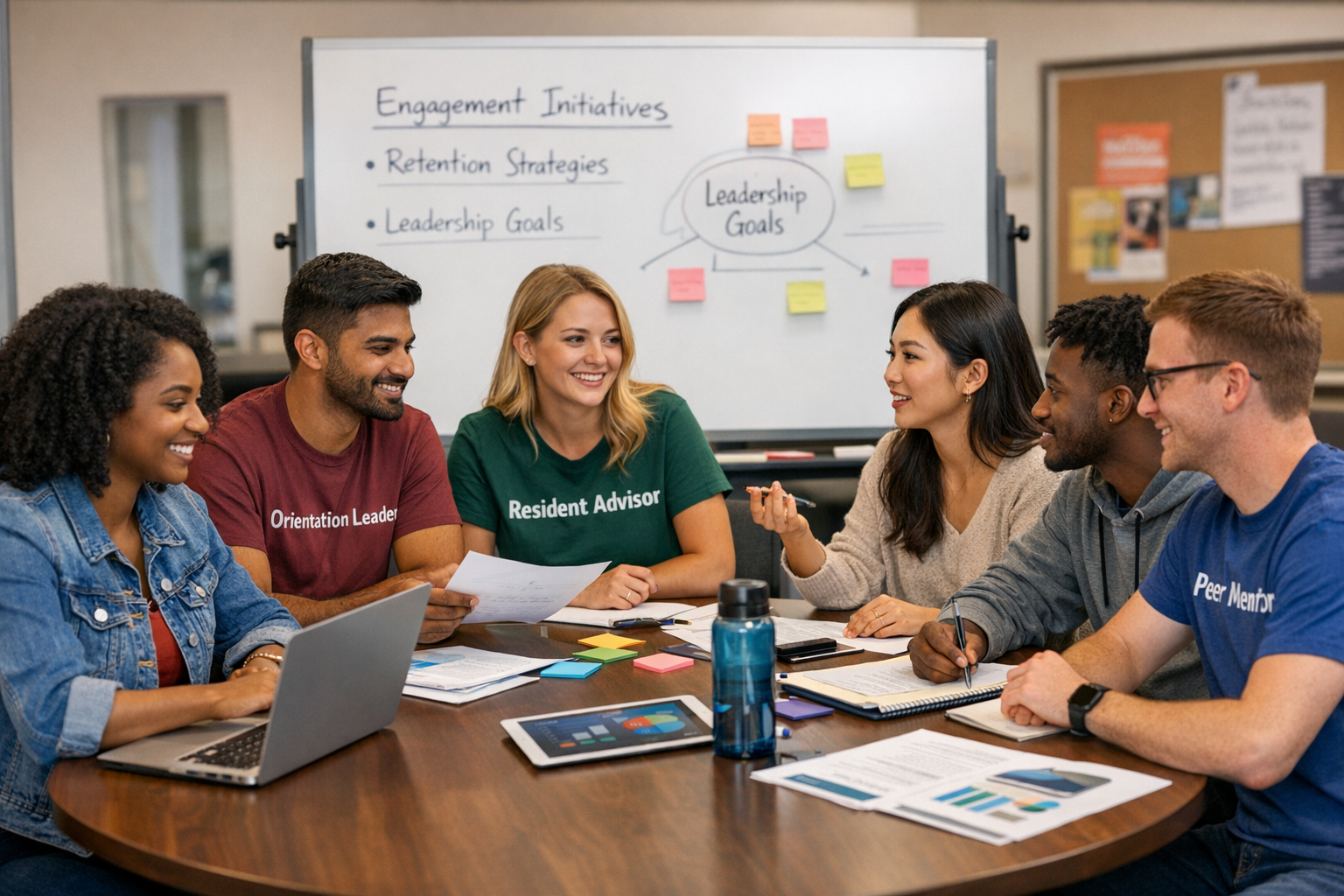
Here's where institutions need honest self-assessment: Who has access to student leadership roles, and who doesn't?
Students working multiple jobs to pay tuition often can't afford the time commitment that unpaid leadership positions require. First-generation students may not know these opportunities exist or may feel they're "not for people like me." Students from underrepresented backgrounds might not see themselves reflected in current leadership structures.
Research on high-impact practices has consistently found that participation rates vary by student demographics, with working students, first-generation students, and students from lower-income backgrounds often participating at lower rates [8].
Addressing these barriers requires intentional effort:
Compensate student leaders fairly. When possible, pay students for their leadership work rather than relying on volunteers. This expands access for students with financial constraints and signals institutional value for the work. Some institutions have shifted RA compensation models specifically to attract more economically diverse candidates.
Actively recruit from underrepresented populations. Don't wait for students to self-select into leadership. Reach out to students who might not see themselves as "leadership material" but have demonstrated potential through other means—strong classroom participation, informal peer support, or involvement in cultural organizations.
Provide mentoring for emerging leaders. Some students need more support entering leadership roles than others. Pairing new leaders from underrepresented backgrounds with experienced mentors can bridge confidence gaps and provide crucial guidance during early challenges.
Examine existing structures for bias. Are selection processes favoring students who already have advantages? Are requirements—like prior leadership experience or specific GPAs—excluding capable students for arbitrary reasons? Review criteria with equity in mind.
Create multiple entry points. Not every student can commit to a full RA position or year-long mentoring role. Consider lower-commitment leadership opportunities that allow students to build skills and demonstrate capability before advancing to more intensive positions.
Measuring Impact
Campus leaders need data to justify investment in leadership programs. Fortunately, these programs lend themselves to meaningful assessment.
Persistence metrics: Compare retention rates between student leaders and matched non-participants. Track whether leadership participants show higher rates of return from fall to spring and from year to year. Use propensity score matching or similar techniques to account for selection bias—students who seek leadership may differ from those who don't in ways that independently affect retention.
Engagement indicators: Survey student leaders about their sense of belonging, institutional commitment, and satisfaction. Compare responses to non-participants using validated instruments like the NSSE or campus-specific engagement surveys.
Skill development: Use pre- and post-assessments to measure growth in targeted competencies like communication, problem-solving, and self-efficacy. The Multi-Institutional Study of Leadership provides validated instruments for this purpose [9].
Graduate outcomes: Track career outcomes for former student leaders. Do they show advantages in job placement, graduate school admission, or starting salary? Alumni surveys can capture this data, though attribution remains challenging.
Qualitative feedback: Numbers tell part of the story. Exit interviews and focus groups capture the nuanced, transformative aspects of leadership experiences that surveys miss. These narratives also provide powerful material for program promotion and fundraising.
Track program health indicators: Beyond participant outcomes, monitor program metrics like application rates, completion rates, supervisor evaluations, and peer feedback. These operational indicators help identify improvement opportunities.
Scaling Leadership Opportunities
Every campus has students ready to lead. The question is whether institutions create enough meaningful opportunities for them to do so.
Scaling doesn't mean diluting quality. It means looking creatively at where leadership opportunities might emerge:
Academic departments can develop peer learning assistant programs that create leadership roles while improving course outcomes
Student organizations can formalize officer development and succession planning, turning casual positions into structured learning experiences
Career services can train peer career advisors who help classmates with resume reviews, interview preparation, and job search strategies
Recreation facilities can develop student manager pipelines that build supervision and operations skills
Academic support centers can expand tutoring and supplemental instruction programs to reach more subjects and students
Health and wellness offices can train peer health educators who deliver programming on topics from stress management to healthy relationships
Each of these creates leadership capacity while simultaneously extending services that benefit the broader student population—a win for institutional efficiency and student development.
Your Next Steps (Yes, Today)
For student affairs professionals:
Audit current leadership programs for accessibility barriers—who's applying, who's being selected, and who's not in the pipeline at all
Identify departments that could benefit from peer leader support and don't currently have programs
Review training curricula for currency and comprehensiveness—are you preparing students for the challenges they'll actually face?
For academic leaders:
Explore peer instruction models within your discipline—undergraduate teaching assistants, supplemental instruction leaders, or course-embedded tutors
Consider course credit options for structured leadership experiences, which creates space for reflection and signals academic value
Connect with student affairs partners to bridge curricular and co-curricular learning
For institutional researchers:
Establish baseline retention data for leadership program participants, using appropriate comparison groups
Develop assessment frameworks that capture both quantitative outcomes and qualitative experiences
Create feedback loops that inform program improvement, not just accountability reporting
Student leadership isn't a nice-to-have amenity. It's a strategic investment in engagement, retention, and student success. Institutions that recognize this—and act accordingly—create campuses where more students find their place, develop their potential, and persist through graduation.
Ready to explore how data-driven engagement tools can identify emerging student leaders and connect them with opportunities? Book a CampusMind demo call to learn how proactive approaches support student leadership development across your campus.
Frequently Asked Questions
What types of student leadership roles have the strongest retention impact?
Residential life positions, peer mentoring programs, and orientation leadership consistently show strong associations with persistence. These roles share key characteristics: sustained engagement over time (not one-off events), direct responsibility for other students' experiences, and regular interaction with professional staff who provide guidance. The combination of relationship-building, meaningful responsibility, and ongoing support creates particularly strong institutional bonds. Roles that involve weekly or daily engagement tend to show stronger effects than those requiring only occasional participation.
How can colleges encourage first-generation students to pursue leadership roles?
Active outreach matters more than passive availability. Institutions seeing success with first-generation leaders often assign staff or faculty mentors to personally invite promising students into leadership pipelines—don't assume students will self-identify. Remove financial barriers through compensation or work-study integration. Reduce application complexity that may disadvantage students without prior leadership experience. Showcase diverse current leaders so prospective applicants can see themselves in these roles. Finally, provide additional onboarding support, since first-gen students may need more context on institutional norms and expectations.
Do paid leadership positions produce better outcomes than volunteer roles?
Compensation removes barriers for students with financial constraints, expanding the talent pool and increasing demographic diversity among leaders. Paid positions also signal institutional value and tend to attract higher commitment levels—students treat compensated work more seriously. However, the design of the role matters more than payment alone. Meaningful responsibility, quality training, genuine autonomy, and ongoing support drive developmental outcomes regardless of compensation structure. A well-designed volunteer role may outperform a poorly structured paid one. When possible, compensate; always invest in program quality.
How many hours per week do typical student leadership positions require?
Commitments vary widely depending on the role. Peer tutors might work five to eight hours weekly on scheduled sessions. Orientation leaders may have intensive summer commitments (30+ hours per week during training and move-in) followed by minimal ongoing duties. Resident advisors often commit 15–20 hours weekly plus on-call responsibilities that can vary significantly week to week. Effective programs clearly communicate time expectations during recruitment—including peak periods and on-call requirements—so students can assess fit with their academic and personal obligations before committing.
Can online or hybrid students participate in meaningful leadership roles?
Yes, though it requires intentional program design. Virtual peer mentoring works well when structured with clear communication expectations and regular check-ins. Online orientation leadership can welcome new distance learners and help them navigate digital campus resources. Remote tutoring has expanded dramatically and provides legitimate leadership experience. The key is ensuring virtual roles include the same elements that make in-person leadership effective: real responsibility, quality training, ongoing support, and recognition. These roles can build many of the same skills and connections as in-person positions when structured thoughtfully—though building informal relationships requires more intentional effort in virtual environments.
About CampusMind
CampusMind works with colleges and universities to support student engagement, wellbeing, and retention through evidence-based approaches. Our platform helps campus leaders identify students who would benefit from leadership opportunities and connects them with resources that support their development. With backgrounds spanning student affairs, behavioral science, and education technology, our team understands both the research behind student success and the operational realities of campus implementation. We believe that data and compassion work together—measuring what matters while treating students as whole people.
Works Cited
[1] Dugan, J.P. & Komives, S.R. — "Influences on College Students' Capacities for Socially Responsible Leadership." Journal of College Student Development. https://mslreview.org/
[2] National Survey of Student Engagement — "Engagement Insights: Survey Findings on the Quality of Undergraduate Education—Annual Results."
https://nsse.indiana.edu/research/annual-results/
[3] Astin, A.W. — "What Matters in College: Four Critical Years Revisited." Jossey-Bass. https://www.heri.ucla.edu/
[4] Collings, R., Swanson, V., & Watkins, R. — "The Impact of Peer Mentoring on Levels of Student Wellbeing, Integration and Retention." Journal of Student Affairs Research and Practice. https://www.naspa.org/journals/journal-of-student-affairs-research-and-practice
[5] Bowman, N.A. & Holmes, J.M. — "Getting Off to a Good Start? First-Year Undergraduate Research Experiences and Student Outcomes." Higher Education. https://link.springer.com/journal/10734
[6] CampusMind Insights — "Gamification in Student Engagement: Evidence from Montclair State." https://www.linkedin.com/company/campus-mind
[7] Gallup-Purdue Index — "Great Jobs, Great Lives: The Relationship Between Student Debt, Experiences and Perceptions of College Worth." https://www.gallup.com/education/
[8] Finley, A. & McNair, T. — "Assessing Underserved Students' Engagement in High-Impact Practices." Association of American Colleges and Universities. https://www.aacu.org/
[9] Multi-Institutional Study of Leadership — "Research and Resources on Student Leadership Development." https://www.leadershipstudy.net/