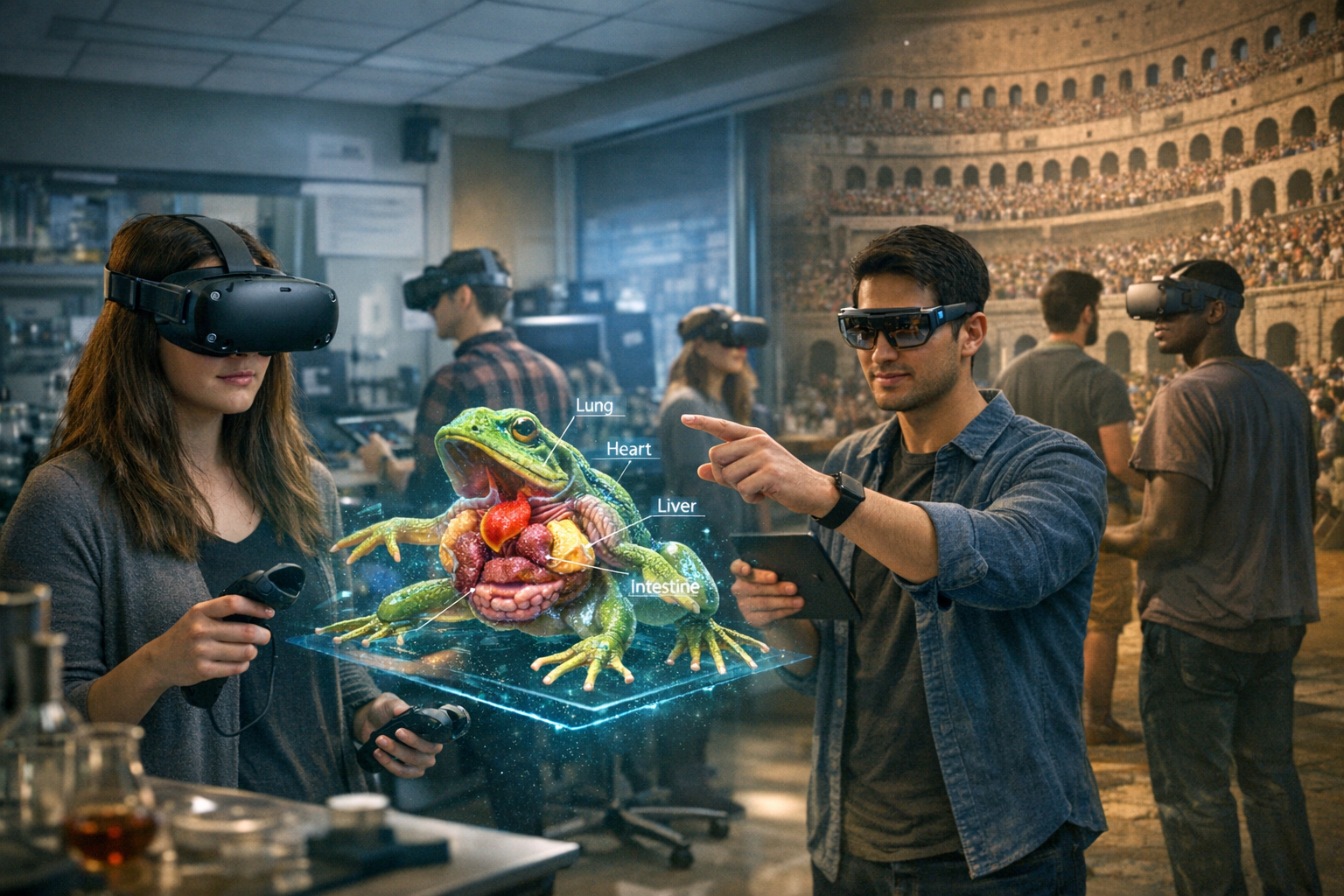
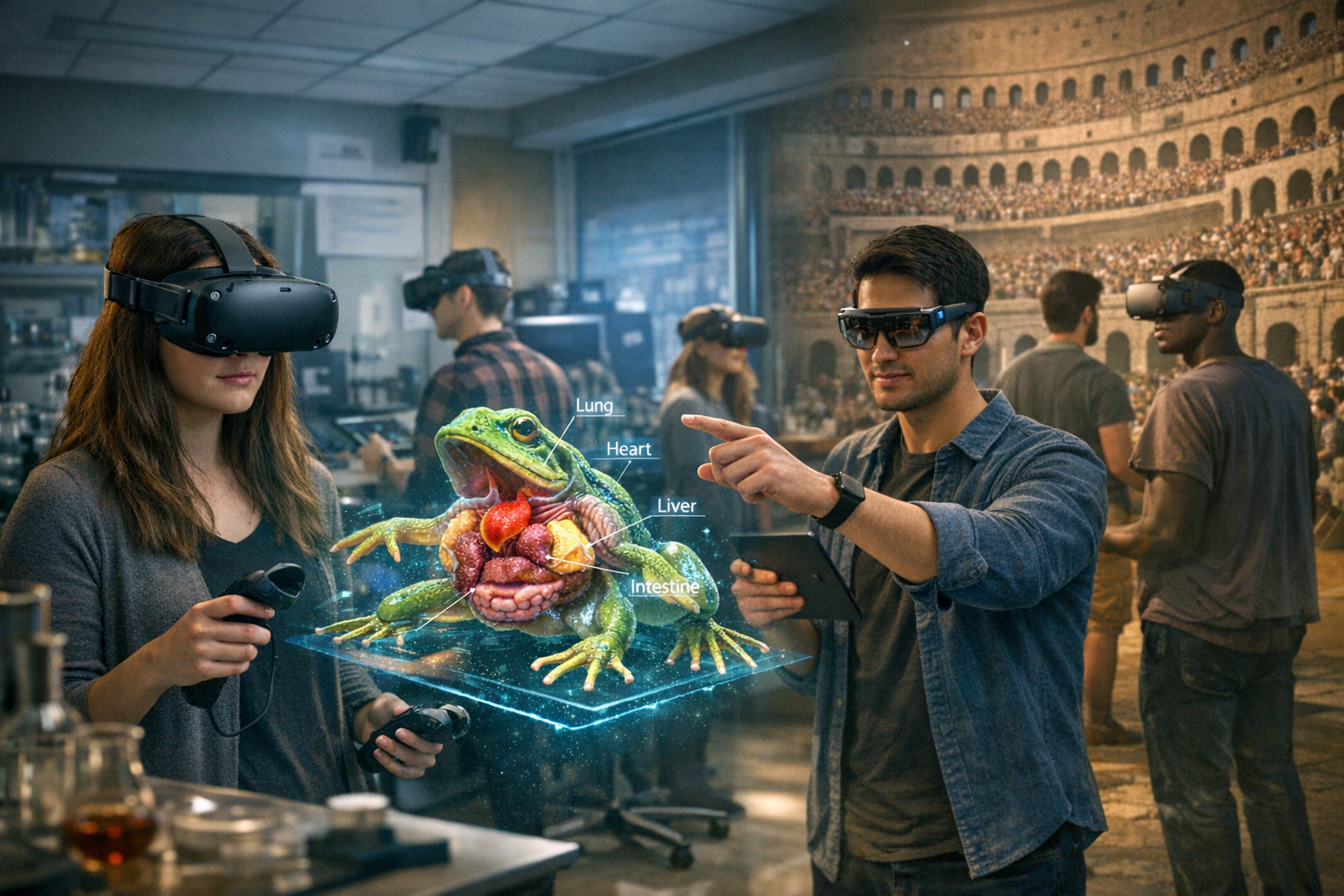
Walk into a biology lab at Arizona State University, and you might find students dissecting a frog—except the frog isn't real. It's a detailed 3D hologram floating in front of them, organs labeled, systems animated, every layer explorable without a single scalpel. Down the hall, a history class is "standing" in ancient Rome, watching the Colosseum fill with spectators.
This isn't science fiction. It's happening right now on college campuses across the country.
Virtual reality (VR) and augmented reality (AR) are moving from gaming novelties to legitimate educational tools—and the early data suggests they're doing something traditional lectures struggle to accomplish: keeping students genuinely engaged.
Here's the truth: engagement isn't just about making class more entertaining. It's directly tied to retention, learning outcomes, and whether a student feels connected enough to their institution to stay enrolled. For campus leaders navigating the enrollment cliff and rising dropout rates, immersive technology offers a compelling opportunity to rethink how students experience learning.
Key Takeaways
VR creates fully simulated environments; AR overlays digital content onto the real world—both have distinct educational applications
Research grounded in active learning theory supports the premise that immersive experiences can improve knowledge retention compared to passive instruction
Practical applications range from virtual science labs to accessible campus tours for prospective students
Implementation doesn't require replacing existing curriculum—it works best as a supplement to proven teaching methods
Accessibility remains a challenge, but costs are dropping and solutions are improving
Understanding VR and AR in Educational Contexts
Before diving into applications, let's clarify what we're actually talking about. These terms get thrown around interchangeably, but they represent fundamentally different experiences.
Virtual Reality (VR) fully immerses users in a computer-generated environment. Put on a headset, and you're transported somewhere else entirely—a chemistry lab, a historical battlefield, the surface of Mars. The real world disappears. This complete immersion makes VR particularly powerful for simulations where students need to practice skills in controlled, consequence-free environments [1].
Augmented Reality (AR) keeps you grounded in the physical world while adding digital layers on top. Think Pokémon GO, but for education. Point your phone at a textbook diagram, and a 3D model pops up. Look at a machine, and step-by-step repair instructions appear overlaid on the actual equipment. AR enhances reality rather than replacing it [2].
Both technologies leverage the same core principle: humans learn better when they can interact with content rather than passively receive it. This insight isn't new—educational researchers have documented the "learning by doing" advantage for decades. What's new is the technology to make that interaction possible for subjects that were previously impossible or impractical to experience firsthand.
The Engagement Problem VR and AR Address
Here's what campus leaders already know: traditional lecture formats struggle to maintain student attention. Research into active learning has consistently shown that students retain more information and demonstrate deeper understanding when they participate in their learning rather than passively absorb it [3].
Students today grew up with interactive media. They're accustomed to immediate feedback, visual stimulation, and active participation. Sitting in a 300-person lecture hall while someone reads from PowerPoint slides isn't just boring—it's fundamentally misaligned with how this generation processes information.
The consequences show up in the data. According to the National Center for Education Statistics, roughly 40% of first-time students at four-year institutions don't complete their degree within six years [4]. Engagement plays a documented role in this dropout rate. Students who feel disconnected from their learning experience are more likely to disengage academically, then socially, then institutionally—a well-studied pattern that often ends with them leaving.
Immersive technologies attack this problem at its root. They transform passive observers into active participants.
Real-World Applications: Where VR/AR Is Making a Difference
Virtual Science Labs
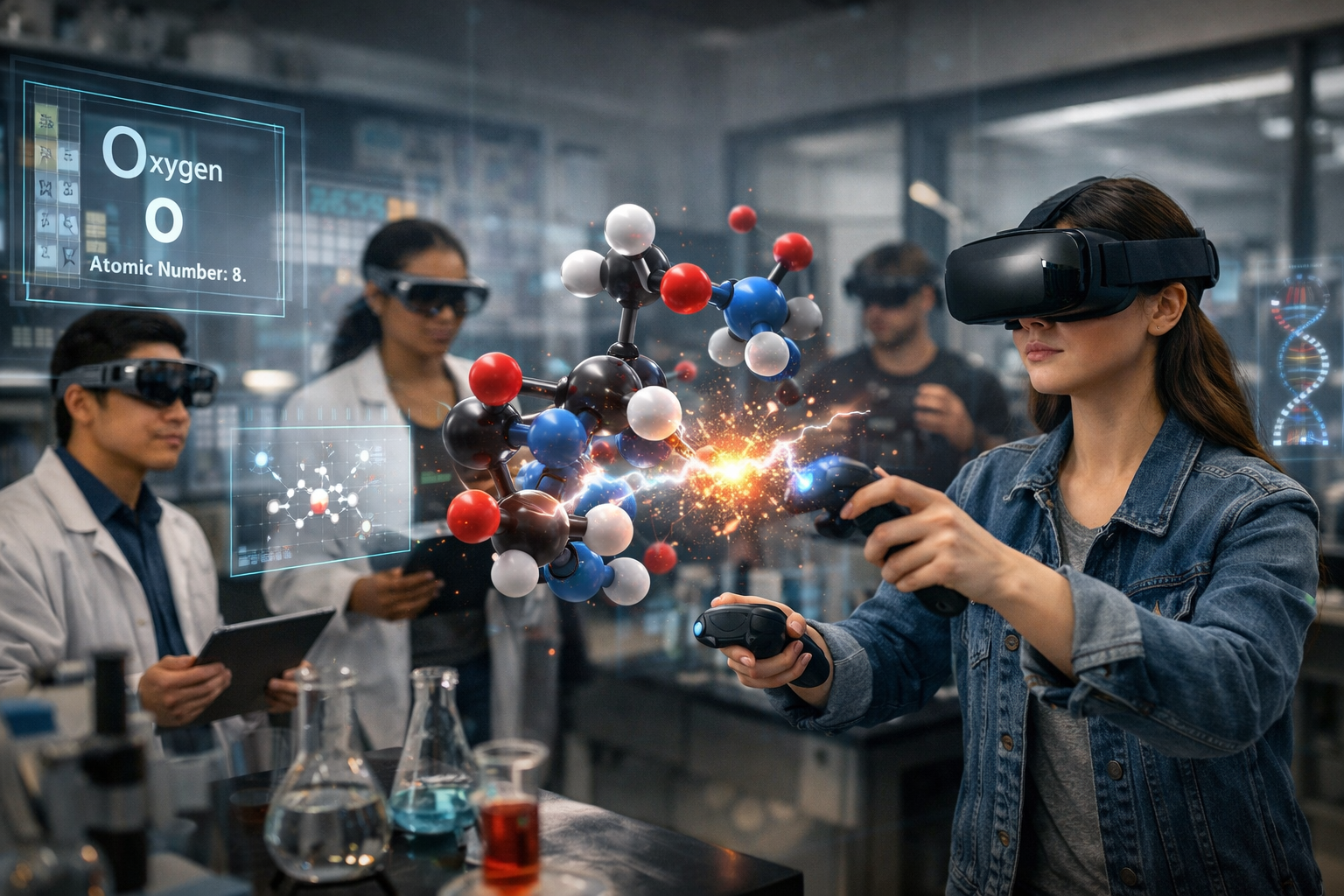
Perhaps the most mature application of VR in higher education is the virtual laboratory. Chemistry students can mix volatile compounds without safety risks. Biology students can perform dissections repeatedly until they understand every system. Physics students can visualize quantum mechanics concepts that are impossible to demonstrate in physical space.
The appeal is straightforward: students can fail, restart, and experiment without wasting expensive materials or creating safety hazards. Multiple peer-reviewed studies have found that students using well-designed virtual simulations demonstrate learning outcomes comparable to—and in some cases exceeding—those achieved through traditional lab instruction alone [5].
The University of Texas at San Antonio integrated virtual labs into their nursing program and found that students demonstrated higher confidence levels when transitioning to real clinical environments [6]. They'd already "practiced" procedures dozens of times in simulation. The pressure of the first real attempt was significantly reduced.
3D Campus Tours and Recruitment
For admissions teams facing demographic headwinds, VR campus tours offer a practical solution to a logistical problem: how do you get prospective students—especially first-generation students or those from far away—to experience your campus before they commit?
Physical campus visits remain the gold standard, but they're expensive, time-consuming, and often impossible for students with limited resources. VR tours allow any prospective student with internet access to "walk" through residence halls, sit in lecture spaces, and explore campus facilities from their living room.
Several universities have reported that VR tours increase application rates from students who would otherwise never visit. Institutions using immersive tour technology have observed measurable upticks in enrollment deposits, particularly among out-of-state and international applicants who face significant barriers to in-person visits [7].
Beyond recruitment, these tools support accessibility. Students with mobility challenges can explore every corner of campus before arrival, identifying potential barriers and planning their routes.
Clinical Training and Healthcare Education
Medical and nursing education programs have embraced VR simulation with particular enthusiasm. The stakes in healthcare training are high—mistakes cost lives—so the ability to practice repeatedly in realistic but consequence-free environments is invaluable.
Stanford University's Virtual Human Interaction Lab has documented how VR training helps medical students develop empathy by experiencing conditions from the patient's perspective [8]. Students who "lived through" age-related vision and hearing impairment in VR demonstrated more patient-centered communication in subsequent clinical encounters.
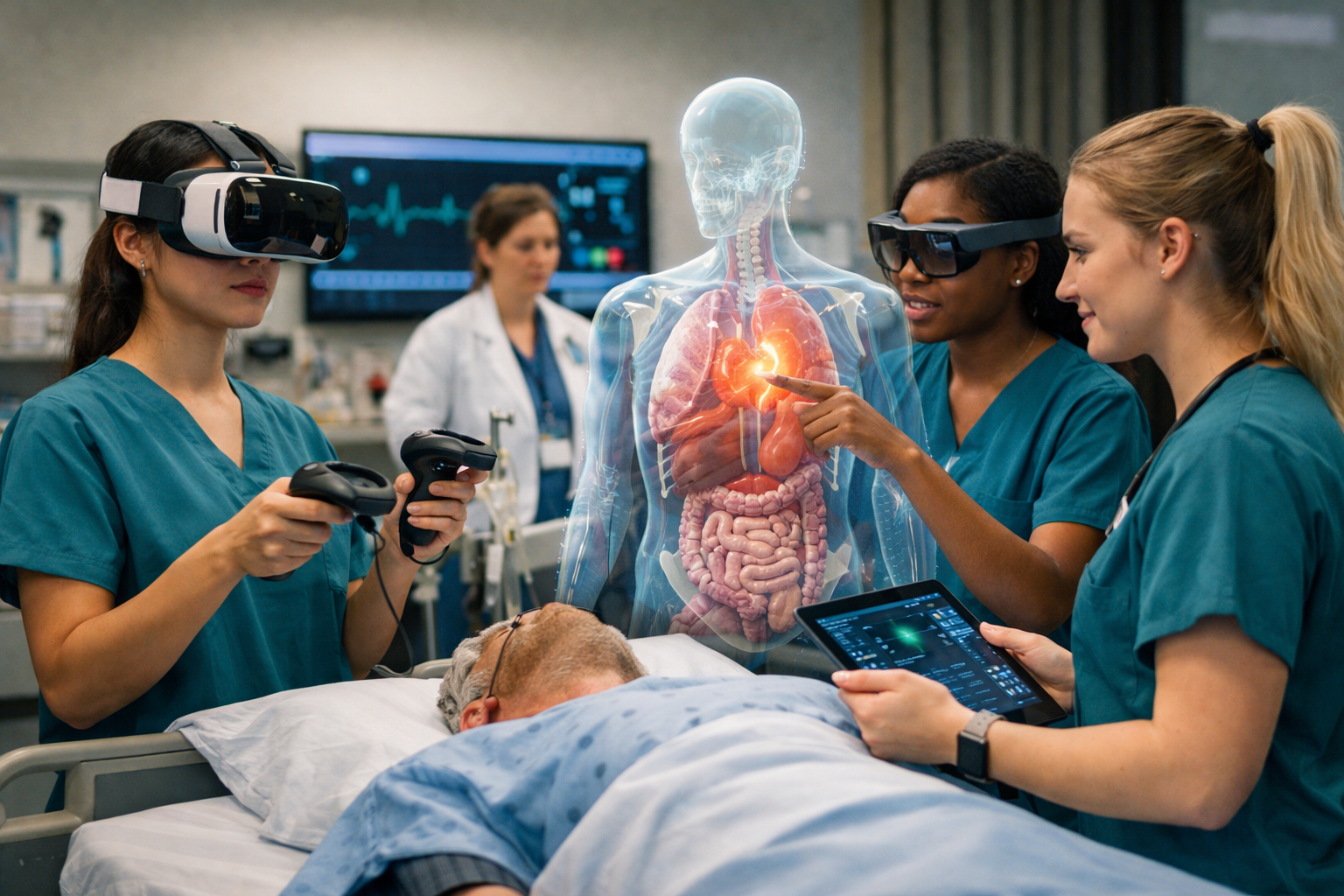
AR applications in healthcare training are equally promising. Microsoft's HoloLens technology allows anatomy students to see 3D organ systems overlaid on physical mannequins, combining tactile feedback with digital visualization. Case Western Reserve University reported significant reductions in time required to reach learning milestones when AR supplemented traditional anatomy instruction [9].
Historical and Cultural Immersion
History and humanities courses face a unique challenge: their subject matter is, by definition, inaccessible. You can't take students to ancient Greece or the signing of the Declaration of Independence.
VR changes that equation. Institutions are creating historically accurate reconstructions that place students "inside" historical moments. The University of Illinois built a VR experience of the 1893 World's Columbian Exposition, allowing students to explore an event that shaped American culture—buildings, sounds, crowds, and all [10].
The research supports what instructors observe anecdotally: students who experience history immersively demonstrate stronger recall and deeper engagement with course material. Context matters for learning, and VR provides context that textbooks simply cannot.
What the Research Actually Shows
Let's be direct about the evidence: VR and AR in education are promising, but the research base is still developing. Most studies are small-scale pilots rather than large randomized controlled trials. That's worth acknowledging.
That said, the early findings are compelling:
Active Learning Foundations: The theoretical basis for immersive learning is well-established. Decades of research into active learning consistently show that students learn more effectively when they engage with material rather than passively receive it. A landmark meta-analysis published in the Proceedings of the National Academy of Sciences found that active learning approaches significantly improved exam performance and reduced failure rates compared to traditional lecturing [3].
Engagement and Confidence: A rigorous study by PwC examining VR-based training found that VR learners completed training four times faster than classroom learners and felt significantly more confident applying skills afterward [11]. They were also more emotionally connected to the content—a factor that research links to improved retention.
Learning Outcomes in STEM: A meta-analysis examining VR applications in STEM education found a statistically significant positive effect on learning outcomes compared to traditional methods [12]. The effect was particularly strong for spatial reasoning and procedural knowledge—areas where visualization and practice matter most.
Accessibility Benefits: Research from accessibility advocates has highlighted how VR can actually improve educational access for students with certain disabilities by providing alternative sensory experiences [13]. A student who cannot perform a physical chemistry experiment can still learn the concepts through haptic feedback and audio cues in VR.
The honest limitation: we don't yet have strong longitudinal data on whether these engagement gains translate to improved graduation rates or long-term learning outcomes. The technology is too new. But the mechanism makes sense—engaged students persist, and these tools demonstrably increase engagement.
Implementation Challenges Worth Understanding
If VR and AR were easy to implement, every campus would already use them. Several barriers remain:
Cost: While prices have dropped significantly (quality VR headsets now start around $300-400, compared to thousands a few years ago), equipping an entire program still requires meaningful investment. Development of custom educational content is expensive. Ongoing maintenance and updates add to total cost of ownership.
Equity Concerns: Not all students have equal access to the technology. Programs that require VR components for completion need backup plans for students who experience motion sickness, have visual impairments that VR doesn't accommodate, or simply can't afford the equipment for at-home use.
Faculty Training and Buy-In: Technology is only as good as its implementation. Instructors need time and support to integrate immersive tools effectively. Without pedagogical intention, VR becomes a novelty rather than a learning enhancement. Faculty resistance—often rooted in legitimate concerns about workload, effectiveness, or pedagogical fit—remains one of the most significant barriers to adoption.
Technical Integration: Campus IT teams must consider how VR/AR platforms integrate with existing learning management systems (LMS). Questions about LTI standards, single sign-on compatibility, and data security (particularly FERPA compliance for student data generated within immersive environments) require careful planning before deployment.
Motion Sickness: Some students experience significant discomfort in VR environments. This isn't a minor inconvenience—it can make the technology completely inaccessible for a meaningful percentage of users. Estimates vary, but research suggests 40-70% of people experience some degree of VR-induced discomfort, though severity varies widely.
Content Quality Variation: The market is flooded with VR educational content of wildly varying quality. Not everything branded as "educational VR" actually improves learning outcomes. Critical evaluation of tools matters.
Getting Started: Practical Steps for Campus Leaders
If you're considering VR or AR integration, here's a realistic approach:
Start small. Identify one program or course where immersive technology addresses a genuine pedagogical need—not because it's trendy, but because existing methods have clear limitations. Virtual labs for a science program with inadequate physical facilities. Clinical simulation for a nursing program with limited patient access. Work backward from the problem.
Pilot before scaling. Run a controlled comparison between immersive and traditional delivery methods. Measure actual learning outcomes, not just student satisfaction. Students might enjoy VR more without learning more—make sure you're measuring what matters.
Budget for the ecosystem, not just hardware. Headsets are the visible cost. Content licenses, technical support, faculty development, IT integration, and replacement equipment are the hidden costs that trip up implementation plans. Current hardware options range from entry-level devices like Meta Quest 3 to premium solutions like Apple Vision Pro—each with different capabilities, price points, and institutional support requirements.
Address accessibility from the start. Build alternative pathways into your program design. Document accommodation procedures before you need them. Consult with disability services during planning, not after complaints arise.
Engage faculty early and often. The most successful implementations involve faculty as partners, not recipients of top-down mandates. Provide adequate training time, compensate curriculum redesign work appropriately, and listen to concerns about pedagogical fit.
Connect immersive experiences to broader engagement. VR and AR are tools, not strategies. They work best when integrated into a holistic approach to student engagement that includes peer connection, wellbeing support, and consistent check-ins. An isolated VR lab experience won't transform student outcomes on its own.
The Broader Student Engagement Connection
Here's what matters most: technology alone doesn't improve student outcomes. Engaged students improve student outcomes—and technology can be a powerful tool for creating engagement when used intentionally.
The same principles that make immersive learning effective—active participation, immediate feedback, emotional connection to content—apply to student engagement more broadly. Students who feel seen, supported, and connected to their campus community are more likely to persist. Students who feel like passive recipients of institutional services are more likely to disengage.
VR and AR represent one approach to activating student participation. Gamified engagement platforms represent another. Peer mentorship programs represent another. The common thread is shifting students from observers to participants in their own educational journey.
For campus leaders facing enrollment pressures and retention challenges, the question isn't whether to adopt any specific technology. It's whether your current approach creates genuine student engagement—or just delivers content and hopes engagement follows.
Ready to explore how technology can support student engagement on your campus? Book a call with CampusMind to discuss how our platform helps institutions identify engagement gaps and support students before challenges become crises.
Frequently Asked Questions
Is VR/AR technology too expensive for most institutions to implement?
Costs have dropped significantly in recent years, making pilot programs increasingly accessible. Basic VR headsets now start around $300-400, and many AR applications run on smartphones students already own. The key is starting small with targeted applications that address specific pedagogical needs rather than attempting campus-wide deployment. Many institutions begin with a single high-impact course or program, measure outcomes, and expand based on demonstrated value.
Do students actually learn better with immersive technology, or is it just more entertaining?
Research grounded in active learning theory supports genuine learning improvements when immersive technology is implemented thoughtfully. Studies show VR learners often demonstrate higher confidence when applying skills and report stronger emotional connection to content—factors linked to improved retention. However, the technology works best when it addresses genuine pedagogical limitations rather than replacing methods that already work well.
What about students who get motion sickness or can't use VR headsets?
This is a legitimate accessibility concern that institutions must address in program design. A meaningful percentage of people experience some VR-induced discomfort, though severity varies widely. Best practices include offering alternative pathways to meet learning objectives, selecting VR content designed to minimize motion sickness, and consulting with disability services during planning stages rather than after implementation.
How does VR/AR integrate with existing campus technology systems?
Integration complexity varies by platform. Key considerations include LTI compatibility with your learning management system, single sign-on capabilities, data security protocols, and FERPA compliance for any student data generated within immersive environments. Before committing to any platform, involve your IT team in evaluating these technical requirements and any infrastructure upgrades that may be necessary.
Can AR work without expensive equipment?
Yes. Many AR educational applications are designed for smartphones and tablets that students already possess. AR overlays digital content onto the real world through a device's camera, making it far more accessible than VR, which requires dedicated headsets. This lower barrier to entry makes AR a practical starting point for institutions exploring immersive technology.
About CampusMind's Perspective on Student Engagement
CampusMind works at the intersection of technology and student success. Our platform helps higher education institutions identify engagement patterns, support student wellbeing, and intervene early when students show signs of disengagement. We believe in data-driven approaches to student support—and in being honest about what technology can and cannot accomplish. This article reflects our commitment to helping campus leaders make informed decisions about tools that genuinely improve student outcomes.
Works Cited
[1] Milgram, P., & Kishino, F. — "A Taxonomy of Mixed Reality Visual Displays." IEICE Transactions on Information and Systems.
https://cs.gmu.edu/~zduric/cs499/Readings/r76JBo-Milgram_IEICE_1994.pdf
[2] Azuma, R.T. — "A Survey of Augmented Reality." Presence: Teleoperators and Virtual Environments.
https://www.cs.unc.edu/~azuma/ARpresence.pdf
[3] Freeman, S., et al. — "Active learning increases student performance in science, engineering, and mathematics." Proceedings of the National Academy of Sciences. https://www.pnas.org/doi/10.1073/pnas.1319030111
[4] National Center for Education Statistics — "Undergraduate Retention and Graduation Rates." NCES. https://nces.ed.gov/programs/coe/indicator/ctr
[5] Potkonjak, V., et al. — "Virtual laboratories for education in science, technology, and engineering: A review." Computers & Education. https://www.sciencedirect.com/journal/computers-and-education
[6] University of Texas at San Antonio — "Virtual Simulation in Nursing Education." UTSA College of Nursing. https://www.utsa.edu/today/2023/nursing-simulation.html
[7] Educause — "Extended Reality (XR) in Higher Education." Educause Review. https://www.educause.edu/
[8] Stanford Virtual Human Interaction Lab — "VR and Empathy Research." Stanford University. https://vhil.stanford.edu/research/
[9] Case Western Reserve University — "HoloLens Anatomy Education Study." CWRU School of Medicine. https://case.edu/medicine/news/hololens-study
[10] University of Illinois — "Virtual World's Fair Project." Illinois Informatics. https://informatics.illinois.edu/
[11] PwC — "The Effectiveness of Virtual Reality Soft Skills Training in the Enterprise." PwC Research. https://www.pwc.com/us/en/tech-effect/emerging-tech/virtual-reality-study.html
[12] Educational Technology Research and Development — "Meta-Analysis of VR in STEM Education." Springer. https://link.springer.com/journal/11423
[13] National Federation of the Blind — "Virtual Reality Accessibility Considerations." NFB Research. https://nfb.org/resources/accessibility